✅ What Is Battery Life
✅ What Affects Battery Life
• Temperature Effects • Charging Habits • Usage Patterns • Storage Conditions
✅ How to Extend and Preserve Battery Life
✅ How to Check and Measure Battery Life
✅ Battery Life Calculation and Estimation
✅ Can Battery Life Be Fixed or Restored
✅ How Charging Methods Affect Battery Life✅ Common Myths About Battery Life✅ Conclusion✅ FAQ Can battery life be restored once it declines?
Does cold weather reduce battery life?
Does fast charging affect battery life?
Do rechargeable batteries have a shelf life?Battery life is a term people use every day, but it often means different things in different contexts. Sometimes it refers to how long a device runs on a single charge, while in other cases it describes how long a battery remains usable over months or years. Understanding what battery life actually means—and what influences it—helps users make better decisions about usage, charging, and maintenance.
What Is Battery LifeBattery life generally describes how long a battery can provide usable power before it needs to be recharged or replaced. Unlike a fixed specification, battery life is not a single number. It varies depending on how the battery is used, the environment it operates in, and the type of battery technology involved.
In everyday use, battery life may refer to short-term performance, such as daily runtime, or long-term performance, such as how many years the battery remains reliable.
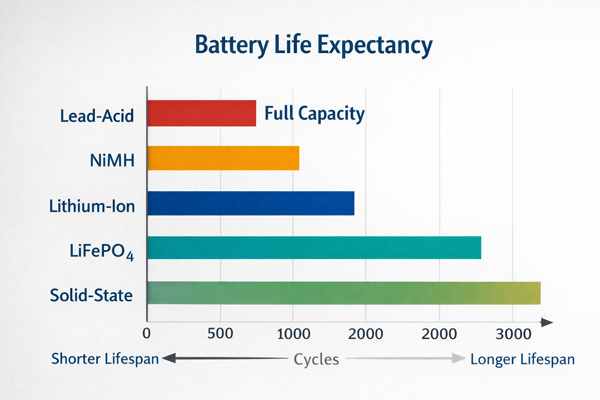
What Affects Battery LifeBattery life is influenced by a combination of physical, environmental, and behavioral factors rather than one single cause.
• Temperature Effects
Both heat and cold can affect battery life. High temperatures accelerate chemical reactions inside the battery, which can lead to faster degradation over time. Extremely cold conditions, on the other hand, reduce battery efficiency and temporarily lower available capacity.
• Charging Habits
How a battery is charged plays a significant role in long-term performance. Frequent full charges, deep discharges, and inconsistent charging patterns can all place stress on the battery and shorten its usable life.
• Usage Patterns
High power demand, heavy loads, and continuous operation increase internal stress. Devices that regularly draw high current tend to experience faster battery wear than those used under moderate conditions.
• Storage Conditions
Storing batteries for long periods in fully charged or fully depleted states can negatively impact battery life. Stable temperatures and partial charge levels generally support better long-term preservation.
 How to Extend and Preserve Battery Life
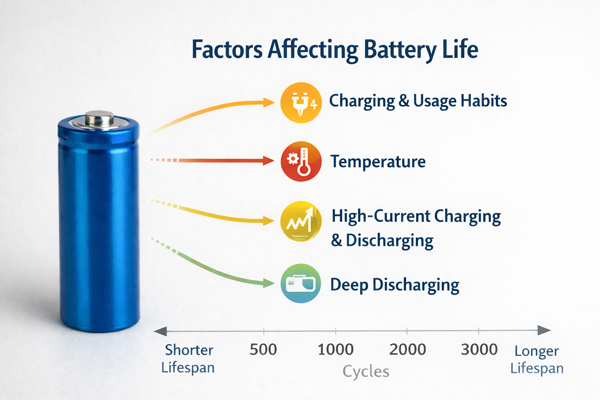
Extending battery life and preserving battery health often involve the same practical habits. The goal is not to eliminate normal wear, but to slow long-term degradation.
Key practices include:
Avoiding extreme temperatures during use and storage
Reducing unnecessary deep discharges
Maintaining moderate charge levels when possible
Using chargers designed for the device or battery type
These steps help reduce internal stress and keep battery performance more consistent over time.
While the general principles of battery life apply across different battery technologies, modern rechargeable systems have significantly reshaped how battery life is experienced in everyday devices. In particular, lithium-based batteries have enabled higher energy density, longer usable lifespans, and more flexible design compared to earlier technologies. For readers interested in how battery life behaves specifically within these modern systems, a more focused discussion on
lithium-based battery longevity explores the factors unique to this chemistry in greater detail.
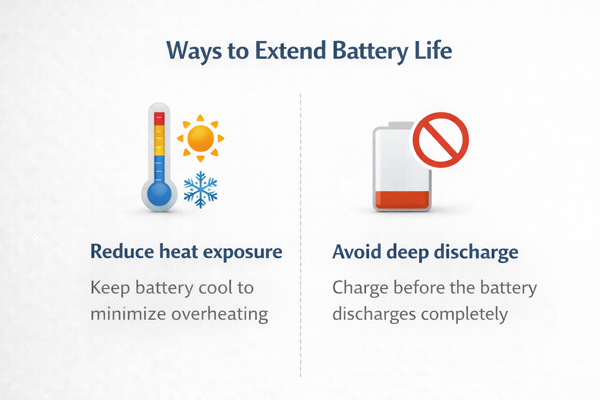
How to Check and Measure Battery LifeBattery life can be assessed through a combination of estimation, observation, and testing methods, depending on the device, battery type, and level of accuracy required. While many systems provide convenient indicators, a more precise understanding of battery life often requires direct measurement and controlled evaluation.
In everyday use, battery life is commonly estimated using built-in indicators that display remaining charge, battery health, or usage time. Another practical approach is runtime observation—measuring how long a device operates under typical conditions before requiring a recharge. These methods are useful for general awareness but may become less accurate as batteries age.
For more technical or diagnostic purposes, battery life can be measured by evaluating actual capacity under load. In this context, battery health is often calculated by comparing the battery’s current measured capacity to its original rated capacity using a simple formula:
Battery Health (%) = (Measured Capacity ÷ Original Capacity) × 100
For example, if a battery was originally rated at 5000 mAh and testing shows a measured capacity of 3800 mAh, the calculation would be: Battery Health = (3800 ÷ 5000) × 100 = 76%
This result indicates that approximately 24% of the battery’s usable capacity has been lost due to normal aging and use.
It is important to note that battery testing should always account for battery type and operating conditions. Different battery chemistries respond differently to load, temperature, and discharge rates, which means testing methods and results may vary. For this reason, controlled testing generally provides a more accurate picture of battery life than estimation alone.
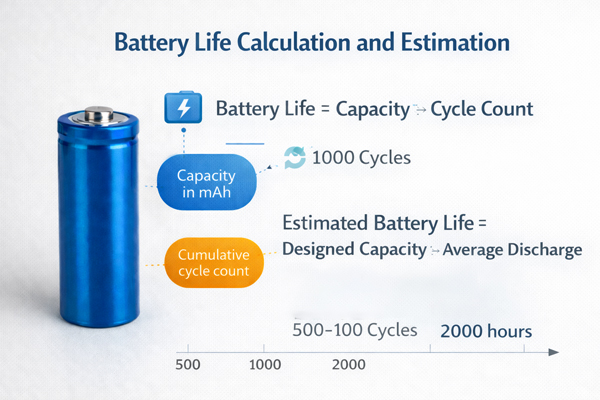
 Battery Life Calculation and Estimation
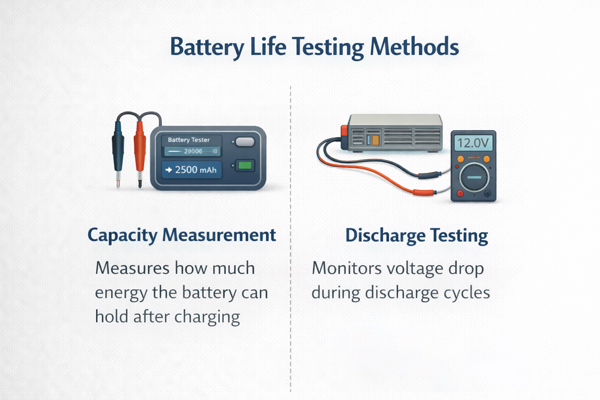
Battery life estimation can be approached in two ways: rated specifications and actual usage history.
Battery Life Estimation by Cycle Count
Manufacturers often specify battery life in cycles. A simplified estimation is:
Remaining Life (%) ≈ 1 − (Used Cycles ÷ Rated Cycle Life)
Battery Example
If a battery is rated for 1000 cycles and has undergone 300 full cycles, the estimated remaining life is:
1 − (300 ÷ 1000) = 70%.
This means the battery has roughly 70% of its usable life remaining under similar conditions.
Practical Estimation Limitations
In real use, cycles are rarely full charge–discharge cycles. Partial charging and partial discharging make exact estimation difficult. Some modern batteries include intelligent systems that track equivalent full cycles, allowing for more accurate life estimation.
 Can Battery Life Be Fixed or Restored
In most cases, battery life cannot be physically restored once the battery has degraded. Chemical aging is irreversible. However, some apparent battery life issues are related to calibration or software estimation rather than actual battery condition.
Resetting battery indicators or recalibrating charge measurements may improve accuracy, but this does not reverse internal aging. When performance drops below acceptable levels, replacement is usually the only long-term solution.
How Charging Methods Affect Battery LifeCharging methods influence how much stress is placed on a battery during each charge cycle.
Fast charging can increase heat and electrical stress if not properly managed, while poorly designed or incompatible chargers may cause inefficient charging or excessive temperature rise. Wireless charging may also generate additional heat due to energy transfer losses.
Charging speed alone is not the deciding factor—temperature control, voltage regulation, and charge consistency matter far more for long-term battery life.
Common Myths About Battery LifeMany battery life myths persist despite changes in modern battery technology. For example, storing batteries in extreme cold environments does not extend their usable life and may cause condensation or damage. Similarly, constantly charging a battery does not automatically destroy it, as modern systems are designed to manage charge cycles safely.
Understanding real causes of battery degradation helps separate outdated advice from practical guidance.
ConclusionBattery life is not a single measurement but a combination of runtime, usage patterns, environmental conditions, and long-term degradation. While all batteries experience aging, understanding what affects battery life—and how to manage those factors—allows users to maximize performance and reliability over time.
FAQCan battery life be restored once it declines?Battery life cannot be fully restored once chemical aging has occurred inside the battery. While proper charging habits, temperature control, and reduced stress can slow further degradation, they cannot reverse capacity loss. When performance drops below acceptable levels, battery replacement is usually the only effective long-term solution.
Does cold weather reduce battery life?Cold weather reduces battery efficiency by slowing internal chemical reactions, which temporarily lowers available capacity and runtime. This effect is usually reversible once temperatures return to normal. Long-term battery damage is more commonly associated with prolonged exposure to high heat rather than short-term cold conditions.
Does fast charging affect battery life?Fast charging can increase electrical and thermal stress if charging systems are poorly designed or heat is not properly managed. However, modern devices and chargers often include protective controls that regulate voltage and temperature, helping minimize long-term impact on battery life when used under normal conditions.
Do rechargeable batteries have a shelf life?Yes. Rechargeable batteries gradually degrade over time even when not in use due to internal chemical aging. Storage conditions such as temperature and charge level influence how quickly this occurs, which is why long-term storage recommendations typically involve moderate charge levels and stable, cool environments.


