✅ Types Of Lead Acid And Lithium Batteries
• Types Of Lead Acid Battery • Types Of Lithium Battery✅ Lifespan Comparison✅ Price Comparison✅ Discharge Rate✅ Charging Speed And Efficiency✅ Energy Density (Weight And Size)✅ Temperature Performance✅ Capacity And Runtime
✅ Environmental Impact✅ Advantages And Disadvantages
✅ Battery Type Identification (Car, Motorcycle, Forklift, Golf Cart)
• Are Car Batteries Lithium Or Lead Acid
• How To Tell If A Battery Is Lead-Acid Or Lithium✅ Switching From Lead-Acid To Lithium Batteries
• Key Considerations • Can You Mix Lithium And Lead-Acid Batteries?✅ Comparison In Common Applications
✅ Charger Compatibility✅ Key Differences And Comparison Table✅ Conclusion
✅ FAQ
What is the difference between lead-acid and lithium batteries? Why do lead-acid batteries last shorter than lithium batteries? Are lithium batteries better than lead-acid batteries? Can I use a lead-acid charger on a lithium battery? Are lead-acid batteries lithium? Can you connect lithium and lead-acid batteries in parallel? Can I replace a lead-acid battery with lithium?
Lead-acid and lithium batteries are two common rechargeable battery types, but they differ greatly in weight, cycle life, charging speed, usable capacity, maintenance needs, and long-term cost. Lead-acid batteries are still widely used in cars, backup power, and low-cost systems, while lithium batteries are increasingly chosen for energy storage, electric mobility, portable power, and high-efficiency equipment.
Before comparing both chemistries, it helps to understand the basics of lithium battery design, because lithium batteries store and release energy in a different way from traditional lead-acid options. In this guide, we will compare lead-acid vs lithium batteries across lifespan, price, discharge rate, charging efficiency, energy density, safety, temperature behavior, and real-world applications.
 Types Of Lead Acid And Lithium Batteries
Lead-acid and lithium batteries include several different types, but in most practical applications, these differences can be simplified for easier comparison. Lead-acid batteries are commonly divided into types such as flooded, AGM, and gel, while lithium batteries include several chemistries with different performance characteristics. Understanding these categories helps clarify how each technology is used in real-world scenarios.
• Types Of Lead Acid Battery
Lead-acid batteries come in several structural types, including flooded (wet cell), AGM (Absorbent Glass Mat), and gel batteries. In addition to these construction differences, lead-acid batteries are also categorized by usage, such as starting (SLI) batteries and deep cycle batteries. While these designs and applications differ in structure, maintenance requirements, and performance characteristics, they all belong to the same lead-acid chemistry.
For most comparisons, it is not necessary to distinguish between these subtypes in detail. In this article, they are collectively referred to as lead-acid batteries, unless a specific type (such as AGM or deep cycle) is relevant in a particular application.
• Types Of Lithium Battery
Lithium batteries, on the other hand, are commonly divided into two main categories:
- Lithium-ion (ternary lithium, NMC/NCA): Ternary lithium batteries offer higher energy density, making them suitable for applications where weight and compact size are critical. However, they typically have shorter cycle life and lower thermal stability compared to LiFePO4.
- Lithium iron phosphate (LiFePO4): LiFePO4 batteries provide longer lifespan, better safety, and greater thermal stability, although their energy density is relatively lower.
In practice, most lithium batteries used to replace lead-acid batteries are LiFePO4. This is because:
- Their voltage characteristics are closer to lead-acid systems
- They are widely used in large-capacity applications such as forklifts, golf carts, vehicles, and energy storage systems
- Safety and cycle life are more important than maximum energy density in these use cases
For this reason, when comparing lithium and lead-acid batteries in real-world applications, LiFePO4 is typically the most relevant lithium technology.
Lifespan ComparisonLithium batteries—last significantly longer than lead-acid batteries, both in cycle life and real-world service lifespan. When comparing lead-acid battery vs lithium-ion battery life, this difference is clearly seen in both cycle life and years of use.
Lead-Acid Battery Lifespan
Lead-acid batteries typically provide around 300–500 charge cycles under normal conditions. In practical use, this usually translates to approximately 1–3 years of service life.
However, their lifespan is highly sensitive to usage patterns:
- Frequent deep discharges significantly reduce cycle life
- Partial charging and improper maintenance can accelerate degradation
As a result, in demanding applications such as forklifts or golf carts, lead-acid batteries often require frequent replacement.
Lithium Battery (LiFePO4) Lifespan
Lithium batteries—especially LiFePO4, which is commonly used as a replacement for lead-acid—offer a much longer lifespan of 2,000–5,000 cycles.
In real-world applications, this corresponds to roughly 5–10 years or more of use. Key advantages include:
- Ability to handle deep discharge (80–100% DoD) with minimal impact on lifespan
- More stable performance over repeated charge cycles
- Lower degradation rate over time
In practical terms, lithium batteries can last 4–10 times longer than lead-acid batteries under similar operating conditions. Although lead-acid batteries have a lower upfront cost, their shorter lifespan leads to more frequent replacements, making lithium batteries a more cost-effective solution over time.
Price ComparisonLead-acid batteries are significantly cheaper than lithium batteries, especially in terms of upfront price. When comparing lead-acid battery vs lithium-ion battery price, lead-acid batteries typically cost around $100–$300 per kWh, while LiFePO4 batteries are usually in the range of $400–$800 per kWh. In most cases, lithium batteries are about 2 to 4 times more expensive than lead-acid batteries.
Although lithium batteries offer clear advantages in lifespan and performance, the higher cost remains a major factor. This is one of the main reasons why lead-acid batteries are still widely used across many industries.
For large-scale applications—such as energy storage systems or forklift batteries—the investment can be substantial, making cost a critical consideration. In practice, the choice between lead-acid and lithium batteries should be based on specific use cases, budget, and long-term requirements.
Discharge RateLithium batteries support significantly higher discharge rates than lead-acid batteries, especially under high current demand. Lead-acid batteries typically operate at low discharge rates, generally around 0.2C to 1C in most applications, with a practical upper limit of about 2C–3C under specific conditions. Higher discharge rates can lead to rapid voltage drop, reduced efficiency, and accelerated degradation.
In contrast, lithium batteries can handle much higher discharge rates. Standard lithium batteries commonly support 1C to 3C continuous discharge, while high-performance applications—such as power tools or drones—can reach 10C, 20C, or even 30C–50C. Under high current loads, lithium batteries maintain more stable voltage output and better overall performance, whereas lead-acid batteries experience significant performance loss.
Overall, in applications requiring high power output, lithium batteries have a clear and substantial advantage over lead-acid batteries.
Charging Speed And EfficiencyLithium batteries charge significantly faster and more efficiently than lead-acid batteries. Lead-acid batteries are typically charged at around 0.2C, which means a full charge often takes 8–10 hours or more. Charging too quickly can damage the battery and reduce its lifespan.
In contrast, lithium batteries commonly support 0.5C charging, allowing them to be fully charged in approximately 2–3 hours. With advances in technology, many modern lithium batteries can support higher charging rates, enabling 80–90% charge in under an hour with suitable high-power chargers.
In addition to faster charging, lithium batteries also offer higher charging efficiency, meaning less energy is lost during the charging process.
Energy Density (Weight And Size)Lithium batteries have a much higher energy density than lead-acid batteries, which means they can store more energy for the same weight and size.
In general, lead-acid batteries are around 30–50 Wh/kg, while lithium batteries are commonly around 120–200+ Wh/kg (depending on the specific chemistry and design). In practical terms, a lithium battery pack is often 2–4× lighter than a lead-acid battery with the same usable capacity. This higher energy density makes lithium batteries especially attractive in applications where weight, portability, or limited installation space matters. Lead-acid batteries can still work well in stationary setups, but they become bulky and heavy when large capacity is required.
Temperature PerformanceLead-acid and lithium batteries behave very differently in extreme temperatures, especially when charging. In general, both can discharge in cold weather, but lithium charging is much more temperature-sensitive, while lead-acid is more tolerant (though performance still drops).
Typical operating ranges (general guidance):
Lead-Acid
- Charging: about 0 to 45–50°C
- Discharging: about -20 to 50°C
Lithium
- Charging: about 0 to 45°C (charging below 0°C can damage the battery without protection)
- Discharging: about -20 to 60°C (performance drops at low temperatures)
Low temperature
In cold conditions, both battery types experience reduced capacity and lower voltage output. Lead-acid batteries can usually still be charged at low temperatures, although charging becomes slower and less efficient. Lithium batteries can often discharge in the cold, but charging below freezing (0°C) is a common limitation. Many lithium battery systems use a BMS and sometimes heating features to prevent cold charging damage.
High temperature
High temperatures accelerate aging for both battery types. Lead-acid batteries may suffer faster water loss and plate corrosion, while lithium batteries degrade faster when stored or charged hot. For both, keeping batteries out of prolonged high heat greatly improves lifespan and safety. Bottom line: if your application involves frequent charging in freezing conditions, lead-acid may be easier to manage. If using lithium in cold climates, choose a system with low-temperature charge protection (and ideally a heater).
Capacity And RuntimeAt the same voltage and rated capacity (Ah), lithium batteries usually deliver noticeably longer runtime than lead-acid batteries. In many real-world cases, a lithium battery can provide up to about 1.5× the usable runtime compared with a lead-acid battery labeled with the same Ah rating.
The main reason is usable capacity. Lead-acid batteries typically should not be deeply discharged, and their voltage drops more under load—so a “100Ah” lead-acid battery often delivers much less usable energy in practice. Lithium batteries can operate at a deeper discharge level with more stable voltage, which means more of the rated capacity is actually usable.
As a result, for applications that demand steady power, lithium batteries often provide longer and more consistent runtime even when the nameplate voltage and capacity look the same.
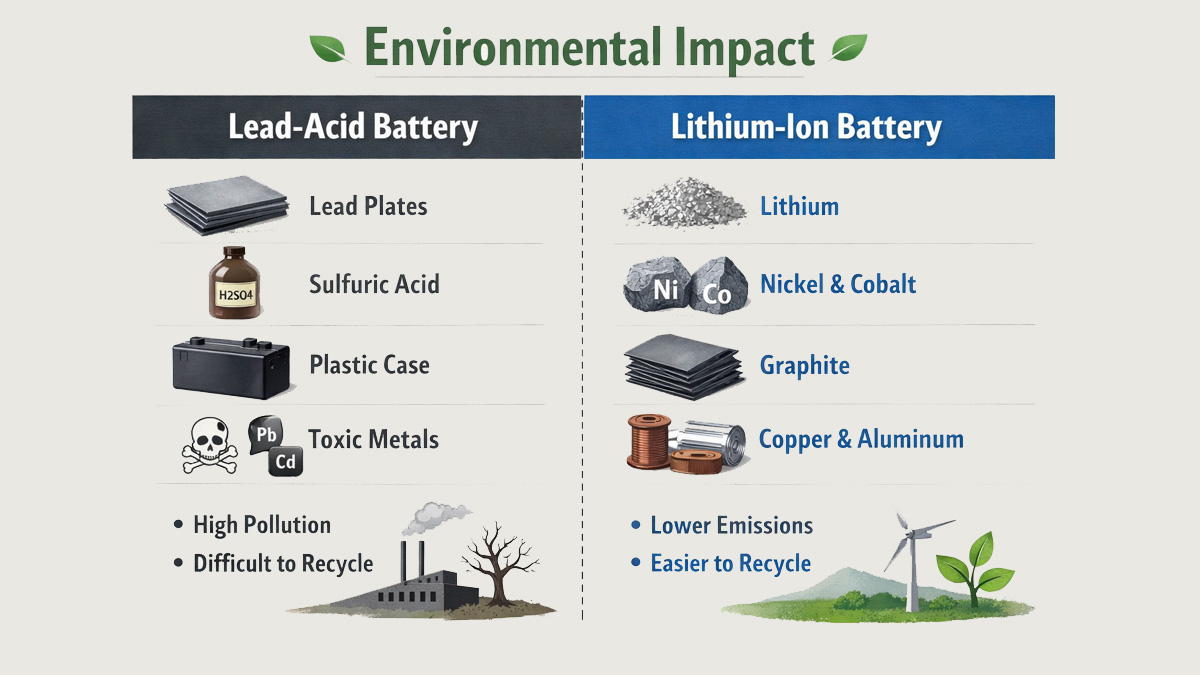 Environmental Impact
Lead-acid batteries pose greater environmental and health risks than lithium batteries due to the presence of lead and corrosive acid. Improper disposal of lead-acid batteries can lead to soil and water contamination, and direct exposure may pose serious risks to human health. Lithium batteries do not contain lead and do not pose a risk of lead leakage, which reduces the likelihood of direct environmental contamination. However, they still require proper handling and disposal.
At the same time, both lead-acid and lithium batteries have significant recycling value. Used batteries are widely collected and processed through established secondary markets in many countries.
As a result, governments around the world are placing increasing emphasis on battery recycling, introducing policies to encourage proper disposal and, in many cases, to promote the transition from lead-acid to lithium batteries.
Advantages And Disadvantages
Here’s a quick summary of the pros and cons of lithium vs lead-acid batteries, highlighting which option performs better in the areas that matter most.
Lithium batteries are generally better for:
- Lifespan
- Charging speed
- Efficiency
- Energy density / lighter weight
- High-current performance
- Voltage stability
- Low maintenance
Lead-acid batteries are generally better for:
- Upfront price / budget
Battery Type Identification (Car, Motorcycle, Forklift, Golf Cart)• Are Car Batteries Lithium Or Lead Acid
Not all batteries used in cars, motorcycles, forklifts, or golf carts are lithium batteries. In fact, many of these applications still use lead-acid batteries, and in some markets lead-acid remains the dominant option.
The reason is often cost. Even though lithium batteries generally offer better lifespan and performance, large battery systems can be a significant investment. In highly competitive markets, manufacturers and users may continue choosing lead-acid to keep upfront costs lower—especially for equipment that requires large-capacity batteries.
As a result, the battery type you see in real products depends on the specific model, budget, and design goals. Before assuming a battery is lithium, it’s best to confirm the battery label/specs or consult the supplier.
• How To Tell If A Battery Is Lead-Acid Or Lithium
The simplest way is to check the label on the battery or the label on the charger. In most cases, the label will clearly state the battery type (such as lead-acid or lithium) and the corresponding voltage (for example, 12V, 24V, or 48V).
Switching From Lead-Acid To Lithium Batteries
Replacing lead-acid batteries with lithium batteries has become a growing trend, with many applications gradually shifting away from lead-acid. Before making the switch, several key factors should be carefully considered.
• Key Considerations
- Price / Budget
Lithium batteries usually cost several times more than lead-acid. Decide based on your budget and whether the longer lifespan/performance is worth the higher upfront cost for your use case.
- Voltage Compatibility
Confirm the system voltage (e.g., 12V / 24V / 48V) before buying. Ask the supplier to verify the correct lithium battery voltage to avoid mismatch and potential equipment issues.
- Battery Size / Dimensions
Measure the installation space (length × width × height). Provide exact dimensions to the supplier so they can recommend a matching battery or offer a custom-size option.
- System Compatibility (Controller & Battery Type)
Check whether the controller and charger support the battery voltage range (e.g., electric tricycles). Lithium batteries can often replace lead-acid, but compatibility should still be confirmed. Some lithium types are easier to match with existing systems, while others may require more attention to voltage range. The safest approach is to consult the supplier for proper matching.
• Can You Mix Lithium And Lead-Acid Batteries?
No, you should not connect lithium and lead-acid batteries together in the same system.
These two battery types have different voltage characteristics, charging profiles, and internal resistance. Connecting them together can cause imbalance, uncontrolled current flow, and may quickly damage the batteries or connected equipment. In some cases, it can even lead to overheating or fire risk.
If you plan to switch from lead-acid to lithium, the correct approach is to fully replace the battery system, rather than mixing the two types.
Comparison In Common ApplicationsAlthough this guide focuses on the core comparison of lithium vs lead-acid batteries, these differences apply across many real-world use cases, including forklifts, golf carts, cars, motorcycles, jump starters, UPS systems, and solar energy storage.
In most of these applications, lithium batteries typically perform better in lifespan, charging speed, efficiency, weight, and high-current stability, while lead-acid batteries remain widely used mainly because of lower upfront cost. The best choice still depends on practical constraints such as budget, system compatibility, and replacement cost—especially for large projects like forklift batteries or solar storage, where the initial investment can be significant.
Charger CompatibilityLead-acid and lithium batteries cannot share the same charger. These two battery types require different charging profiles and voltage limits. Using a lead-acid charger on a lithium battery—or vice versa—can result in improper charging, reduced performance, or even damage to the battery and equipment.
To ensure safe and optimal operation, always use a charger designed for the specific battery type or confirm compatibility with the supplier.
Key Differences And Comparison Table
| Feature |
Lead Acid Battery |
Lithium Battery |
| Lifespan (Cycles) |
300–500 cycles |
2,000–5,000+ cycles |
| Service Life |
1–3 years |
5–10+ years |
| Price (per kWh) |
$100–$300 |
$400–$800 |
| Upfront Cost |
Low |
2–4× higher |
| Usable Capacity |
~50–60% |
~80–100% |
| Energy Density |
30–50 Wh/kg |
120–200+ Wh/kg |
| Weight |
Heavy |
2–4× lighter |
| Charging Rate |
~0.2C |
~0.5C (or higher) |
| Charging Time |
8–10 hours |
2–3 hours (fast charge: <1 hour to 80–90%) |
| Discharge Rate |
~0.2C–1C (max ~3C) |
1C–3C (up to 10C–50C in some cases) |
| Voltage Stability |
Drops under load |
Stable output |
| Temperature (Charge) |
0 to 45–50°C |
0 to 45°C |
| Temperature (Discharge) |
-20 to 50°C |
-20 to 60°C |
| Maintenance |
Requires maintenance |
Maintenance-free |
| Environmental Impact |
Lead & acid pollution risk |
Lower toxicity, but still recyclable |
| Recycling System |
Mature and widespread |
Developing but improving |
Lithium batteries outperform lead-acid batteries in most aspects, including lifespan, efficiency, weight, and performance, but they come at a significantly higher cost. Lead-acid batteries remain a practical choice for users with limited budgets or lower usage demands, while lithium batteries are better suited for applications that require long lifespan, high efficiency, and consistent performance.
Ultimately, the best choice depends on your budget, application, and long-term expectations. By understanding the differences, you can select the battery type that best fits your specific needs.
What is the difference between lead-acid and lithium batteries?
Lithium batteries last longer, charge faster, and are lighter, while lead-acid batteries are cheaper and widely used in cost-sensitive applications.
FAQ
What is the difference between lead-acid and lithium batteries?Lithium batteries last longer, charge faster, and are lighter, while lead-acid (agm) batteries are cheaper and widely used in cost-sensitive applications.
Why do lead-acid batteries last shorter than lithium batteries?Lead-acid batteries typically last 300–500 cycles, while lithium batteries can reach 2,000–5,000+ cycles, making lithium much more durable.
Are lithium batteries better than lead-acid batteries?Lithium batteries perform better in most aspects, but lead-acid (agm) batteries remain a practical choice when lower upfront cost is the priority.
Can I use a lead-acid charger on a lithium battery?No, lead-acid chargers are not designed for lithium batteries and may cause improper charging or damage.
Are lead-acid batteries lithium?No, they are completely different battery technologies with different materials and performance.
Can you connect lithium and lead-acid batteries in parallel?No, they should not be connected together due to different voltage behavior and safety risks.
Can I replace a lead-acid battery with lithium?Yes, but you should check voltage, size, and system compatibility before replacing.
 Types Of Lead Acid And Lithium Batteries


