✅
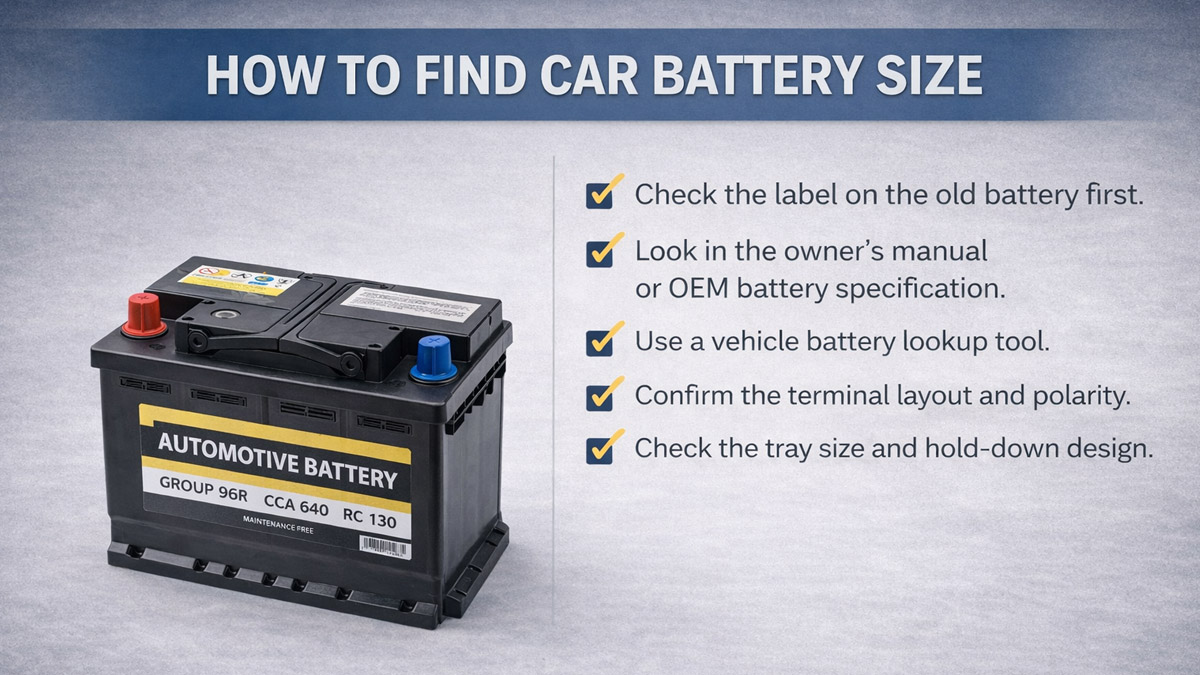
How to Find Your Car Battery Size • Check the label on the old battery first. • Look in the owner’s manual or OEM battery specification. • Use a vehicle battery lookup tool. • Confirm the terminal layout and polarity. • Check the tray size and hold-down design.✅
The Meanings of Car Battery Group Size • Group Size Defines More Than Dimensions • Different Markets Use Different Battery Size Standards✅
Car Battery Size Chart✅
Popular Car Models and Their Battery Sizes✅
Conclusion✅
FAQ What size battery for my car? How to find car battery size? How to read car battery size? Are all car batteries the same size? What does group size mean for car batteries?Car battery size is one of the first things to check when replacing a battery, but it is also one of the most misunderstood. Many drivers assume that any 12V battery will fit as long as the power is similar, but battery replacement is not that simple. Case dimensions, terminal layout, and group size all affect whether the battery will install correctly and work safely in your vehicle. If you want a broader look at how automotive batteries are classified and used, you can start with our
overview of car battery types and basics.
In this article, we will focus on the size side of the equation, including what group size means, how to read a battery label, and how to use a car battery size chart to find the right fit for your vehicle.
How to Find Your Car Battery Size
If you need to identify the correct car battery size, the process is usually straightforward. In most cases, the right size can be confirmed by checking the old battery, the vehicle manual, or a battery lookup tool. The goal is to verify the group size, because that number determines the battery’s external dimensions, terminal layout, and fitment.
• Check the label on the old battery first.
This is usually the quickest method. Many batteries print the group size directly on the top or front label, such as Group 35, 24F, or 48 (H6). If the existing battery is the correct one for the vehicle, this number is the most useful reference.
• Look in the owner’s manual or OEM battery specification.
Vehicle manufacturers usually list the recommended battery group size in the battery or maintenance section. This is often the most reliable reference because it reflects the original fitment requirement rather than an aftermarket replacement choice.
• Use a vehicle battery lookup tool.
If the battery label is missing or unclear, entering the vehicle year, make, model, and engine into a battery lookup system can quickly narrow down the correct size. This method is useful because it often shows both the original size and any approved replacement options.
• Confirm the terminal layout and polarity.
Batteries with similar dimensions may still have different terminal positions. For example, a standard layout and an R version may place the positive terminal on opposite sides. Even if the case size is close, the battery may not install correctly if the cable routing does not match.
• Check the tray size and hold-down design.
The battery tray and bracket determine whether the battery can sit securely in place. A battery that is too long, too wide, or too tall may not fit the tray or may interfere with the hold-down clamp, cover, or nearby components.
Treat group size as the first requirement, then compare performance.
Once the correct size is confirmed, capacity and starting power can be compared within that size. In other words, the group size determines whether the battery fits the car, while Ah and CCA determine how the battery performs.
Using these steps in order makes battery selection much easier. In most cases, the correct battery size is confirmed not by guessing the capacity, but by matching the group size specification first.
The Meanings of Car Battery Group Size
Car battery group size is a standardized code used to identify the physical fitment of a battery. It helps determine whether a battery will fit properly in a vehicle’s battery tray and connect correctly to the existing cables and hold-down system. In other words, group size is mainly about installation compatibility rather than battery performance.
This is why group size should always be checked before comparing capacity or starting power. Even if two batteries have the same voltage, they may not be interchangeable if their case dimensions or terminal layout are different.
• Group Size Defines More Than Dimensions
A battery group size usually reflects more than overall case dimensions. It also relates to important fitment details such as terminal placement, polarity orientation, and the way the battery is secured in the vehicle. These factors affect whether the battery can be installed safely and whether the cables can reach the correct terminals without strain.
Because of this, two batteries with similar output ratings may still require different group sizes. The correct size is the one that matches the vehicle’s original installation design, not simply the one with enough power.
• Different Markets Use Different Battery Size Standards
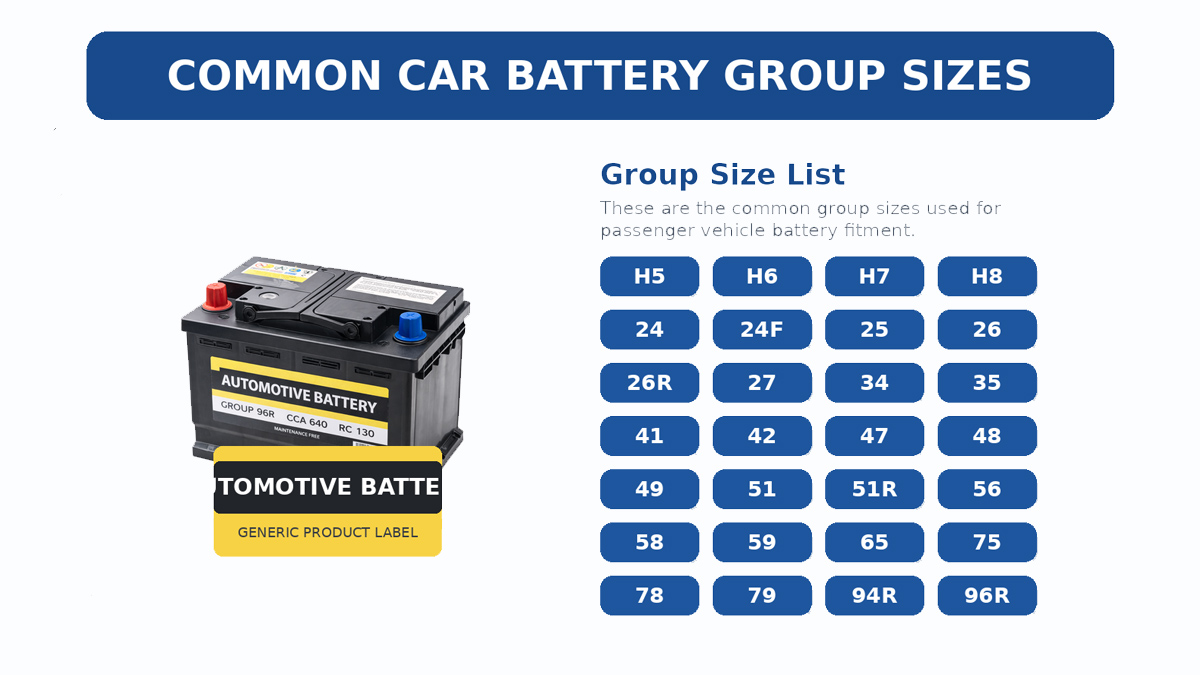
Battery size naming is not the same in every region. In North America, automotive batteries are commonly identified by BCI group sizes such as 24F, 35, 48, and 94R. In Europe, batteries are often labeled under the DIN or EN system, with common references such as H5, H6, H7, and H8. In Japan and some other Asian markets, many batteries use the JIS system, with codes such as 55D23L or 46B24R.
Although these standards use different naming formats, they serve the same purpose: helping match a battery to the vehicle’s required size and layout. This is why a product listing may sometimes show both names together, such as Group 48 (H6), to make cross-market identification easier.
Car Battery Size Chart
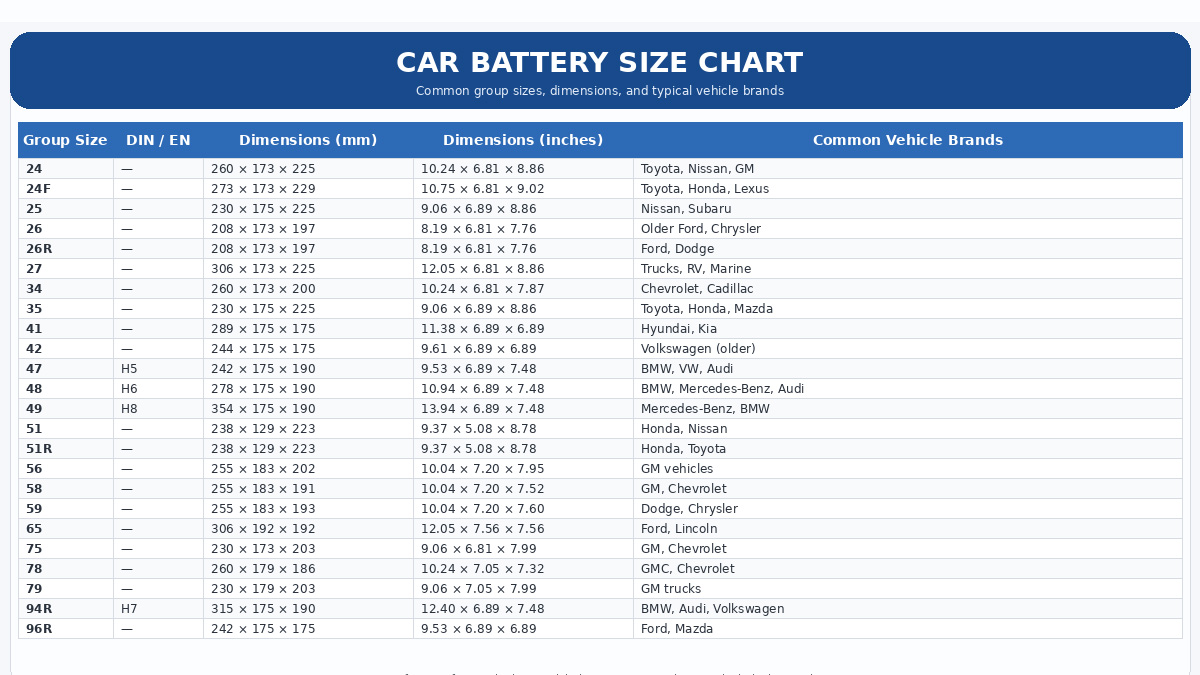
A car battery size chart provides a quick reference for comparing the most common automotive battery group sizes and their physical dimensions. Since batteries are not universal, using a chart like this helps you confirm whether a specific size will fit your vehicle before focusing on capacity or performance.
The chart below includes widely used BCI group sizes along with their approximate dimensions in both millimeters and inches. It also shows common European equivalents such as H5, H6, H7, and H8, which are often used alongside BCI naming in the aftermarket.
| Group Size |
DIN / EN Equivalent |
Dimensions (L × W × H, mm) |
Dimensions (inches) |
Common Vehicle Brands |
| 24 |
— |
260 × 173 × 225 |
10.24 × 6.81 × 8.86 |
Toyota, Nissan, GM |
| 24F |
— |
273 × 173 × 229 |
10.75 × 6.81 × 9.02 |
Toyota, Honda, Lexus |
| 25 |
— |
230 × 175 × 225 |
9.06 × 6.89 × 8.86 |
Nissan, Subaru |
| 26 |
— |
208 × 173 × 197 |
8.19 × 6.81 × 7.76 |
Older Ford, Chrysler |
| 26R |
— |
208 × 173 × 197 |
8.19 × 6.81 × 7.76 |
Ford, Dodge |
| 27 |
— |
306 × 173 × 225 |
12.05 × 6.81 × 8.86 |
Trucks, RV, Marine |
| 34 |
— |
260 × 173 × 200 |
10.24 × 6.81 × 7.87 |
Chevrolet, Cadillac |
| 35 |
— |
230 × 175 × 225 |
9.06 × 6.89 × 8.86 |
Toyota, Honda, Mazda |
| 41 |
— |
289 × 175 × 175 |
11.38 × 6.89 × 6.89 |
Hyundai, Kia |
| 42 |
— |
244 × 175 × 175 |
9.61 × 6.89 × 6.89 |
Volkswagen (older) |
| 47 |
H5 |
242 × 175 × 190 |
9.53 × 6.89 × 7.48 |
BMW, VW, Audi |
| 48 |
H6 |
278 × 175 × 190 |
10.94 × 6.89 × 7.48 |
BMW, Mercedes-Benz, Audi |
| 49 |
H8 |
354 × 175 × 190 |
13.94 × 6.89 × 7.48 |
Mercedes-Benz, BMW |
| 51 |
— |
238 × 129 × 223 |
9.37 × 5.08 × 8.78 |
Honda, Nissan |
| 51R |
— |
238 × 129 × 223 |
9.37 × 5.08 × 8.78 |
Honda, Toyota |
| 56 |
— |
255 × 183 × 202 |
10.04 × 7.20 × 7.95 |
GM vehicles |
| 58 |
— |
255 × 183 × 191 |
10.04 × 7.20 × 7.52 |
GM, Chevrolet |
| 59 |
— |
255 × 183 × 193 |
10.04 × 7.20 × 7.60 |
Dodge, Chrysler |
| 65 |
— |
306 × 192 × 192 |
12.05 × 7.56 × 7.56 |
Ford, Lincoln |
| 75 |
— |
230 × 173 × 203 |
9.06 × 6.81 × 7.99 |
GM, Chevrolet |
| 78 |
— |
260 × 179 × 186 |
10.24 × 7.05 × 7.32 |
GMC, Chevrolet |
| 79 |
— |
230 × 179 × 203 |
9.06 × 7.05 × 7.99 |
GM trucks |
| 94R |
H7 |
315 × 175 × 190 |
12.40 × 6.89 × 7.48 |
BMW, Audi, Volkswagen |
| 96R |
— |
242 × 175 × 175 |
9.53 × 6.89 × 6.89 |
Ford, Mazda |
This chart should be used as a general reference rather than an exact fitment guide. While group size defines the overall dimensions and layout, small variations may exist between manufacturers. Always verify the battery size recommended for your specific vehicle before making a purchase.
When using the chart, focus on matching the group size first, since it determines whether the battery will fit properly in the tray and connect correctly. Once the correct size is confirmed, you can then compare capacity (Ah) and cold cranking amps (CCA) within that group to choose the best performance option.
If you are unsure which size your vehicle requires, check the existing battery label, refer to the owner’s manual, or use a vehicle-specific battery lookup tool to confirm the correct group size.
Popular Car Models and Their Battery SizesDifferent vehicles use different battery group sizes depending on engine design, electrical demand, and battery tray layout. While the exact size can vary slightly by year and engine type, most popular models tend to use a consistent range of group sizes. The table below lists common battery sizes for several widely used vehicles, along with their approximate dimensions for easy comparison.
| Vehicle Model |
Group Size |
Dimensions (mm) |
Dimensions (inches) |
| Mazda 3 |
35 |
230 × 175 × 225 |
9.06 × 6.89 × 8.86 |
| Mazda 6 |
35 / 24F |
230 × 175 × 225 / 273 × 173 × 229 |
9.06 × 6.89 × 8.86 / 10.75 × 6.81 × 9.02 |
| Nissan Altima |
35 / 24F |
230 × 175 × 225 / 273 × 173 × 229 |
9.06 × 6.89 × 8.86 / 10.75 × 6.81 × 9.02 |
| Toyota Camry |
24F / 35 |
273 × 173 × 229 / 230 × 175 × 225 |
10.75 × 6.81 × 9.02 / 9.06 × 6.89 × 8.86 |
| Toyota Corolla |
35 / 51R |
230 × 175 × 225 / 238 × 129 × 223 |
9.06 × 6.89 × 8.86 / 9.37 × 5.08 × 8.78 |
| Ford Focus |
96R / 40R |
242 × 175 × 175 / 278 × 175 × 175 |
9.53 × 6.89 × 6.89 / 10.94 × 6.89 × 6.89 |
Battery size may vary by model year, engine type, and trim level, so this table should be used as a quick reference rather than a final fitment guide. Before buying a replacement battery, it is still best to confirm the exact group size on the existing battery label, in the owner’s manual, or through a vehicle-specific battery lookup tool.
ConclusionCar battery size is defined by standardized group sizes that determine how a battery fits into your vehicle, not how much power it delivers. While most automotive batteries are 12V lead-acid types, they come in different sizes, layouts, and standards across regions, which is why choosing the correct group size is essential for proper installation and safe operation.
By using a car battery size chart, you can quickly compare common group sizes and understand their dimensions. However, the most important step is always to match the recommended group size for your specific vehicle. Once the correct size is confirmed, you can then select the right battery based on capacity, cold cranking performance, and overall reliability.
In short, start with fitment, then compare performance. Choosing the right car battery becomes much easier when you understand how group size works and how to use it as your primary reference.
FAQ
What size battery for my car?The correct battery size for your car is usually determined by the recommended group size. You can find it on the old battery label, in the owner’s manual, or through a vehicle battery lookup tool. Matching the correct size is important because the battery must fit the tray and terminal layout properly.
How to find car battery size?To find your car battery size, first check the label on the existing battery, where the group size is often printed as a code such as 35, 24F, or 48. You can also check the owner’s manual or use a vehicle battery lookup tool to confirm the correct battery size for your car.
How to read car battery size?Car battery size is usually shown as a group size code, such as 35, 24F, 48, or 94R. This code identifies the battery’s physical dimensions and fitment layout rather than its performance. Some batteries may also show an equivalent European code, such as H6 or H7.
Are all car batteries the same size?No, car batteries are not all the same size. Different vehicles use different battery group sizes based on their battery tray dimensions, terminal layout, and installation requirements. Even if most car batteries are 12V, their physical size and fitment can still be very different.
What does group size mean for car batteries?Group size is a standardized battery size classification used to identify the battery’s dimensions, terminal position, and installation compatibility. It helps ensure the battery fits the vehicle correctly. In simple terms, group size tells you whether the battery will physically fit your car.


