✅
Toyota Hybrid Battery Types • Nickel-Metal Hydride Hybrid Battery • Lithium-Ion Hybrid Battery • Toyota Has Not Fully Phased Out NiMH Batteries✅
Toyota Hybrid Battery Voltage✅
Battery Capacity of Toyota Hybrids✅
Driving Range in Toyota Hybrids • Toyota HEV Range and Mileage • Toyota PHEV Range and Mileage✅
Toyota Hybrid Battery Replacement Cost✅
Toyota Hybrid Battery Health Check✅
Warranty Coverage for Toyota Hybrid Battery✅
How Toyota Hybrids Charge the Battery • Toyota Hybrid Electric Vehicle (HEV) Charging • Toyota Plug-In Hybrid Electric Vehicle (PHEV) Charging✅
Toyota Hybrid Battery Problems and Repair Options • Common Problems and Repair Methods • What Happens When Toyota Hybrid Battery Dies? • Can Toyota Hybrid Run Without Battery?✅
Hybrid Battery Maintenance Tips✅
Battery Disposal and Recycling✅
Conclusion✅
FAQ How Long Do Toyota Hybrid Batteries Last? How Much Does a Toyota Hybrid Battery Cost? How to Check Toyota Hybrid Battery Health? How to Charge Toyota Hybrid Battery? Toyota hybrid batteries are a key part of Toyota’s hybrid system, helping the vehicle save fuel, recover braking energy, and support the gasoline engine during daily driving. Different Toyota hybrid models may use different battery types, including Nickel-Metal Hydride (NiMH) batteries and Lithium-Ion batteries, depending on the model year, trim level, market, and vehicle design.
Before comparing Toyota hybrid battery voltage, capacity, lifespan, replacement cost, charging method, and maintenance, it helps to understand
how hybrid vehicle batteries work. Toyota does not use one single battery specification across all hybrid models, so the exact battery type and performance can vary between vehicles such as the Prius, Camry Hybrid, RAV4 Hybrid, Highlander Hybrid, Sienna Hybrid, Avalon Hybrid, and Corolla Hybrid.
Toyota Hybrid Battery TypesToyota hybrid batteries are mainly divided into Nickel-Metal Hydride (NiMH) batteries and Lithium-Ion batteries. Toyota first introduced lithium-ion batteries in hybrid vehicles through the Prius Plug-in Hybrid around 2010, mainly because lithium-ion technology offered better energy density, a more compact battery pack, and faster charging than NiMH batteries. In non-plug-in Toyota full hybrids, the Prius+ became one of the first Toyota models to replace NiMH with a lithium-ion hybrid battery in 2012.
• Nickel-Metal Hydride Hybrid Battery
Nickel-Metal Hydride batteries were the traditional battery choice for Toyota hybrids for many years. Early Toyota hybrid models, including many Prius, Camry Hybrid, Highlander Hybrid, and Corolla Hybrid versions, used NiMH battery packs because they offered strong durability, stable performance, and proven reliability in daily hybrid driving.
Toyota has not completely eliminated NiMH batteries. Some Toyota hybrid models and configurations have continued to use NiMH because this chemistry performs well in repeated charge-discharge cycles and can be suitable for different climates and vehicle designs. Toyota has also continued developing NiMH technology, including the bipolar nickel-hydrogen battery used in the Toyota Aqua.
• Lithium-Ion Hybrid Battery
Lithium-ion batteries are now common in newer Toyota hybrid and plug-in hybrid vehicles. Compared with NiMH batteries, lithium-ion batteries are usually lighter, smaller, and more energy-dense. This allows Toyota to reduce battery size, save interior space, and improve overall hybrid system efficiency.
However, lithium-ion batteries did not replace NiMH across all Toyota hybrids at the same time. Toyota uses different battery types depending on the model, year, trim level, market, and hybrid system design. For example, some Prius versions used lithium-ion batteries in most trims, while certain lower trims or AWD versions continued using NiMH batteries.
• Toyota Has Not Fully Phased Out NiMH Batteries
Although Toyota has expanded the use of lithium-ion batteries since around 2010–2012, it has not fully phased out NiMH batteries from its hybrid lineup. Instead, Toyota chooses between NiMH and lithium-ion based on cost, durability, packaging, output, temperature performance, and the vehicle’s intended use.
For replacement or comparison, the safest approach is to check the exact Toyota model, production year, trim, market, VIN, or original battery label before identifying the battery type.
 Toyota Hybrid Battery Voltage
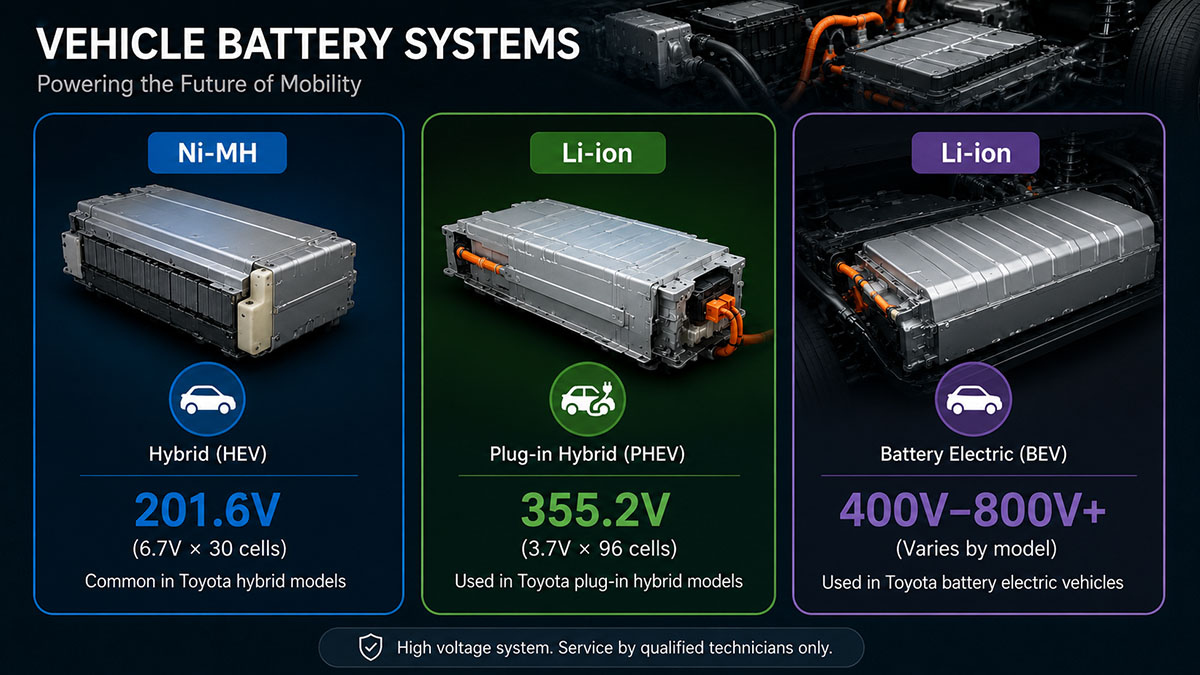
Toyota hybrid battery voltage depends on the battery chemistry, model year, and hybrid system design. Most Toyota hybrid vehicles use either a Nickel-Metal Hydride (NiMH) battery pack or a Lithium-Ion battery pack. In general, Toyota hybrid battery packs are high-voltage systems, commonly ranging from about 140V to over 300V, depending on the model.
| Battery Type |
Cell / Module Voltage |
Common Toyota Hybrid Pack Voltage |
Main Features |
| Nickel-Metal Hydride (NiMH) |
1.2V per cell; Toyota modules are often 7.2V nominal |
Commonly around 144V–300V+ |
Durable, stable, widely used in older and many long-running Toyota hybrids |
| Lithium-Ion Battery |
About 3.6V–3.7V per cell, depending on design |
Commonly around 200V–350V+ |
Lighter, more compact, higher energy density, common in newer Toyota hybrids |
Toyota does not use one standard battery voltage for all hybrid vehicles. A Prius Hybrid, Camry Hybrid, Corolla Hybrid, RAV4 Hybrid, or Highlander Hybrid may use different pack voltages, even if they all belong to the Toyota hybrid family. For replacement, testing, or diagnosis, always confirm the exact battery voltage by checking the vehicle’s VIN, owner’s manual, OEM specifications, or original battery label. This helps avoid choosing the wrong Toyota hybrid battery replacement.
Battery Capacity of Toyota HybridsToyota hybrid battery capacity depends on the battery chemistry, vehicle model, model year, and hybrid system design. In general, regular Toyota hybrid batteries have a smaller capacity than plug-in hybrid batteries because they are mainly used to assist the gasoline engine and recover braking energy, not to provide long electric-only driving range.
| Battery Type |
Common Capacity Range |
Common Toyota Use |
Main Features |
| Nickel-Metal Hydride (NiMH) |
Usually around 1.0–2.0 kWh |
Older and many long-running Toyota hybrids, such as Prius, Camry Hybrid, Highlander Hybrid, Corolla Hybrid, and some RAV4 Hybrid versions |
Durable, stable, proven for frequent charge and discharge cycles |
| Lithium-Ion Battery |
Usually around 0.7–2.0 kWh in regular hybrids |
Many newer Toyota hybrid models and higher-efficiency trims |
Lighter, smaller, and more energy-dense than NiMH batteries |
| Larger Lithium-Ion Hybrid Battery |
Usually above 5 kWh in plug-in hybrid models |
Toyota plug-in hybrid models such as Prius Prime and RAV4 Prime |
Larger capacity, supports external charging and longer electric-only driving |
Toyota hybrid battery capacity is not fixed across all models. A regular Toyota hybrid usually uses a smaller high-voltage battery pack because the battery works together with the gasoline engine, while a plug-in hybrid uses a larger lithium-ion battery because it needs more stored energy for electric driving. For battery replacement or comparison, the exact capacity should always be confirmed by the vehicle’s VIN, owner’s manual, OEM specifications, or original battery label.
 Driving Range in Toyota Hybrids
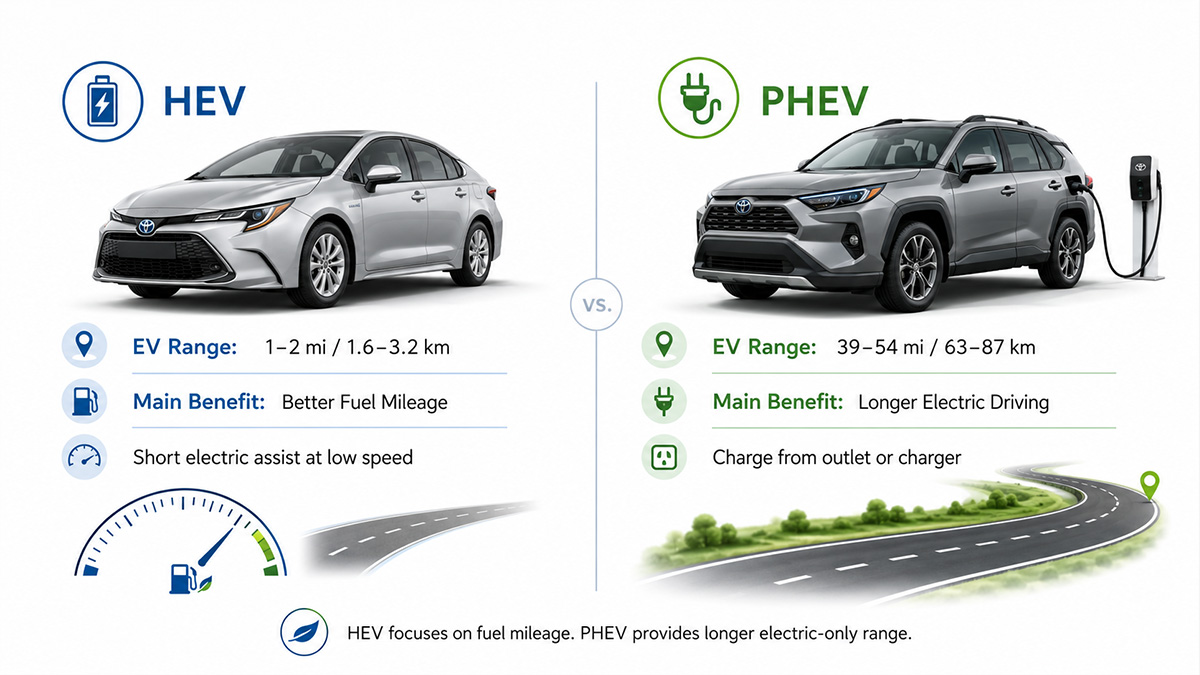
Toyota hybrid driving range depends on the hybrid system type. A Toyota HEV usually has only about 1–2 miles / 1.6–3.2 km or less of electric-only driving under low-speed conditions, because its battery is mainly used to improve fuel economy. A Toyota PHEV has a much larger lithium-ion battery and can usually provide about 39–54 miles / 63–87 km of electric-only range, depending on the model and trim.
• Toyota HEV Range and Mileage
- Electric-only range is very short: Toyota HEVs can drive on electric power for short distances under low-speed and light-load conditions, but they are not designed for long EV-only driving.
- Typical EV-only distance: In many real driving situations, the electric-only distance is around 1–2 miles / 1.6–3.2 km or less, depending on speed, battery charge level, temperature, road conditions, and driving load.
- Fuel mileage is the main advantage: The HEV battery helps improve MPG by assisting the gasoline engine, recovering braking energy, and reducing fuel use in city driving.
- Battery type is not the main range factor: Toyota HEVs may use NiMH or lithium-ion batteries, but both are mainly designed for hybrid assistance rather than long electric range.
• Toyota PHEV Range and Mileage
- Electric-only range is much longer: Toyota PHEVs use larger lithium-ion battery packs that can be charged from an external power source.
- Typical EV-only distance: Depending on the model and trim, Toyota PHEVs commonly provide about 39–54 miles / 63–87 km of electric-only range.
- Lower fuel use when charged regularly: If the battery is charged often, many short daily trips can be completed mostly on electric power.
- Still works as a hybrid after battery depletion: When the plug-in battery charge is low, a Toyota PHEV can still operate like a regular hybrid using the gasoline engine and regenerative braking.
Toyota HEVs and PHEVs should be understood differently. HEVs focus on fuel mileage and short electric assistance, while PHEVs provide meaningful electric-only range through a larger lithium-ion battery. Battery chemistry can affect weight and efficiency, but the biggest range difference comes from the hybrid system type.
 Toyota Hybrid Battery Replacement Cost
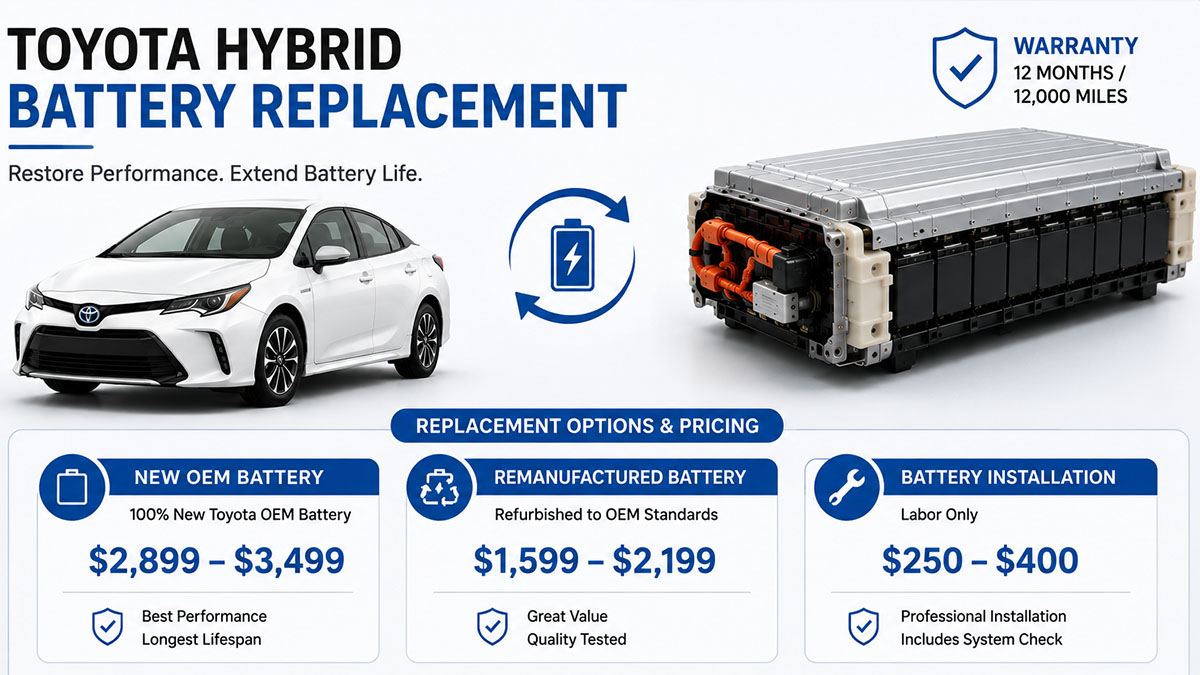
Toyota hybrid battery replacement cost usually ranges from about $2,000 to $8,000, depending on the model, battery type, model year, labor cost, and whether you choose a new OEM battery, refurbished battery, or aftermarket replacement. Smaller Toyota hybrids such as the Prius usually cost less to replace, while larger hybrid models such as the Highlander Hybrid and Sienna Hybrid usually cost more because their battery packs are larger and more expensive.
| Toyota Hybrid Model |
Estimated Replacement Cost |
Notes |
| Toyota Prius Hybrid |
$5,253–$5,484 |
One of the most common Toyota hybrid battery replacements. Older Prius models may have more aftermarket and refurbished options. |
| Toyota Camry Hybrid |
$3,000–$5,000 |
Cost varies by model year, battery chemistry, and whether the replacement pack is new OEM or refurbished. |
| Toyota RAV4 Hybrid |
$3,000–$9,000 |
New OEM battery cost can be higher; refurbished packs may be cheaper. Labor is often around $500–$1,000. |
| Toyota Highlander Hybrid |
$6,564–$6,735 |
Larger hybrid SUV battery pack, usually more expensive than Prius or Camry Hybrid. |
| Toyota Sienna Hybrid |
$6,853–$7,087 |
Hybrid minivan battery replacement is usually on the higher side because of pack size and vehicle design. |
| Toyota Avalon Hybrid |
$4,272–$4,392 |
Usually less expensive than larger SUV or minivan hybrid battery replacement. |
Toyota hybrid battery replacement cost is not fixed. A new OEM Toyota hybrid battery is usually the most expensive choice, while refurbished or remanufactured battery packs can reduce the upfront price. However, the final cost also depends on labor, warranty length, local repair rates, battery availability, and the exact model year. Before replacing a Toyota hybrid battery, always confirm the battery type, pack voltage, part number, and warranty terms through the VIN, owner’s manual, dealer, or a qualified hybrid battery specialist.
| Toyota Hybrid Model |
Estimated Battery Life by Years |
Estimated Battery Life by Mileage |
| Toyota Camry Hybrid |
8–15 years |
100,000–200,000 miles / 160,000–320,000 km |
| Toyota Highlander Hybrid |
8–15 years |
100,000–200,000 miles / 160,000–320,000 km |
| Toyota RAV4 Hybrid |
8–15 years |
100,000–200,000 miles / 160,000–320,000 km |
| Toyota Sienna Hybrid |
8–15 years |
100,000–200,000 miles / 160,000–320,000 km |
| Toyota Avalon Hybrid |
8–15 years |
100,000–200,000 miles / 160,000–320,000 km |
| Toyota Corolla Hybrid |
8–15 years |
100,000–200,000 miles / 160,000–320,000 km |
Toyota hybrid battery life is not the same for every vehicle. A Camry Hybrid or Corolla Hybrid used mainly for daily commuting may have a different battery aging pattern than a Highlander Hybrid, RAV4 Hybrid, or Sienna Hybrid used for heavier loads, long trips, or hot climates. High temperature, poor battery cooling, long periods of storage, frequent short trips, and high mileage can shorten battery life. In normal use, however, Toyota hybrid batteries are designed to last for many years, and many vehicles can exceed
200,000 miles / 320,000 km before battery replacement becomes necessary.
Toyota Hybrid Battery Health CheckA Toyota hybrid battery health check can be done by looking at warning lights, fuel economy, charge behavior, cooling airflow, and diagnostic data. You do not need to check every model separately because the basic methods are similar across Toyota hybrid vehicles.
- Check Warning Lights: If the dashboard shows “Check Hybrid System,” a hybrid battery warning, or a master warning light, the battery system should be scanned.
- Watch Fuel Economy: A sudden drop in MPG or fuel efficiency may mean the hybrid battery is not assisting the engine as well as before.
- Observe Charge and Discharge Speed: If the battery display charges very quickly and then drops very quickly, the usable capacity may be reduced.
- Check Driving Performance: Weak acceleration, more frequent engine running, or rough engine start-stop behavior can be signs of battery aging.
- Inspect the Cooling Vent: Blocked vents, dust, pet hair, or poor airflow can make the hybrid battery overheat and shorten its life.
- Use a Hybrid Scan Tool: A proper diagnostic scan can check battery block voltage, internal resistance, temperature, and fault codes.
Toyota hybrid battery health should be judged by both driving symptoms and scan data. If warning lights, poor fuel economy, fast charge-discharge behavior, or high battery temperature appear repeatedly, the battery should be inspected by a qualified hybrid technician before replacement.
Warranty Coverage for Toyota Hybrid BatteryToyota hybrid battery warranty is usually based on years and mileage. In the U.S., Toyota states that every Toyota hybrid battery is covered by a 10-year / 150,000-mile limited warranty, whichever comes first. This equals about 10 years / 240,000 km. Warranty terms can vary by country, model year, and local policy, so the owner’s warranty booklet should always be checked.
- Warranty Period: Most newer Toyota hybrid batteries are covered for up to 10 years from the first use date.
- Warranty Mileage: The mileage limit is usually 150,000 miles / about 240,000 km, whichever comes first.
- Older Toyota Hybrids: Some older Toyota hybrid models may have shorter warranty coverage, such as 8 years / 100,000 miles, depending on model year and market. Toyota’s support page says the hybrid battery warranty increased from 8 years / 100,000 miles to 10 years / 150,000 miles starting with - the 2020 model year.
- What It Usually Covers: The warranty mainly covers defects or failure of the high-voltage hybrid battery under normal use. It does not always cover damage caused by accidents, flooding, improper repair, poor maintenance, or unauthorized modification.
- Replacement Under Warranty: If the battery fails within the warranty period and meets Toyota’s warranty conditions, the dealer may repair or replace the hybrid battery according to Toyota’s policy.
Toyota hybrid battery warranty is an important factor when comparing replacement cost and long-term ownership. For newer Toyota hybrid models, the common U.S. warranty is 10 years / 150,000 miles / about 240,000 km, but the exact coverage should always be confirmed by the vehicle’s model year, VIN, market, and official warranty guide.
 How Toyota Hybrids Charge the Battery
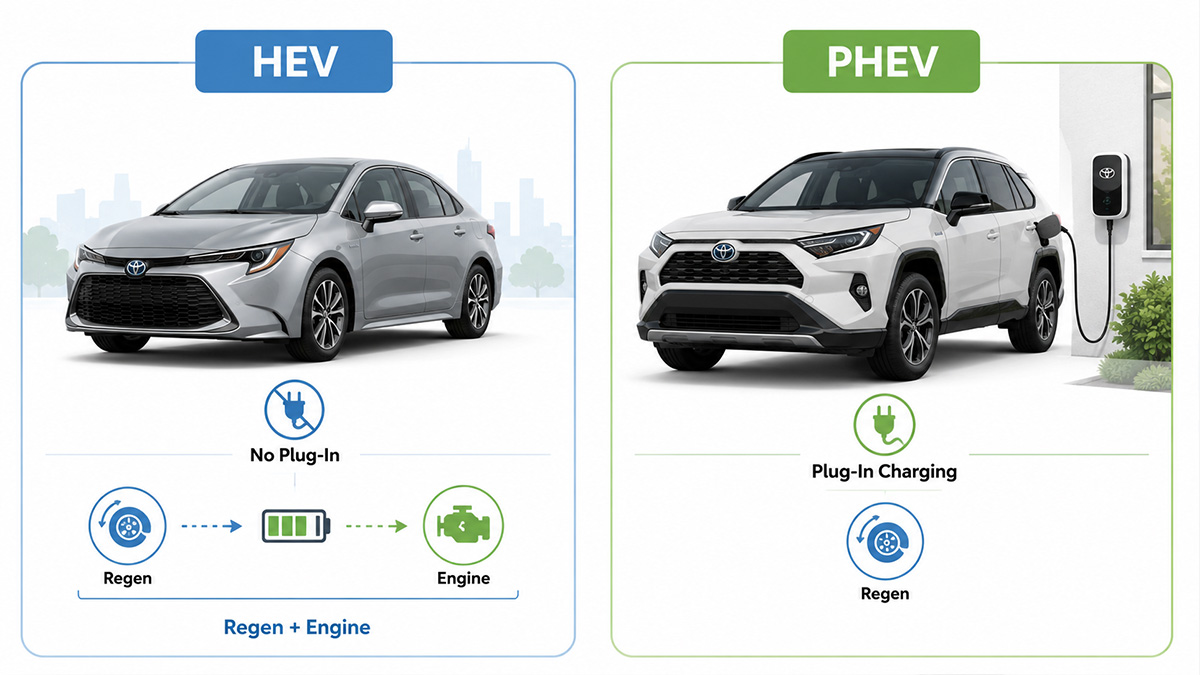
Toyota hybrid battery charging depends on the hybrid system type. Toyota Hybrid Electric Vehicles (HEVs) do not need to be plugged in, while Toyota Plug-In Hybrid Electric Vehicles (PHEVs) can be charged from an external power source. This is the main charging difference between HEV and PHEV models.
• Toyota Hybrid Electric Vehicle (HEV) Charging
- No external charging needed: Toyota HEVs, such as many Prius Hybrid, Camry Hybrid, Corolla Hybrid, RAV4 Hybrid, Highlander Hybrid, and Sienna Hybrid models, do not use a charging cable.
- Charged by regenerative braking: When the vehicle slows down or brakes, the hybrid system converts part of the braking energy into electricity and stores it in the hybrid battery.
- Charged by the gasoline engine: The gasoline engine can also help charge the hybrid battery when needed, especially when the battery level is low.
- Automatically managed by the hybrid system: The driver does not need to fully charge or fully discharge the battery. Toyota’s hybrid control system keeps the battery within a safe working range.
• Toyota Plug-In Hybrid Electric Vehicle (PHEV) Charging
- External charging is available: Toyota PHEVs, such as Prius Prime and RAV4 Prime, use a larger lithium-ion battery that can be charged from a household outlet or charging station.
- Supports longer electric-only driving: After charging, a Toyota PHEV can drive a longer distance using electric power before the gasoline engine starts.
- Still uses regenerative braking: A Toyota PHEV can also recover energy during braking, just like a Toyota HEV.
- Charging time depends on the power source: A standard household outlet usually charges more slowly, while a Level 2 charger can charge the battery faster.
Toyota HEVs are self-charging hybrid vehicles, so they do not need external charging. Toyota PHEVs have larger lithium-ion battery packs and can be plugged in to provide longer electric-only driving. Both systems use regenerative braking, and both are managed automatically by Toyota’s hybrid control system to protect battery life and performance.
Toyota Hybrid Battery Problems and Repair OptionsToyota hybrid battery problems usually appear as warning lights, lower fuel economy, fast battery charge and discharge, weak acceleration, or overheating. Some issues can be caused by poor cooling, sensor faults, wiring problems, or battery imbalance, while serious battery aging may require module repair or full battery replacement.
• Common Problems and Repair Methods
| Common Problem |
Possible Cause |
Repair Method |
| Check Hybrid System Warning |
Battery aging, voltage imbalance, sensor fault, wiring issue, or hybrid control problem |
Use a hybrid-capable scan tool to read fault codes and battery data before deciding on repair or replacement |
| Fast Battery Charge and Discharge |
Reduced usable capacity, weak modules, or battery imbalance |
Test battery block voltage and internal resistance; reconditioning may help older NiMH packs, but severe aging usually needs replacement |
| Poor Fuel Economy |
Battery provides less electric assist, engine runs more often |
Check battery health, cooling airflow, tire pressure, and driving conditions; repair weak battery blocks or replace the pack if needed |
| Weak Acceleration |
Battery cannot deliver enough power under load |
Perform a road test and scan battery output data; repair wiring or replace weak modules / battery pack |
| Battery Overheating |
Blocked cooling vent, dirty cooling fan, pet hair, dust, or high-temperature driving conditions |
Clean the battery cooling vent, fan, and air duct; check temperature sensors and airflow |
| Voltage Imbalance |
One or more weak battery blocks or cells |
Compare block voltage and internal resistance; replace weak modules or replace the full battery pack |
| Cooling Fan Noise |
Dirty fan, blocked airflow, or fan motor issue |
Clean or replace the cooling fan; remove debris from vents and ducts |
| Battery Not Holding Charge |
Battery aging, high internal resistance, or cell deterioration |
Run a full battery health test; reconditioning may be temporary, while full replacement is more reliable for severe aging |
| Corroded Connectors or Wiring Faults |
Moisture, age, poor contact, or previous repair damage |
Inspect and clean connectors; repair or replace damaged wiring and terminals |
• What Happens When Toyota Hybrid Battery Dies?
When a Toyota hybrid battery dies, the vehicle may show warning lights, lose electric assist, suffer poor fuel economy, or fail to drive normally. Common signs include a “Check Hybrid System” message, fast battery charge and discharge, weak acceleration, frequent engine running, and reduced MPG.
If the high-voltage hybrid battery is seriously failed, the gasoline engine alone usually cannot keep the vehicle working like a normal non-hybrid car. The hybrid system depends on the battery, motor, inverter, and engine working together. In many cases, the car may enter limp mode, limit power, or refuse to start until the battery problem is diagnosed and repaired.
• Can Toyota Hybrid Run Without Battery?
A Toyota hybrid generally cannot run properly without the high-voltage hybrid battery. Even though it has a gasoline engine, the hybrid battery is still needed for starting, electric assist, regenerative braking, and hybrid system control.
If the hybrid battery is removed, disconnected, or completely failed, most Toyota hybrid vehicles will not operate normally. Some may start briefly or move in a limited way, but they are not designed to be driven without the hybrid battery. The safe solution is to diagnose the battery fault and repair or replace the battery pack instead of trying to drive the vehicle without it.
Toyota hybrid battery repair should match the actual problem. Simple issues such as dirty cooling fans, blocked vents, sensor faults, or wiring problems may be repairable at a lower cost. If the battery has serious aging, repeated warning lights, large voltage differences, or poor capacity, full battery replacement is usually the safer and more reliable solution.
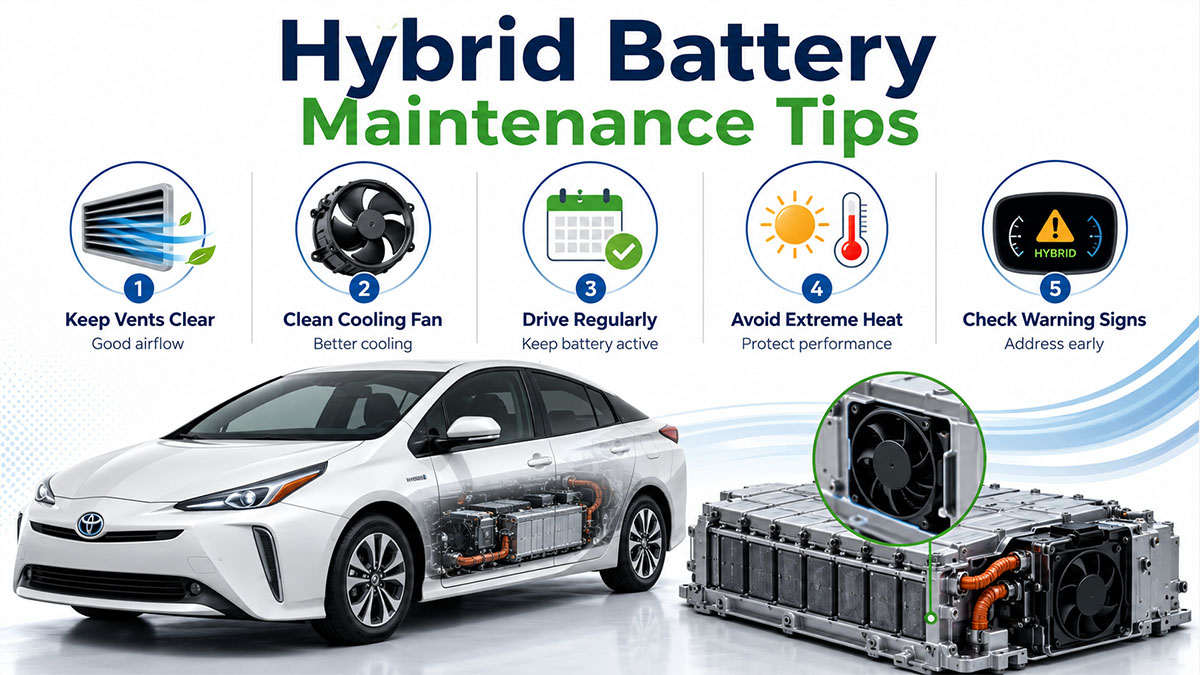 Hybrid Battery Maintenance Tips
Toyota hybrid battery maintenance is mainly about keeping the battery cool, driving the vehicle regularly, avoiding extreme heat, and checking warning signs early. The high-voltage hybrid battery is managed automatically by the vehicle, so it does not need manual charging or fluid maintenance.
Keep the Cooling Vents Clear
- Do not block the hybrid battery cooling vents with luggage, seat covers, clothing, or other items.
- Dust, pet hair, and debris can reduce airflow and cause the battery to run hotter.
- Poor cooling can shorten battery life and trigger hybrid system warnings.
Clean the Cooling Fan When Needed
- The hybrid battery cooling fan may collect dust and hair over time.
- If the fan becomes noisy or the vehicle is used in dusty conditions, the fan and air duct should be inspected.
- Cleaning the cooling fan helps prevent overheating and keeps the battery working efficiently.
Drive the Vehicle Regularly
- Avoid leaving the vehicle unused for a long time.
- Regular driving helps the hybrid system maintain the battery within a healthy charge range.
- Long-term storage may affect battery condition, especially in very hot or cold environments.
Avoid Extreme Heat
- High temperature can speed up hybrid battery aging.
- Parking in the shade or a garage can help reduce heat exposure.
- Keeping the cabin cooler also helps the battery cooling system work better.
Check Warning Signs Early
- Watch for fast charge-discharge, lower fuel economy, weak acceleration, or frequent engine running.
- If the dashboard shows “Check Hybrid System” or a battery warning light, scan the vehicle early.
- Early diagnosis may help avoid more serious battery damage.
Toyota hybrid battery maintenance is simple but important. Keep the cooling vents and fan clean, drive the vehicle regularly, avoid excessive heat, and check warning signs as soon as they appear. These habits can help extend Toyota hybrid battery life and reduce the chance of early replacement.
 Battery Disposal and Recycling
Toyota hybrid batteries should not be thrown away with normal waste. They are high-voltage battery packs that contain recyclable metals and materials, so they should be handled through Toyota dealers, certified hybrid battery recyclers, or approved battery collection programs.
Return the Battery to a Toyota Dealer
- Toyota dealers can help direct old hybrid batteries to proper recycling channels.
- This is often the safest option for owners who are replacing the battery through a dealer.
- Dealer recycling helps make sure the battery is handled according to local safety and environmental rules.
Use a Certified Battery Recycler
- Hybrid batteries contain materials such as nickel, lithium, cobalt, copper, steel, and plastic, depending on the battery type.
- Certified recyclers can recover usable materials and reduce environmental waste.
- Do not sell or ship a damaged hybrid battery to an unqualified buyer.
Do Not Open the Battery Pack Yourself
- Toyota hybrid batteries are high-voltage systems.
- Opening the pack without training can cause electric shock, short circuit, fire risk, or chemical exposure.
- Battery removal, transport, and recycling should be handled by trained technicians.
Follow Local Recycling Rules
- Battery disposal rules vary by country, state, and region.
- Some areas require hybrid batteries to be collected by licensed waste or recycling companies.
- Always check local regulations before transporting or disposing of a used hybrid battery.
Handle Damaged Batteries Carefully
- A battery involved in an accident, flood, overheating event, or fire should be treated as high-risk.
- Damaged batteries may need special packaging, isolation, or hazardous-material handling.
- In this case, contact a Toyota dealer, repair shop, or certified recycler before moving the battery.
Toyota hybrid battery recycling is the safest and most responsible disposal method. Old NiMH and lithium-ion hybrid batteries can often be recycled to recover valuable materials, but they should only be handled through qualified channels. For most vehicle owners, the best solution is to let a Toyota dealer, professional repair shop, or certified battery recycler manage the disposal process.
ConclusionToyota hybrid batteries are built to support fuel efficiency, smooth driving, and long-term hybrid system performance. Because Toyota uses different battery chemistries and pack designs across different models, the exact battery type, capacity, voltage, lifespan, and replacement cost can vary by vehicle.
For Toyota owners, the most important points are to identify the correct battery type, monitor early warning signs, keep the battery cooling system clean, and choose a reliable repair or replacement option when needed. With proper use and maintenance, a Toyota hybrid battery can usually provide many years of dependable service.
FAQHow Long Do Toyota Hybrid Batteries Last?Toyota hybrid batteries usually last about 8–15 years or 100,000–200,000 miles / 160,000–320,000 km. Actual battery life depends on driving habits, climate, mileage, battery cooling condition, and vehicle maintenance. Some Toyota hybrids can last longer before battery replacement is needed.
How Much Does a Toyota Hybrid Battery Cost?A Toyota hybrid battery replacement usually costs about $2,000 to $8,000, depending on the model, battery type, model year, labor cost, and whether the battery is new OEM, refurbished, or aftermarket. Smaller models such as the Prius often cost less, while larger models such as the Highlander Hybrid or Sienna Hybrid may cost more.
How to Check Toyota Hybrid Battery Health?You can check Toyota hybrid battery health by watching for warning lights, lower fuel economy, fast charge and discharge, weak acceleration, frequent engine running, or overheating. A proper health check should also use a hybrid-capable scan tool to check battery block voltage, internal resistance, temperature, and fault codes.
How to Charge Toyota Hybrid Battery?Toyota Hybrid Electric Vehicles (HEVs) do not need external charging. Their batteries are charged automatically by regenerative braking and the gasoline engine. Toyota Plug-In Hybrid Electric Vehicles (PHEVs), such as Prius Prime and RAV4 Prime, can be charged from a household outlet or charging station, while still using regenerative braking during driving.


