✅
Fire And Explosion
• Fire And Explosion Cause • Fires And Explosion Are Uncommon • Fire Statistics • How to Prevent Ebike Battery Fires And Explosion • How to Put Out an Ebike Battery Fire • When Do Ebike Batteries Catch Fire • Ebike Battery Fire And Explosion in an Elevator✅
Charging Safety
• Charging an Ebike Battery Indoors Is Generally Safe • Charging an Ebike Battery Overnight • How To Charge A Dead Ebike Battery • Can Ebike Batteries Catch Fire Or Explode When Not Charging✅
Storage
• Indoor Storage for Ebike Batteries • Best Place to Store an Ebike Battery • Best Way to Store an Ebike Battery • Where to Store an Ebike Battery Safely • Long Term Storage✅
Disposal
• How to Dispose of an Ebike Battery • Dispose Location✅
Conclusion✅
FAQ What Causes Ebike Battery Fires? How to Store an Ebike Battery? Is It Safe to Store an Ebike Battery Indoors? Can I Charge My Ebike Battery Overnight? How Often Do Ebike Batteries Explode?Ebike batteries are generally safe, and the overall risk is low when they are used properly. Most people use them daily without any issues, especially when the battery is high-quality and comes from a reputable manufacturer. Safety largely depends on the design, cell quality, and how the battery is handled during everyday use, which is why understanding the basics of an
ebike battery system is important.
Like all lithium-ion batteries, they do carry some risk, but problems are usually linked to poor-quality products, improper charging, unsafe storage, or physical damage rather than normal operation. Key safety aspects include fire and explosion prevention, correct charging practices, and proper storage conditions, all of which are closely related to how a modern Ebike battery pack is built and managed.
Overall, with the right battery and responsible use, ebike batteries are safe and reliable for everyday use, and the chances of serious incidents remain very low.
Fire And Explosion
E-bike batteries are generally safe, but like all lithium-ion batteries, they carry a small risk of fire or explosion under certain conditions. Most incidents are linked to poor battery quality, improper charging, physical damage, or extreme environments, rather than normal use. While these events are relatively rare, understanding the causes and knowing how to prevent and respond to them is essential. With the right battery and proper handling, the risk of fire or explosion can be kept very low.
• Fire And Explosion Cause
Ebike lithium batteries are mainly composed of lithium cells and a battery management system (BMS). Among all potential causes, cell quality is the most critical factor in fire and explosion incidents. Low-quality or defective cells are more prone to internal short circuits, overheating, and thermal runaway, which can quickly lead to fire. While other issues—such as faulty BMS, poor chargers, excessive load, high temperatures, moisture, or physical damage—can also contribute to failures, they are often secondary triggers. In most cases, the root cause of an Ebike battery fire and explosion can be traced back to unstable or poorly manufactured battery cells.
- Poor Battery Cell Quality
- Faulty Battery Management System (BMS)
- Poor Manufacturing Quality
- Low-Quality or Incompatible Charger
- Excessive Motor Power (Overload)
- High Temperature Exposure
- Water Ingress or Moisture
- Physical Damage
• Fires And Explosion Are Uncommon
Ebike battery fires and explosion are still relatively uncommon, and the overall probability is very low, so there’s no need to be overly anxious day to day. That said, when fires and explosion do happen they can be serious—and the risk is not evenly distributed across all products. The biggest difference usually comes down to battery cell quality and pack design, which is why it’s important not to chase the cheapest option when buying an Ebike battery. Choosing a reputable brand or a well-reviewed manufacturer with proper safety protections, reliable cells, and quality control is one of the most effective ways to keep the risk and explosion as low as possible.
• Fire Statistics
- London (UK, 2025): 206 Ebike & e-scooter fires, including 171 Ebike fires
- New York City (USA, 2024): 277 fires caused by lithium-ion batteries
- China (H1 2022): 8,370 Ebike fire incidents
• How to Prevent Ebike Battery Fires And Explosion
The most important step is simple: buy a high-quality Ebike battery from a reputable brand—don’t go for the cheapest option. Battery cell quality and manufacturing standards are the biggest factors in safety. Here are other key measures to reduce fire and explosion risk:
- Use the correct charger: Always use the original or manufacturer-approved charger.
- Avoid overcharging: Do not leave the battery charging overnight or unattended for long periods.
- Do not charge below 0°C (32°F): Let the battery warm up to room temperature before charging.
- Keep away from heat: Avoid direct sunlight, hot cars, or placing the battery near heaters.
- Store properly: Store at 10–25°C (50–77°F) with about 40–60% charge.
- Keep the battery dry: Avoid water exposure and high humidity environments.
- Prevent physical damage: Do not drop, crush, or puncture the battery.
- Check for warning signs: Stop using immediately if you notice swelling, unusual heat, or strange smells.
- Avoid overloading: Make sure the battery matches the motor power and system requirements.
• How to Put Out an Ebike Battery Fire
If an Ebike battery catches fire, evacuate the area, call emergency services, and only attempt to extinguish it if it is small and safe to handle. Use a fire extinguisher or large amounts of water to cool the battery continuously, as lithium battery fires can reignite.
Key Steps:
- Evacuate and keep distance
- Call emergency services
- Use a fire extinguisher if available
- If not, use plenty of water to cool the battery continuously
- Do not get close or try to handle the battery
- Watch for possible re-ignition
• When Do Ebike Batteries Catch Fire
In most cases, Ebike batteries catch fire during charging or shortly after charging ends. Charging puts the battery under the highest stress, especially if the charger is faulty, the battery is damaged, or the BMS fails.
Other common situations include:
- Using the bike under heavy load: High motor power draw, steep hills, or long high-speed riding can overheat the pack.
- Right after a crash or physical impact: Damage can create an internal short that may ignite immediately or later.
- After water exposure: Water ingress or moisture can cause corrosion or short circuits, sometimes hours or days later.
- In very hot environments: Hot cars, direct sunlight, or storage near heaters can raise temperatures and increase risk.
- After using the wrong charger: Incorrect voltage/current or poor-quality chargers can trigger overheating and failure.
- When the battery shows warning signs: Swelling, unusual heat, burning smell, or leaking often appears before a serious failure.
• Ebike Battery Fire And Explosion in an Elevator
An elevator is one of the worst places for an Ebike battery fire and explosion because it’s a small, sealed space. Smoke and toxic gases can build up fast, visibility drops quickly, and you may not be able to escape until the doors open. Lithium-ion battery fires and explosion can also flare up suddenly and may reignite. In many countries and cities, bringing Ebike batteries into elevators is strictly restricted or strongly discouraged due to serious safety risks. Users should always follow local regulations and safety guidelines.
For your own safety:
- Do not take Ebike batteries into elevators
- Always follow building and local safety rules
- If you see someone carrying a battery into an elevator, advise them not to
- If a battery is already inside, exit the elevator immediately
Because elevators are enclosed spaces, a battery fire and explosion can become life-threatening within seconds. Avoiding this situation is the safest choice.
Charging SafetyCharging is the most critical stage for Ebike battery safety, as this is when the battery is under the highest stress and most fire incidents occur. While the overall risk remains low, improper charging—such as using low-quality batteries, faulty chargers, or unsafe environments—can significantly increase the danger. By choosing reliable equipment and following safe charging practices, most risks can be effectively minimized.
• Charging an Ebike Battery Indoors Is Generally Safe
Charging an Ebike battery at home is generally safe, and most people do it every day without any issues. The overall risk is low, so there’s no need to be overly concerned. However, safety largely depends on the quality of the battery and how it is used. High-quality batteries from reputable brands, combined with proper chargers, are designed with protection systems and rarely cause problems.
Most fire incidents are linked to cheap or poorly made batteries, faulty chargers, or improper charging habits, rather than normal indoor charging itself. For example, charging a damaged battery, leaving it unattended for long periods, or placing it near flammable materials can increase the risk.
In short, indoor charging is safe when done properly, but choosing a reliable battery and using it responsibly makes all the difference.
• Charging an Ebike Battery Overnight
Charging an Ebike battery overnight is convenient, but it is not recommended. Leaving a battery charging unattended for long periods increases the risk, especially if there is a fault with the battery or charger. While high-quality batteries and chargers usually have protection systems to stop charging when full, failures can still happen. It’s safer to charge the battery when you are nearby and able to monitor it, and to unplug it once it reaches full charge.
• How To Charge A Dead Ebike Battery
Charging a completely dead Ebike battery is not recommended, as it carries a higher safety risk. When a battery is deeply discharged, the cells can become unstable, and attempting to recharge it may lead to overheating or failure.
If you must attempt to charge it, take extra precautions. It should be done outdoors in a safe, open area, with someone present at all times to monitor the process. Be ready to disconnect power immediately if anything unusual occurs, such as heat, swelling, or strange smells. It’s also advisable to have a bucket of water nearby so that, in case of a fire, the battery can be quickly cooled to prevent the situation from escalating.
In general, if a battery appears completely dead or unresponsive, the safest option is to replace it rather than attempt recovery.
• Can Ebike Batteries Catch Fire Or Explode When Not Charging
Yes, it is possible for an Ebike battery to catch fire or even explode when it is not charging. While most incidents happen during charging or shortly after, battery failures can also occur at other times. This usually happens when the battery has underlying problems—such as damaged cells, a faulty BMS, moisture inside the pack, overheating from heavy use, or physical impact. In these situations, a hidden internal short circuit can develop and trigger overheating later, even when the battery is just sitting unused.
Storage
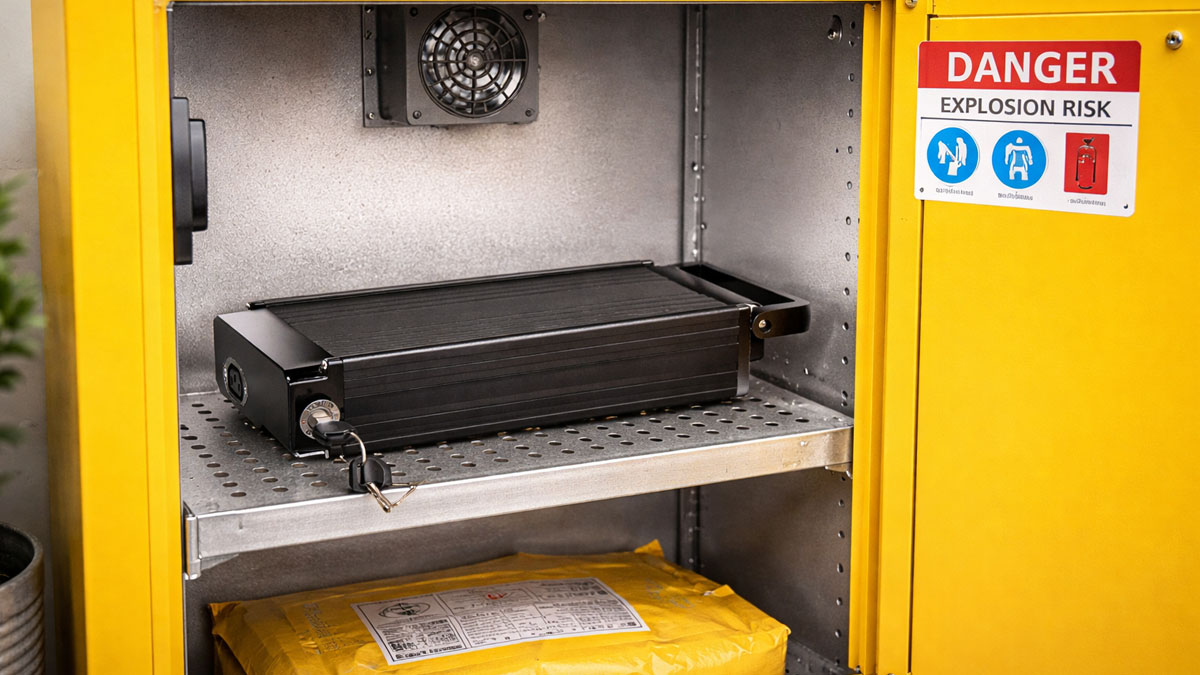
Proper storage helps extend battery life and reduce safety risks. Ebike batteries should be kept in a cool, dry, and stable environment, away from extreme temperatures, moisture, and direct sunlight. The ideal storage temperature is around 10–25°C (50–77°F), where the battery remains stable and less prone to degradation.
It’s also important to store the battery at a partial charge level, typically around 40–60%, rather than fully charged or completely empty. Before storing, make sure the battery is clean, dry, and undamaged, and place it on a non-flammable surface away from combustible materials. If storing for a long period, check the battery occasionally and recharge it slightly if the level drops too low.
In short, moderate temperature, partial charge, and a dry environment are the key factors for safe and effective Ebike battery storage.
• Indoor Storage for Ebike Batteries
Indoor storage is generally the safest option, as it protects the battery from extreme temperatures, moisture, and weather exposure. Choose a dry, well-ventilated area away from direct sunlight or heat sources. Avoid placing the battery near flammable materials such as fabrics, paper, or wooden furniture.
• Best Place to Store an Ebike Battery
The best place to store an Ebike battery is a cool, dry location with stable temperature, such as a room inside your home, a climate-controlled garage, or a storage area. Avoid places like sheds, cars, or uninsulated garages where temperatures can fluctuate significantly.
• Best Way to Store an Ebike Battery
Store the battery at a partial charge level (around 40–60%), rather than fully charged or completely empty. Make sure the battery is clean, dry, and undamaged before storage. Place it on a non-flammable surface and check it periodically if stored for a long time.
• Where to Store an Ebike Battery Safely
A safe storage location is one that is away from heat, water, and physical disturbance. Keep the battery out of reach of children, and avoid areas where it could be dropped or damaged. Proper placement and environment are key to reducing both safety risks and long-term degradation.
• Long Term Storage
For long-term storage, an Ebike battery should be kept in a stable, controlled environment to prevent degradation and safety risks. The ideal condition is a cool, dry place with a temperature around 10–25°C (50–77°F). Avoid extreme cold, heat, or humidity, as these can damage the battery over time.
Before storing, charge the battery to about 40–60%, rather than leaving it fully charged or completely empty. During storage, the battery will slowly lose charge, so it’s important to check it every 1–3 months and recharge slightly if the level drops too low.
Overall, moderate temperature, partial charge, and periodic checks are the key to maintaining battery health during long-term storage.
DisposalEbike batteries should never be thrown away with regular household waste. Because they contain lithium and other hazardous materials, improper disposal can cause environmental damage and even fire risks. The safest approach is to handle disposal through approved recycling systems designed for lithium-ion batteries.
• How to Dispose of an Ebike Battery
Before disposal, make sure the battery is in a safe condition. If possible, discharge it to a low level, avoid damaging or opening the pack, and cover the terminals to prevent short circuits. Place the battery in a non-flammable container and transport it carefully. Never attempt to dismantle the battery yourself, as this can be dangerous and may cause fire or chemical exposure.
• Dispose Location
Ebike batteries should be taken to authorized recycling facilities or hazardous waste collection sites. Many cities offer designated drop-off locations for lithium-ion batteries, and some bike shops or battery retailers may also accept used batteries for recycling. Using official channels ensures the battery is handled safely and that valuable materials are properly recovered.
Conclusion
Ebike batteries are safe for everyday use when they are high-quality and used correctly, and the overall risk of fire or failure remains low. Most safety issues are not caused by normal operation, but by poor battery quality, improper charging, unsafe storage, or physical damage.
By choosing a reliable battery, using the correct charger, storing it in a suitable environment, and paying attention to warning signs, users can significantly reduce potential risks. In the end, battery safety is less about avoiding use and more about using it the right way—with the right product and proper habits.
FAQWhat Causes Ebike Battery Fires?Ebike battery fires are usually caused by poor-quality cells, faulty BMS (battery management system), low-quality chargers, or physical damage. Other factors such as overcharging, overheating, moisture, or excessive load can also increase the risk. In most cases, the root cause is related to battery quality and internal defects.
How to Store an Ebike Battery?Ebike batteries should be stored in a cool, dry place with a stable temperature of around 10–25°C (50–77°F). It’s best to keep the battery at a partial charge (40–60%) and place it on a non-flammable surface, away from heat, moisture, and direct sunlight.
Is It Safe to Store an Ebike Battery Indoors?Yes, it is generally safe to store an Ebike battery indoors as long as it is kept in a dry, well-ventilated area away from flammable materials and heat sources. Indoor storage is often safer than outdoor environments with extreme temperatures or humidity.
Can I Charge My Ebike Battery Overnight?Charging overnight is not recommended. Although many batteries have protection systems, leaving them charging unattended for long periods can increase risk if a fault occurs. It’s safer to charge when you are nearby and unplug once fully charged.
How Often Do Ebike Batteries Explode?Ebike battery explosions are very rare. Most batteries operate safely throughout their lifespan. Incidents usually occur due to low-quality batteries, improper use, or external damage, rather than normal usage.


