✅ Structure✅ Voltage
• Can I Put a Higher Voltage Battery on an Ebike • Ebike Voltage Checking✅ Charging✅ Discharging✅ Capacity
• Capacity Measurement✅ Range✅ Lifespan
✅ Size
✅ Types
✅ Problem And Reparing Advice
✅ Maintenance
✅ Temperature
✅ Safety✅ Conclusion✅ FAQ
How to Check Ebike Battery Voltage? What Type of Batteries Do Ebikes Use? How to Measure Ebike Battery Capacity? What Size Battery for Ebike? How to Discharge an E-bike Battery?
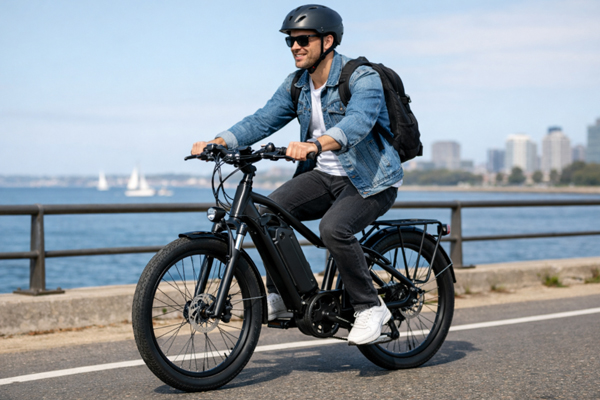
An ebike battery is the rechargeable power source that determines how far an electric bike can travel, how strongly the motor performs, and how stable the ride feels under different loads. Most modern ebike batteries use lithium-based cells because they offer higher energy density, lighter weight, and longer cycle life than older lead-acid options, a topic covered in more detail in a complete lithium battery overview.
A complete ebike battery is more than just a group of cells. It usually includes a battery pack, BMS, wiring, connectors, casing, and mounting structure, all designed to match the bike’s voltage, motor power, controller, and riding conditions. To better understand how ebike batteries work, it helps to look at their voltage, capacity, range, lifespan, charging behavior, safety design, and replacement options.
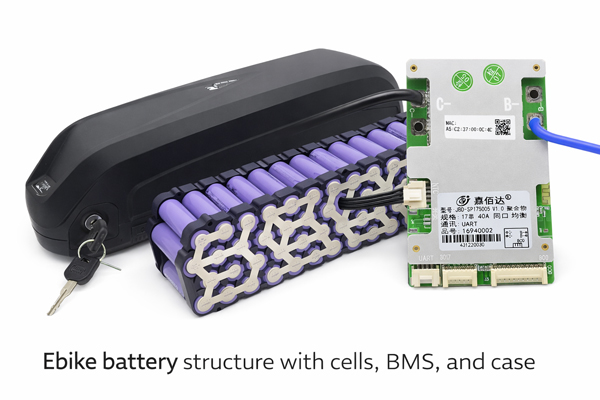
StructureAn ebike battery is mainly composed of three core components: battery cells, a protection board (BMS), and an outer casing.
• Battery Cells – The cells are the core energy storage units. They determine the battery’s voltage, capacity, and overall performance. Most modern ebike batteries use lithium-ion cells connected in series and parallel configurations.
• Protection Board (BMS) – The Battery Management System controls charging and discharging, monitors voltage and temperature, and protects against overcharge, over-discharge, overcurrent, and short circuits.
• Outer Casing – The casing provides structural support and physical protection. It shields the internal components from vibration, dust, and minor impacts while also determining the mounting style and size of the battery.
Together, these components ensure the battery operates safely and reliably during daily use.
Voltage
Ebike battery voltage mainly comes in 36V, 48V, 52V, 60V, and 72V, with a smaller number of 24V packs used on some mini Ebikes.
The chart below covers each voltage option’s full charge voltage and lowest voltage, and shows how battery percentage changes as voltage drops during use. You can compare your current reading (the battery’s output voltage) to the table to quickly estimate remaining charge and avoid running too close to low voltage. Understanding how voltage relates to different ebike battery types can also help you interpret these values more accurately.
| Percentage |
24V |
36V |
48V |
52V |
60V |
72V |
| 100% (Full) |
29.4V |
42.0V |
54.6V |
58.8V |
67.2V |
84V |
| 90% |
28.7V |
41.0V |
53.0V |
57.0V |
65.6V |
82V |
| 80% |
28V |
40.0V |
52.0V |
55.5V |
56V |
80V |
| 70% |
27.3V |
39.0V |
50.5V |
54.0V |
62.4V |
78V |
| 60% |
26.6V |
38.0V |
49.0V |
52.5V |
60.8V |
76V |
| 50% |
25.2V |
36.0V |
48.0V |
51.0V |
57.6V |
72V |
| 40% |
24.5V |
35.0V |
46.5V |
49.5V |
56V |
70V |
| 30% |
23.8V |
34.0V |
45.0V |
48.0V |
54.4V |
68V |
| 20% |
23.1V |
33.0V |
43.5V |
46.5V |
52.8V |
66V |
| 10% |
22.4V |
32.0V |
42.0V |
45.0V |
51.2V |
64V |
| 0% |
21V |
30.0V |
39.0V |
42.0V |
48V |
60V |
• Can I Put a Higher Voltage Battery on an Ebike
Summary: Yes, but only if the controller and motor are compatible with the higher voltage; otherwise, they must be replaced.
In some cases, experienced riders upgrade from a 48V battery to a 52V battery because the voltage difference is relatively small. If the motor controller and motor are rated to operate across both voltage ranges, the system may work safely without major modifications. However, this compatibility is not guaranteed and must be confirmed by checking the controller and motor voltage specifications.
For larger voltage jumps—such as moving from 36V to 48V, or 48V to 60V or higher—the controller and motor must be replaced to match the new battery voltage. Using a higher voltage battery with an incompatible controller or motor can cause overheating, electronic failure, or permanent damage to both the controller and the motor.
• Ebike Voltage Checking
To measure the total battery voltage, use a digital multimeter and set it to DC voltage, selecting an appropriate range (commonly 200V for most Ebike batteries). Place the red probe on the battery’s positive terminal and the black probe on the negative terminal. The reading shown on the multimeter is the battery’s total output voltage.
During measurement, never allow the multimeter probes to short-circuit the battery’s positive and negative terminals, as this can cause sparks, damage the battery, or create a safety hazard.
ChargingCharging simply means using the proper charger to refill your ebike battery after riding. You plug the battery into the charger, connect it to a power outlet, and allow the built-in system to manage the charging process safely. Many riders are unsure about things like when to charge, how long it should stay plugged in, whether the first charge is different, or if there are alternative charging methods. These questions are completely normal, especially for new ebike owners.
Understanding
the charging basics—how to charge, when to charge, first-time charging, charging time, and different charging options—helps remove that uncertainty. Once you know the fundamentals, charging becomes routine rather than something to worry about.
DischargingDischarging refers to the process of the ebike battery releasing stored energy. When the battery is installed on the bike and the ebike is in motion, the battery is actively discharging to power the motor—that riding process is essentially a controlled discharge cycle. In addition to normal riding use, a battery can also be discharged separately after being removed from the bike. This is typically done using professional discharge equipment for testing, maintenance, or storage preparation.
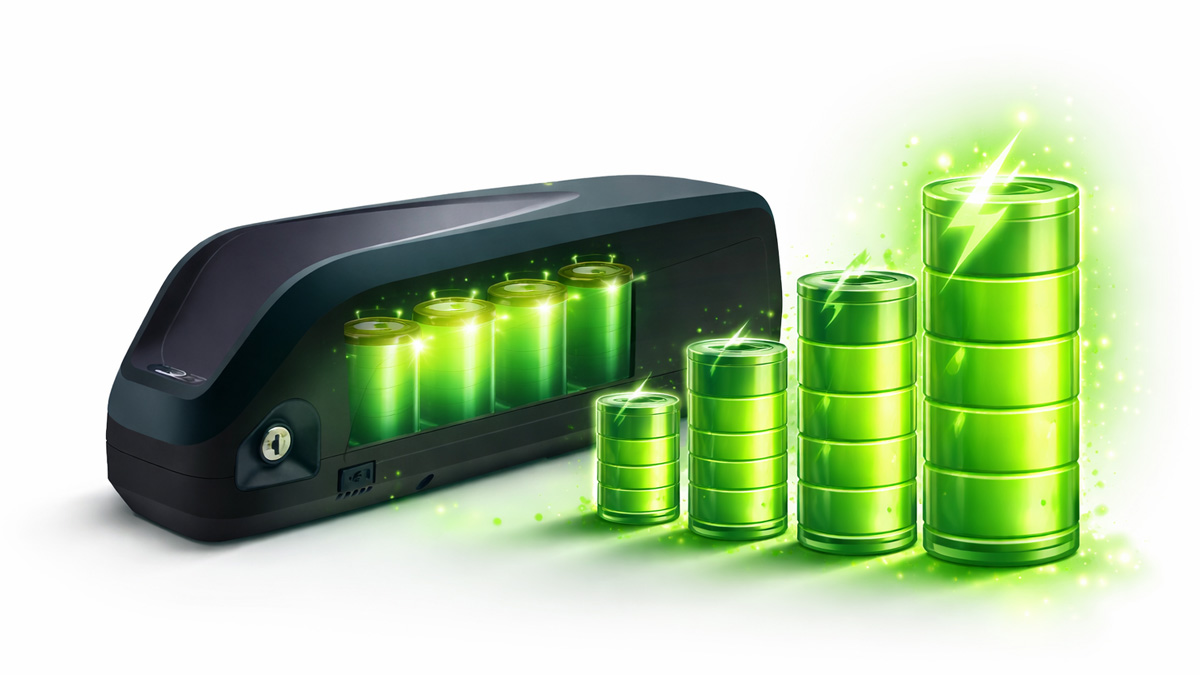
CapacityEbike battery capacity is directly related to riding range. Although range is also influenced by factors such as motor power, terrain, rider weight, and assist level, capacity remains one of the most important determinants. In general, a higher capacity battery provides longer potential riding distance. (See the range section below for more details.)
• Capacity Measurement
Battery capacity is commonly expressed in amp-hours (Ah) or watt-hours (Wh). However, accurately measuring true capacity requires professional lithium battery testing equipment that performs controlled charge and discharge tests under standardized conditions. Some modern ebike batteries come with a smart BMS that allows users to monitor real-time discharge data and released capacity through a mobile app (via Bluetooth) or a computer connection. This makes performance tracking much more convenient. However, batteries equipped with smart monitoring systems are typically priced slightly higher than those using a standard BMS.
 Range
Ebike battery range means the estimated riding distance you can get from a full charge under typical conditions. It’s not a fixed number, because speed, assist level, hills, rider/load, wind, tire pressure, and temperature all change how quickly energy is used. For a simple way to understand the estimation logic, link this phrase to your blog page:
range estimation guide — then continue reading without turning the pillar page into a calculator.
In general, range is estimated by comparing how much energy the battery can deliver with how much energy your setup typically consumes per distance, then adjusting based on real-world riding conditions.
Ebike battery lifespan is the period the battery stays reliably usable before capacity loss noticeably reduces range and performance. Lifespan is estimated from the battery’s chemistry and build quality together with real-world use—especially charging habits, storage conditions, temperature exposure, and how often it’s pushed hard.
To extend lifespan, limit heat, avoid leaving the battery at full charge for long periods, and reduce frequent deep discharges whenever possible.
Size
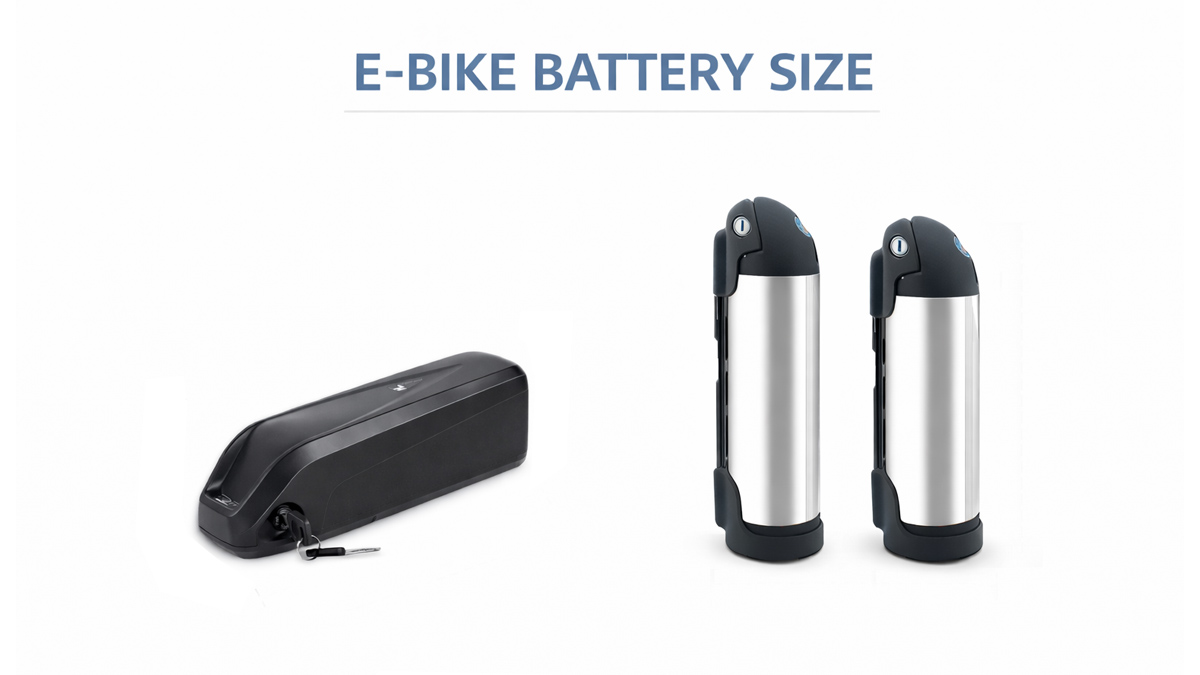
Ebike batteries come in many different sizes and styles, rather than a single standard shape. Some designs are more popular, but the right choice depends on your bike type, required range, and personal preference. Different frame structures and mounting positions require different battery styles, so there is no one-size-fits-all option.
In practice, selecting the right battery is less about choosing a “popular size” and more about finding a model that fits your bike properly and meets your performance needs.
Types
Ebike batteries are commonly classified based on their mounting position on the bike frame. The most popular types include:
- Downtube batteries – Mounted along the bike’s downtube for balanced weight distribution and a clean appearance.
- Rear rack batteries – Installed on the rear cargo rack, often found on commuter or city ebikes.
- Integrated (in-frame) batteries – Built directly into the frame for a sleek, modern design and improved protection.
When choosing an ebike battery, it is essential to consider your bike’s compatible mounting position and frame design. Not all battery types are interchangeable, so proper fit and installation compatibility should always be verified before purchase.
 Problem And Reparing Advice
Ebike batteries can experience a range of issues over time, especially with frequent use or improper charging and storage. Problems like charging failure, reduced capacity, or sudden power loss are often linked to cell aging, imbalance, or BMS-related faults. Understanding the root cause is essential before deciding whether to repair or replace the battery. For a more detailed breakdown of common issues and practical solutions, you can check this guide on
common ebike battery problems and repair solutions to better diagnose and handle different situations.
Maintenance
Proper maintenance is mainly about preventing unnecessary battery stress and keeping the cells in a stable condition. Good habits can significantly reduce performance decline and help maintain consistent riding experience over time.
• Avoid Deep Discharge
The most important rule is to avoid leaving the battery in a fully depleted state. If the battery runs low, recharge it promptly. Long-term storage at 0% can cause serious damage.
• Maintain Proper Storage Level
If the battery will not be used for an extended period, keep it at 40–60% charge. Long-term inactivity is not recommended. Ideally, perform a few light charge and discharge cycles each month to keep the cells active.
• Control Environment Conditions
Store and use the battery in a dry environment. Avoid exposure to moisture, rain, extreme heat, or freezing temperatures. Room temperature conditions are best for maintaining stability.
• Voltage Balancing (Advanced Maintenance)
If you notice the riding range gradually decreasing beyond normal aging, the battery may benefit from voltage balancing. This process helps equalize individual cell voltages and can noticeably improve performance. However, balancing should be performed by a professional service center. It is not recommended to attempt this yourself due to safety risks.
Following these structured maintenance practices helps keep the battery stable, safe, and performing consistently.
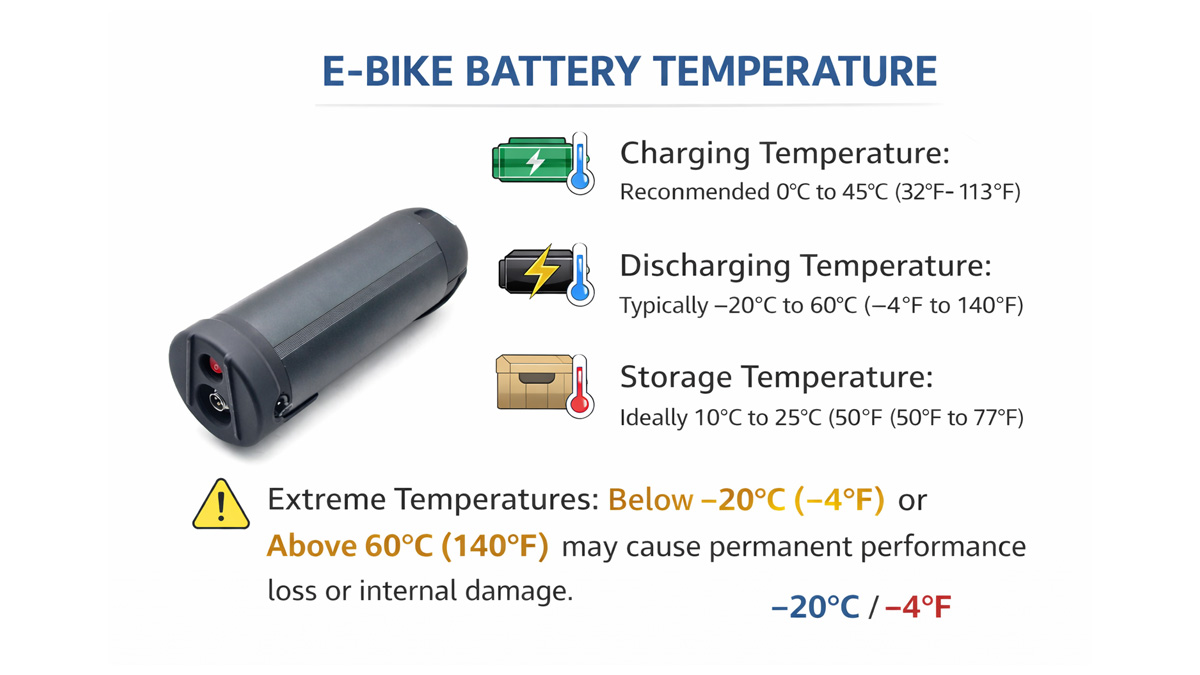
TemperatureTemperature has a direct impact on battery safety, performance, and overall stability. Lithium ebike batteries operate best within controlled temperature ranges, and extreme heat or cold can significantly affect charging, discharging, and storage.
Ebike batteries operate best within controlled temperature ranges.
• Charging temperature: Recommended 0°C to 45°C (32°F to 113°F). Charging below 0°C is not recommended.
• Discharging (operating) temperature: Typically –20°C to 60°C (–4°F to 140°F).
• Storage temperature: Ideally 10°C to 25°C (50°F to 77°F).
• Extreme temperature limits should be avoided. Below –20°C (–4°F) or above 60°C (140°F) may cause permanent performance loss or internal damage.
In cold conditions, available capacity temporarily decreases and range drops. In high temperatures, chemical aging accelerates, which can shorten battery lifespan and increase safety risks. Keeping the battery near room temperature whenever possible is the safest practice.
 Safety
Ebike battery safety is mostly about using the right product and building good habits. A high-quality pack, proper charging, and careful handling can greatly reduce the risk of fire or explosion, while correct storage and responsible disposal help prevent accidents and keep things safe at home. If you want a practical guide covering these topics in one place, check our
battery safety tips for everyday riders.
ConclusionEbike batteries are the core power source of any electric bike, directly influencing range, performance, and overall riding experience. Understanding the basics—such as battery types, capacity, range estimation, charging and discharging behavior, temperature limits, maintenance, and proper disposal—helps riders make informed decisions and avoid common misunderstandings.
While factors like installation position, size compatibility, and smart BMS features vary between models, the fundamental principles remain consistent: choose the right battery for your frame, follow proper charging habits, store it under suitable conditions, and maintain it regularly. By having a clear overview of how ebike batteries work and how they should be handled, riders can use their systems with greater confidence and fewer uncertainties in daily operation.
FAQ
How to Check Ebike Battery Voltage?
Use a digital multimeter set to DC voltage (typically 200V range). Place the red probe on the positive terminal and the black probe on the negative terminal—the reading shows the battery voltage. Avoid touching both terminals together to prevent short circuits.
What Type of Batteries Do Ebikes Use?Ebike batteries are usually classified by their mounting position, including downtube, rear rack, and integrated (in-frame) batteries. The right type depends on your bike’s design and compatibility.
How to Measure Ebike Battery Capacity?
Ebike battery capacity is measured in Ah or Wh, but accurately testing it requires professional equipment that performs controlled charge and discharge cycles. Some batteries with a smart BMS allow you to monitor capacity through an app or computer, making it easier to track performance.
What Size Battery for Ebike?Ebike batteries come in many sizes and styles, with no single standard option. The right choice depends on your bike design, required range, and compatibility, rather than just picking a popular size.
How to Discharge an E-bike Battery?Ebike battery discharging happens naturally when you ride the bike, as the battery releases energy to power the motor. For controlled discharge outside the bike, professional equipment is typically used for testing, maintenance, or storage preparation.