✅ Range
✅ Running Time
✅ Lifespan
✅ Tips to Extend Ebike Battery Life
✅ Conclusion
✅ FAQ
How long do ebike batteries last?
How many miles does an e bike battery last?
How many times can you charge an e bike battery?
How many hours does an ebike battery last?
How long does a 500W, 48V, or 36V ebike battery last?
Ebike battery range and battery life are two of the most important factors riders consider when choosing or maintaining an electric bike battery. Although these terms are often used interchangeably, they refer to different aspects of performance. Range determines how far you can ride on a single charge, while battery life reflects how long the battery will continue to perform effectively over time.
This article focuses on explaining the difference between ebike battery range and battery life, how they are measured, and why understanding both is essential for long-term performance and value

Range
Ebike battery range refers to how far an electric bike can travel on a single full charge. For most standard ebikes, the typical range is around 20–70 km (12–45 miles) per charge. However, this number can vary widely depending on battery capacity, motor power, assist level, terrain, rider weight, and riding style.
Many riders want to know a 500W or 48V or 36V battery The reality is that these questions cannot be answered with voltage or motor power alone. Battery range is determined by total energy (watt-hours, Wh), not just voltage (V) or motor rating (W).
To estimate your own ebike’s range, you can use this simple formula:
Estimated Range (km) = (Battery Wh ÷ Motor Power W) × Maximum Speed (km/h)
Let’s use a 48V 20Ah battery, 500W motor and maximum speed of 40 km/h as an example:
(48V × 20Ah ÷ 500W) × 40 km/h = 76.8 km (theoretical maximum range)
In other words, voltage, motor rating, and speed only influence range when combined with battery capacity and riding conditions. Otherwise, In real-world riding, factors like terrain, wind resistance, assist level, rider weight, and acceleration will reduce the actual range.
Running Time
An ebike battery typically lasts 1.5 to 4 hours per charge, depending on battery capacity (Wh), riding speed, terrain, rider weight, and power assist level.
However, the exact duration cannot be determined without knowing the battery’s total energy and the bike’s average power consumption.
The basic formula is:
Ride Time (hours) = Battery Capacity (Wh) ÷ Power Rating Of Motor (W)
Average power consumption depends on riding conditions and motor usage
For example: 48V 10Ah ebike battery, 350W motor.
48V × 10Ah ÷ 350W = 1.4hours
In real-world riding conditions, an ebike is rarely operated at maximum speed or full motor output continuously. Because of this, actual runtime is often longer than the theoretical estimate calculated using maximum power consumption. Most riders alternate between pedal assist levels, coast downhill, or reduce throttle input, which lowers the average power draw and extends total battery usage time.

Lifespan
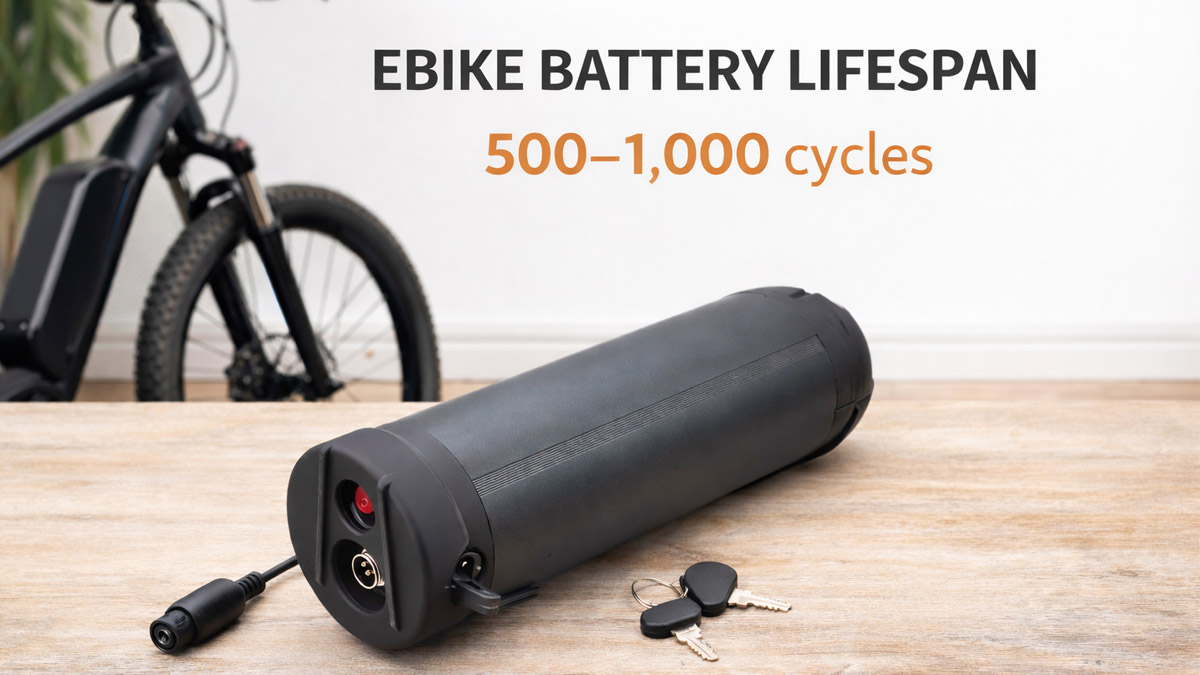
Ebike battery life is typically rated at 500–1,000 full charge cycles, after which capacity declines to around 70–80% of its original level. For most riders, this equals approximately 3–5 years of regular use, while high-quality batteries with premium cells and a reliable BMS can last 5–8 years under normal conditions.
However, actual lifespan depends on several key factors:
• Usage habits
Frequent deep discharges (running the battery close to 0%) accelerate degradation. Partial discharge cycles and avoiding extreme low battery levels help extend overall life.
• Charge and discharge current
High current draw during aggressive acceleration or climbing hills increases heat buildup. Similarly, frequent fast charging stresses the cells. Moderate current levels reduce internal wear and prolong cycle life.
• Storage temperature
Lithium batteries age faster in high temperatures. Long-term exposure above 30°C (86°F) can significantly shorten lifespan. Storing the battery in a cool, dry environment helps preserve capacity.
• Battery quality
Cell grade, internal resistance consistency, and the quality of the battery management system (BMS) directly impact durability. Higher-quality batteries generally maintain performance longer and degrade more slowly.
In summary, while 500–1,000 cycles is the standard benchmark, real-world battery life depends largely on how the battery is used, charged, stored, and manufactured.
Tips to Extend Ebike Battery Life
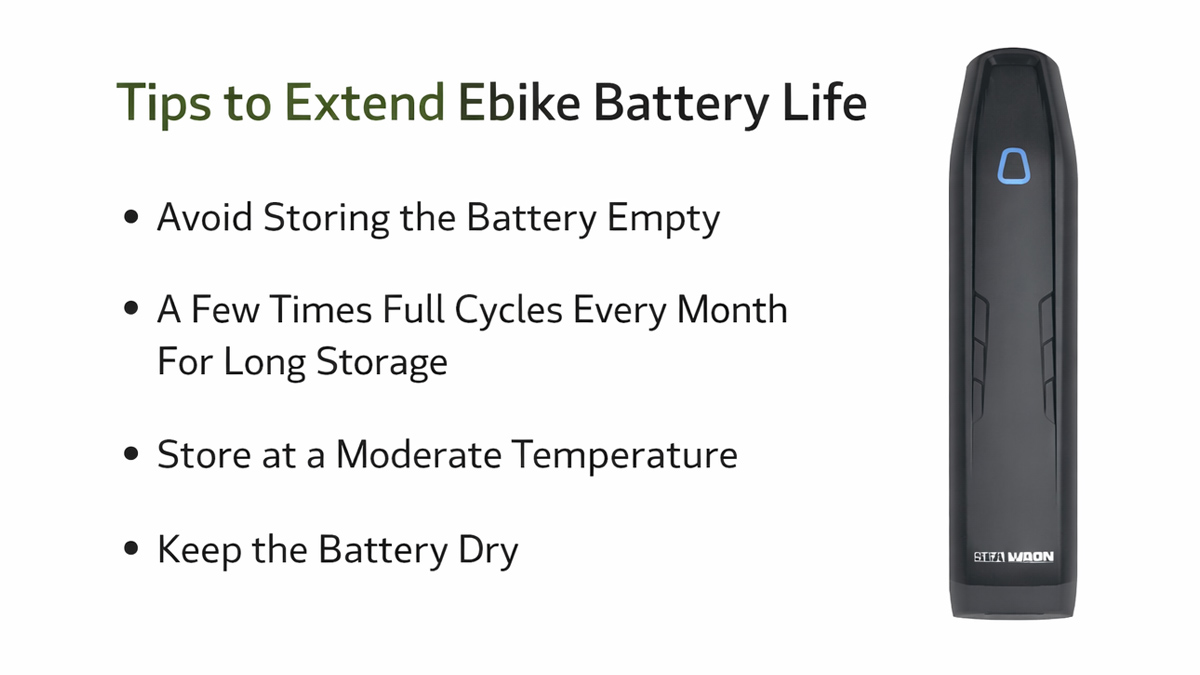
• Avoid Storing the Battery Empty
Do not store an ebike battery at 0% (or near empty) for long periods. Deep discharge during storage can lead to over-discharge, making the battery harder to recover and accelerating permanent capacity loss. For long-term storage, keep the battery around 40–60% charge, and top it up every 1–2 months to prevent it from dropping too low.
• A Few Times Full Cycles Every Month For Long Storage
When ebike battery is not used for a long time, performing a few cycles each month is beneficial for extending its lifespan. Many people might think that not using it is better. However, this is not the case. The lifespan and performance of lithium batteries will significantly decline if they are not used for a long time. On the other hand, using them occasionally is beneficial for the battery's lifespan and performance.
• Store at a Moderate Temperature
Temperature has a major impact on battery aging. Store the battery in a cool, dry place, ideally between 10°C and 25°C (50°F–77°F). Avoid prolonged exposure to high heat or freezing conditions.
• Keep the Battery Dry
While most ebike batteries have some level of water resistance, moisture intrusion can damage internal components and the BMS. Avoid heavy rain exposure when possible, and never store the battery in damp environments.
Conclusion
Ebike battery range and life are two different but equally important aspects of performance. Range determines how far or how long you can ride on a single charge, while battery life defines how many years or charge cycles the battery will deliver reliable performance.
Understanding the difference between these two concepts helps riders set realistic expectations, compare specifications correctly, and make smarter decisions when choosing or maintaining an ebike battery. By focusing on both range and long-term durability, you can achieve better efficiency, lower replacement costs, and more consistent riding performance over time.
FAQ
How long do ebike batteries last?
Most ebike batteries last 3–5 years, or about 500–1,000 charge cycles. With proper care, high-quality batteries can last up to 5–8 years before noticeable capacity loss.
How many miles does an e bike battery last?
Most ebike batteries provide 20–60 miles per charge. Actual range depends on battery capacity (Wh), riding speed, terrain, rider weight, and assist level.
How many times can you charge an e bike battery?
A standard lithium-ion ebike battery can typically be charged 500–1,000 times before capacity drops to around 70–80% of its original level.
How many hours does an ebike battery last?
An ebike battery usually runs for 1.5–4 hours per charge, depending on battery size and average power usage during riding.
How long does a 500W, 48V, or 36V ebike battery last?
It cannot be estimated based on motor power or voltage alone. To determine actual runtime or range, you need the battery voltage (V), capacity (Ah), total energy (Wh), motor power consumption, and the ebike’s top speed. Without these key parameters, there is no accurate way to calculate how long the battery will last.


