✅ Ebike Battery Replacement and Upgrade
• Voltage
• Motor Power and Battery Current Output
• Battery Size and Installation Position
• Using a Spare or Second Battery✅ DIY Ebike Battery: What You Must Understand Before Building One • Battery Cells and Series / Parallel Configuration
• Wiring Diagram: How Cells Are Connected✅ Ebike Battery Repair
• BMS Failure
• Cell Failure: Why Repair Is Not Recommended
✅ Maintenance✅ Battery Terminal & Connector Types✅ Conclusion✅ FAQElectric bike (ebike) batteries are the heart of your ride — they determine range, power consistency, safety, and lifespan. Whether you’re looking to replace an old battery, upgrade capacity, build your own battery pack, connect to a controller, or repair a failing pack, this guide gives you real, actionable techniques and safe procedures, not vague generalities.
Ebike Battery Replacement and UpgradeEbike battery replacement is one of the most common concerns for riders. This usually happens for three main reasons: the original lithium battery has degraded or failed, the battery has reached the end of its service life, or the rider wants more power and longer range through an upgrade. A typical ebike lithium battery consists of three core components:
• Battery cells – responsible for storing energy
• Battery Management System (BMS) – controls charging, discharging, and safety protection
• Battery enclosure (case) – provides structural support and protection
By connecting the cells in series and parallel, integrating a BMS, and placing everything into a protective housing, a complete ebike battery pack is formed.
• VoltageThe most commonly used ebike battery voltages include: 24V, 36V, 48V, 52V, 60V, 72V. Voltage determines the operating range of the motor and controller and is the first parameter that must be matched during replacement or upgrade.
Voltage Matching Is Critical, When replacing an ebike battery, voltage must match the original system: If the voltage is too low, the motor may produce weak power or fail to run at all. If the voltage is too high, the motor and, more importantly, the controller may be damaged. For example, some experienced riders purchase a 48V ebike and later consider upgrading to a 52V battery to gain stronger acceleration and slightly higher top speed. Because 48V and 52V systems are relatively close in voltage, this may work electrically, but only if the controller supports the higher voltage. In many cases, upgrading from 48V to 52V requires replacing the controller as well. From a safety and reliability standpoint, this practice is not recommended for most users. Best practice: Always prioritize a battery with the same voltage rating as the original system.
• Motor Power and Battery Current OutputOne of the most commonly overlooked specifications when replacing an ebike battery is maximum discharge current. Many first-time buyers do not realize that: The battery must supply enough current to match the motor’s power rating. Current output is controlled by the BMS, not just the cells. Manufacturers often ask about motor power (for example, 500W, 750W, or 1000W) because this helps determine the required current capacity of the battery. If the motor demands more current than the battery’s BMS allows: The BMS will trigger protection, the battery will suddenly cut off power. Providing accurate motor power information to the battery supplier is essential.
Important Note: At the same voltage: A battery designed for higher-power motors can safely run lower-power motors, The opposite is not true.
• Battery Size and Installation PositionEbike batteries are commonly classified by installation position:
• Front-mounted batteries
• Rear-mounted batteries
• Frame-integrated (internal) batteries
The final choice is usually shaped by how the battery fits the bike frame and power system across
a wide range of ebike designs, and most modern ebike batteries are supplied with complete mounting hardware such as rails, brackets, and locks, making installation straightforward as long as the size is appropriate.
• Using a Spare or Second BatteryMany ebike enthusiasts install two batteries on the same bike to significantly increase range and, in some cases, improve power delivery.
This setup is generally feasible if:
• There is sufficient physical space
• The batteries are properly connected (typically in parallel)
• Voltage compatibility is maintained
Adding a spare battery is a practical and common solution for long-distance riding and extended trips, provided proper wiring and protection are used.
DIY Ebike Battery: What You Must Understand Before Building OneMany ebike enthusiasts are interested in building a custom battery tailored to their specific riding needs. Before attempting any DIY ebike battery project, it is critical to understand that an ebike battery is not a simple electronic accessory. It is a high-energy system that requires proper design, materials, and safety control.
A complete ebike battery consists of three essential components: Battery cells, Battery Management System (BMS), Battery Case
Only when these three parts are correctly selected and integrated does a safe and functional ebike battery exist.
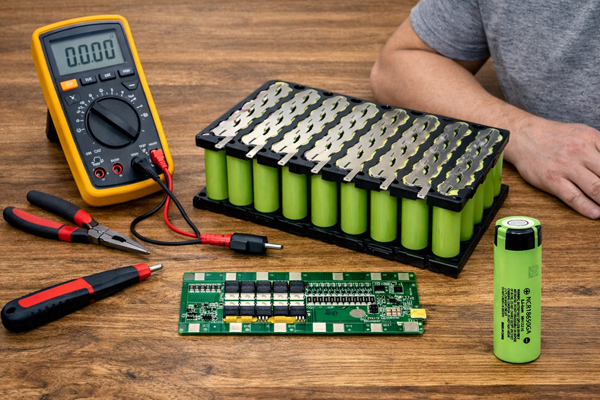 • Battery Cells and Series / Parallel Configuration
Battery Voltage (Series Count)
Battery voltage is usually fixed by the motor and controller, and this information should always be checked before designing a battery pack.
Most ebike batteries use ternary lithium-ion cells with a nominal voltage of 3.7 V per cell. Different system voltages correspond to different series (S) counts: 24V(7S), 36V(10S), 48V(13S), 52V(14S), 60V(16S), 72V(20S)
Selecting the correct series count is mandatory. A wrong voltage design will either result in weak performance or permanent damage to the controller and motor.
Battery Capacity and Cell Selection
Battery capacity depends on cell capacity and parallel (P) configuration.
Common Cell Options
18650 – 2600mAh: Best cost-performance option, widely used in ebike packs.
18650 – 3500mAh: Higher energy density, longer range, smaller and lighter pack. Maximum common 18650 capacity ≈ 3500 mAh
21700 – 5000mAh: Larger cells, higher capacity per cell, commonly used in newer designs. Maximum common 21700 capacity ≈ 5000 mAh
At present:
Higher-capacity cells (18650 4000 mAh, 21700 5800 mAh) are expected to become more common, but stability and consistency must always be verified.
Recommended Cell Brands, Based on industry reliability and consistency: Samsung, EVE, These brands currently offer the most stable quality for ebike use.
Calculating Parallel Groups (Capacity Example): Parallel Counts = Battery Capacity ÷ Cell Capacity
If you want a 20 Ah battery and choose 2600 mAh cells: 20Ah÷2.6Ah≈7.7, You would need 8 cells in parallel (8P).
Once series (S) and parallel (P) are determined, you can calculate the total number of cells required for the pack.
• Wiring Diagram: How Cells Are ConnectedProper wiring is the most critical and dangerous step in DIY battery construction.
• Correct Connection Order
• Cells should be connected in parallel first, then connected in series.
Each cell has a positive (+) and negative (−) terminal.
Parallel connection:
• Positive to positive
• Negative to negative
Series connection:
• Positive to negative
• Continue sequentially to reach total voltage
Insulation Is Critical
During assembly, insulation must be treated as a priority, not an afterthought.
Common causes of lithium battery failure and fire include:
• Exposed nickel strips
• Inadequate insulation between series groups
• Sharp edges cutting into cell wrappers
• Poor spacing between conductive parts
Even a small insulation mistake can result in internal short circuits, which are extremely dangerous.
Although DIY battery construction may appear cost-effective at first glance, it is not recommended for most users. Lithium batteries carry significant fire and explosion risk, Mistakes may not fail immediately, but weeks or months later, While material costs may be lower, labor time, tools, and safety risk make DIY packs effectively more expensive, Professional battery suppliers offer better consistency, testing, and long-term safety.
Ebike Battery RepairMost ebike battery failures generally fall into two main categories: BMS (protection board) failure and cell degradation or failure. These issues are closely related to how the battery is built as a sealed unit, where cells, connections, and control circuitry work together under electrical and thermal stress. Because of this integrated design, not all battery problems are repairable, and the feasibility of repair often depends on
how the battery is internally structured rather than on external symptoms alone.
• BMS FailureIf you open an ebike battery and measure each series group voltage: If all series voltages are similar, And most cell groups remain above 2.75 V, Then the cells are likely still healthy.
Next steps: Measure total battery voltage before the BMS, Measure total voltage after the BMS output, If Input voltage is normal, Output voltage is extremely low or near zero, Then the BMS is likely defective.
Repair Method: Replace the BMS with: The same model or A compatible BMS with identical series count and current rating, This type of repair is relatively straightforward and cost-effective.
• Cell Failure: Why Repair Is Not RecommendedFrom professional manufacturing experience, cell replacement is generally not recommended.
If a cell fails without external damage, it usually indicates: A defect in that cell model or batch or overall pack aging and imbalance
Replacing one failed cell often leads to: Another cell failing soon after, Continuous instability across the pack, For this reason, replacing individual cells is rarely a long-term solution.
Other Common Repairable Issues, Some problems are minor and easy to fix, such as: Connector damage, Loose terminals, Battery level display failure, USB port malfunction, These repairs are typically simple, inexpensive, and safe when done correctly.
DIY ebike batteries are technically possible but carry serious safety responsibilities. Battery repair should focus on BMS and external components, not internal cell replacement. For most riders, purchasing a professionally built replacement battery remains the safest and most reliable choice.
MaintenanceLong periods of inactivity can significantly reduce ebike battery performance if proper care is not taken. Lithium-ion batteries are not designed to sit unused for extended time, and leaving a battery idle for months can accelerate capacity loss and imbalance between cell groups. To maintain battery health, it is recommended to use or cycle the battery periodically, even if the ebike is not ridden regularly. A light discharge followed by proper charging helps keep the internal chemistry active and stable.
Environmental protection is equally important. Ebike batteries should be stored in a dry, well-ventilated area, away from moisture, water exposure, and high humidity. Excessive heat is especially harmful — prolonged exposure to high temperatures can permanently degrade cell capacity and shorten overall lifespan.
If conditions allow, using a cell balancer or balance charger occasionally can further improve long-term performance. Periodic balancing helps keep voltage differences between series cell groups minimal, reducing stress on the BMS and allowing the battery to deliver more consistent power over time.
Proper maintenance does not require complex procedures, but consistent care can noticeably extend battery life and reliability.
Battery Terminal & Connector Types
| Connector Type |
Typical Current |
Best For |
Notes |
| XT60 |
~60A |
Moderate power setups |
Lightweight, easy to solder |
| XT90 |
~90A |
High-current mid-range eBikes |
Anti-spark variants reduce arcing |
| Anderson Powerpole |
30–120A |
Custom packs and DIY |
Modular and robust |
| Bullet Connectors (3.5–8mm) |
30–80A |
Older ebikes |
Must be tight-fit to avoid heat |
| EnergyBus 6-pin standard |
up to 30A |
Smart battery data + power |
Includes CAN/communications lines for some systems |
Connector Best Practices: Use high-quality silicon wire (10–12 AWG typical for 48V ebike), Heat-shrink every solder joint, Always check polarity with a multimeter after crimp/solder
ConclusionReplacing or upgrading an ebike battery doesn’t need to be a black box full of guesswork if you understand voltage, connectors, controller wiring, and safety. DIY battery builds are possible, but only with proper tools, BMS knowledge, and respect for the dangers of lithium cells. Connectors, polarity, and a solid harness make the difference between a reliable ebike and one that leaves you stranded — or worse, overheats.
FAQWhat voltage ebike battery should I choose?You should always choose a battery with the same voltage as your original system to avoid insufficient power or damage to the controller and motor.
Can I upgrade from a 48V battery to 52V?A 52V battery may work on some 48V systems, but it often requires a compatible controller and is not recommended for safety reasons.
Does motor power affect battery selection?Yes, the battery’s maximum discharge current must match the motor’s power requirement or the BMS may cut off power.
Can a higher-power battery run a lower-power motor?Yes, at the same voltage a battery designed for higher power can safely run a lower-power motor.
Can I install a second or spare ebike battery?Yes, installing a spare battery is common for extending range, provided there is enough space and the batteries are properly connected.
Is DIY ebike battery building recommended?DIY ebike battery building is not recommended for most users due to safety risks, insulation challenges, and long-term reliability concerns.
Can you use an ebike without a battery?No, an ebike motor requires battery power to operate, and without a battery the bike can only be ridden as a normal pedal bicycle.
Are ebike batteries interchangeable?No, ebike batteries are not universal and must match voltage, controller compatibility, current output, physical size, and connector type.
Can you connect ebike batteries in series vs parallel?Series connection increases voltage and is generally not recommended, while parallel connection increases capacity and is safer when batteries share the same voltage and similar state of charge.
Buying used ebike batteries: is it worth it?Buying used ebike batteries is risky because remaining capacity, internal cell health, and BMS condition are usually unknown.
How to tell if an ebike battery is bad?Common signs include rapid range loss, voltage drop under load, frequent power cut-offs, or the battery failing to charge fully.
How to reset an ebike battery?There is no universal reset function, but some BMS protections can recover after proper recharging if the cells are still within a safe voltage range.


