Lithium batteries are used in a wide range of everyday devices, from smartphones and power banks to power tools and e-bikes. Because they store a large amount of energy in a small space, many people are concerned about how to charge lithium batteries safely, especially when charging at home.
In normal use, lithium batteries are stable and reliable. Most charging-related accidents are not caused by the battery itself, but by incorrect chargers, mismatched voltage or current, or poor-quality battery products. When the correct charging method is used, lithium batteries can be charged safely without unnecessary risk.
Understanding a few basic charging principles makes a big difference. Using the right charger, knowing when to charge, and avoiding common mistakes can help prevent safety issues while also extending battery life. With proper charging habits, lithium batteries are well suited for daily use and long-term reliability.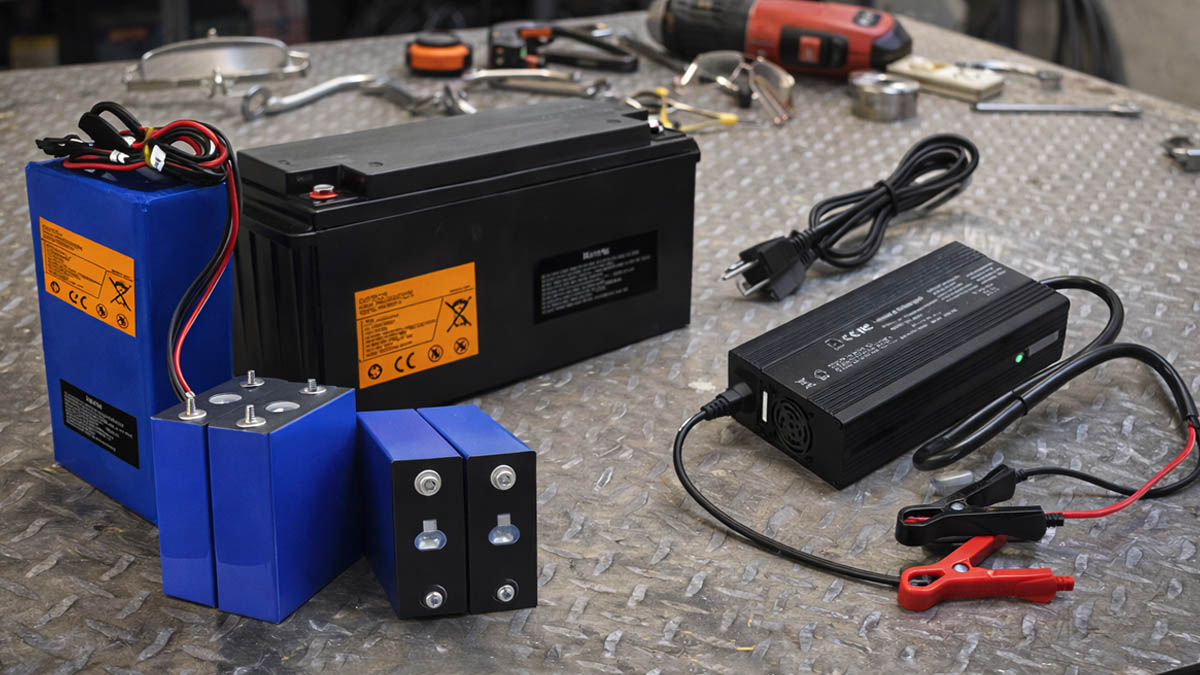
Charging a lithium battery is simple. In most cases, you only need to use a proper, compatible charger, and there is no need to worry too much beyond that. Lithium batteries are widely used in many electronic products today, If you understand the basic principles of lithium batteries, you’ll have far fewer concerns. and although occasional safety incidents do occur, they are generally very safe when used correctly.
The main risk comes from using the wrong charger or attempting DIY charging setups. For most users, there is little reason to do this. Chargers for lithium batteries are widely available, affordable, and designed specifically for safe everyday use. Using a proper charger is the easiest and safest way to avoid unnecessary problems.
• Charging at Home
Charging time is usually very easy to estimate. Charging time = battery capacity (Ah) ÷ charger current (A) + 1 . Why adding 1?
• Charger Current
One reason is that the real current of charger is smaller than standard current. For example, a charger labeled as 5A may actually charge at around 4.7A, and a 10A charger may deliver closer to 9.5A under normal conditions.
• Trickle Charging
The other reason is the trickle charging. As the battery gets closer to full, the charging current gradually decreases. This final stage is often called taper or trickle charging, where charging slows down to safely bring the battery to 100%. Because of this, the last part of charging always takes longer than expected.
For example:
A 10 Ah battery charged at 5 A takes about 3 hours
For lithium batteries, the commonly recommended charging current is below 0.5C, which means charging at no more than half of the battery’s capacity (Ah) . For example, a 20Ah lithium battery can generally be charged safely with a charger rated at 10A or lower.
• Choose a Charger 0.2-0.3C is Better
That said, a more conservative and safer recommendation is to use a charger in the 0.2C to 0.3C range whenever possible. Using the same example, this would mean a charging current of around 4A to 6A for a 20Ah battery. The reason for this is simple. Battery quality can vary, especially with products from different manufacturers or price ranges. Charging at a lower current puts less stress on the battery, generates less heat, and is generally more forgiving. While faster charging may be supported, using a slightly smaller charging current is usually better for long-term reliability and everyday use.
• Is It Better to Charge Slowly
It is also worth noting that higher current, whether during charging or discharging, will shorten the lifespan of a lithium battery. This is determined by the materials used inside the battery and is a normal characteristic of lithium battery chemistry. Higher current creates more stress and heat inside the cells, which gradually accelerates aging over time. Because of this, charging current becomes an important factor to consider. The choice is usually between faster charging and longer battery life. Using a lower charging current may take more time, but it is generally gentler on the battery and helps it last longer in everyday use. Charge State of a Lithium Battery
If a lithium battery does not have a built-in charge indicator, the simplest way to check the charge level is to use a multimeter to measure the voltage.
Different voltages correspond to different charge state. However, lithium batteries have different series. The higher series, the higher voltage. Below, we will list the voltage vs charge state of single serie. Then, once you know the seires of your battery, you can caculate the voltage vs charge state. Then, by measuring the voltage with a multimeter, you can know the power enengy.
For example, if your battery is labeled 48V, you can find the series count on the right side of the table, which is usually 13 cells in series (13S). To estimate the full charge voltage, look at the left side of the table and calculate:
13 × 4.2V = 54.6V
This means a fully charged 48V lithium battery is around 54.6V.
To estimate the empty voltage, you can use:
13 × 3.0V = 39V
So when the battery is close to empty, the voltage is roughly 39V.
Keep in mind that this method is only an estimate, not an exact measurement. In real use, the charger may turn green at 54.2V instead of 54.6V, which is normal and not a problem. At low charge levels, voltage can also fluctuate a lot. A battery may appear empty at 41V or even 37V, and this is still normal. This voltage-based method is meant to give a general idea of the charge level, not a precise reading. The charge level in the middle is the same caculation.
| Single Serie Voltage VS Charge State | Battery Voltage VS Series | |||
| 100% | 4.2V | 1S | 3.7V | |
| 90% | 4.1V | 2S | 7.4V | |
| 80% | 4.0V | 3S | 11.1V | |
| 70% | 3.9V | 4S | 14.8V | |
| 60% | 3.8V | 6S | 22V | |
| 50% | 3.7V | 7S | 24V | |
| 40% | 3.6V | 10S | 36V | |
| 30% | 3.5V | 13S | 48V | |
| 20% | 3.4V | 14S | 52V | |
| 10% | 3.3V | 16S | 60V | |
| 0% | 3.0V | 20S | 72V | |
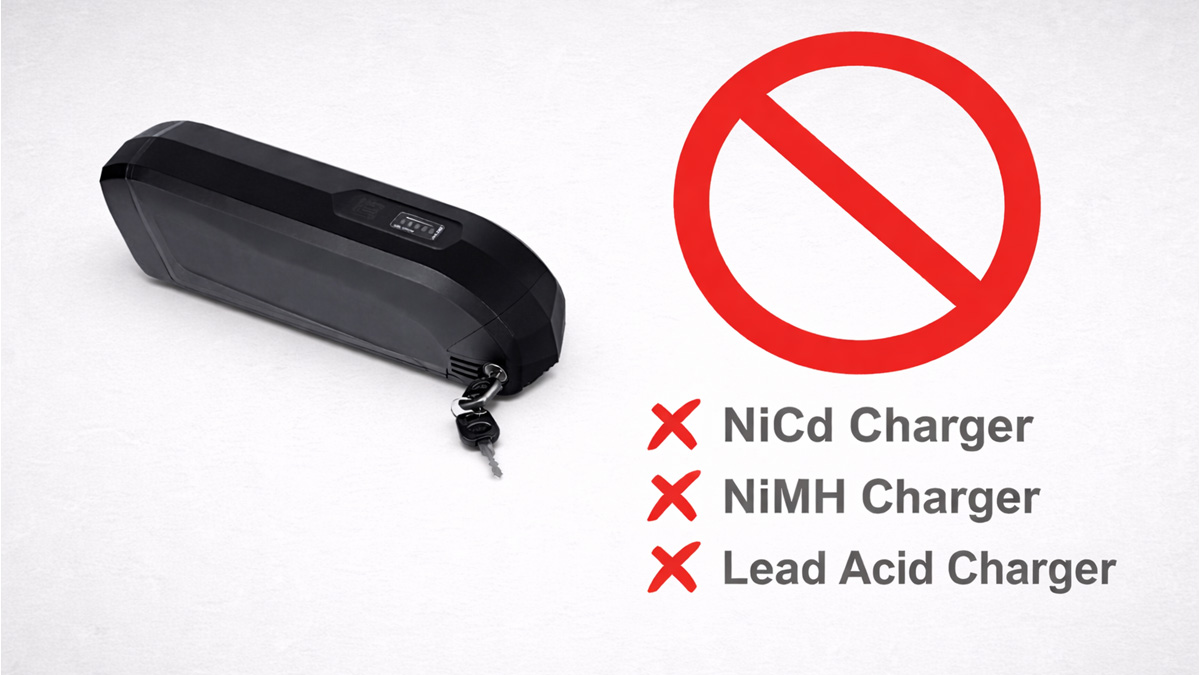
Lithium batteries require dedicated lithium battery chargers, and both voltage and current must be properly matched. different voltage Lithium batteries need different voltage chargers. Charging current should also stay within safe limits, usually below half of the battery’s capacity.
• Can I Charge with a Normal ChargerNo. A lithium battery should be charged with a special lithium battery charger that matches both the voltage and current requirements. Even if a normal charger has the same labeled voltage—for example, a 48V charger for a 48V battery—it is still not recommended. Different chargers use different charging profiles, and a non-lithium charger will often fail to charge the battery properly. In many cases, the battery will not reach full charge, and long-term use may also affect performance and reliability.
• Can I Charge with a Lead-Acid (AGM or GEL) Charger
No. Even though charging lead-acid batteries may look similar to charging lithium batteries, the two are not compatible. Lithium batteries require a dedicated lithium charger with the correct voltage limits and charging profile. AGM and gel chargers are designed for lead-acid chemistry and operate differently, especially near full charge.
Some users try to reuse their existing lead-acid charger when switching to lithium batteries in order to save money. This is not recommended. Using a lead-acid charger may prevent the lithium battery from charging properly and, over time, can damage the battery. In more serious cases, incorrect charging can create safety risks such as overheating or fire. Using the correct lithium charger is the safest and most reliable option.
• Can I Use NiCd or NiMH to Charge
No. Although NiCd, NiMH, and lithium batteries are all rechargeable, their charging methods are very different, and their chargers are not interchangeable. NiCd and NiMH chargers use different voltage detection and charging control methods that are not suitable for lithium batteries. Using these chargers will not charge a lithium battery correctly and may damage the battery. Lithium batteries should always be charged with a charger designed specifically for lithium battery chemistry.
• Can I Use Alternator to Charge
No, connecting a lithium battery directly to an alternator or a raw power source is extremely dangerous and can lead to fire or explosion.
Using an alternator to charge lithium batteries without a dedicated DC-to-DC charger is a major safety risk. The "raw" current from an alternator is unstable, and unlike lead-acid batteries, lithium cells cannot self-regulate the high-amperage input. Furthermore, attempting to use AC mains power (110V-240V) without a proper transformer will instantly destroy the battery's internal structure, causing a thermal runaway. Always use a BMS-controlled charger to convert and regulate the voltage to the required 3V-72V range for your electronics. Charging Habits and Safety Concerns
Most everyday charging habits have little impact on lithium batteries. Many people worry that certain habits might damage the battery, but in most cases, this is not an issue. These concerns often come from past experience with lead-acid or NiMH batteries, which have more limitations and can lose lifespan quickly if used improperly. Lithium batteries are different. As a more advanced battery technology, they include built-in protection mechanisms that help prevent damage and keep the battery operating safely under normal charging conditions.
• Leaving a Lithium Battery on the Charger
In most cases, leaving a lithium battery on the charger is not a problem and wont short lifecycle. Both the charger and the battery itself have built-in protection systems that prevent the battery from exceeding safe voltage limits. This double layer of protection makes overcharging very unlikely during normal use.
That said, there is still a very small potential risk, such as a charger malfunction or a battery fault. While the chance of this happening is extremely low, unplugging the charger once charging is complete is still a good habit. It adds an extra layer of safety, and when it comes to batteries, safety should always come first.
• The Effects of Keeping a Lithium Battery Fully Charged
In most cases, keeping a lithium battery fully charged all the time is not a problems or hurts the battery. This is because lithium batteries are equipped with a built-in protection system that limits overcharging. What we usually consider “fully charged” is not the absolute maximum the battery could theoretically reach. Charging beyond that point would increase safety risks, which is why the battery protection system sets a strict voltage limit.
When using a proper charger, it is not possible to exceed this safe upper voltage. A common example is a laptop computer. If a laptop is kept plugged in at home for long periods, the battery often stays at or near full charge. This situation is generally safe and is managed by the battery’s internal protection and charging control system.
Charging a lithium battery safely does not require complicated procedures or special routines. Unlike older battery technologies, lithium batteries do not need to be fully charged before first use, nor do they need to be completely discharged before recharging. For most users, charging whenever it is convenient is perfectly acceptable.
The key to safe charging is using a charger that matches the battery’s voltage and current requirements, avoiding low-quality or incompatible charging devices, and charging in appropriate environments. For long-term storage, occasional charging helps maintain battery balance, but no strict charging schedule is necessary for regular use.
By following proper charging methods and avoiding common misconceptions, lithium batteries can be used safely, efficiently, and reliably in everyday applications.


