✅ LiPo Battery Definition & Meaning✅ Chemistry And Composition✅ Voltage✅ Charging✅ Discharging✅ C Rating✅ Types ✅ LiPo Pack Configuration✅ Lifespan✅ Common Problems And Fixing✅ Checking And Measuring✅ Advantages ✅ Disadvantages✅ Maintenance And Care Tips✅ Storage✅ Operating Temperature Limits✅ Safety: Fire, Explosion & Burning✅ Disposal & Recycling✅ FAQ What is a lipo battery? How to dispose a lipo battery? What is the c rating on a lipo battery? How long do lipo batteries last? Where to dispose of lipo batteries?
A LiPo battery, short for lithium polymer battery, is a rechargeable battery known for its thin shape, light weight, and flexible size options. It is widely used in drones, RC models, smartphones, tablets, wearable devices, and other compact electronics where space and weight matter.
Unlike many cylindrical lithium-ion cells, LiPo batteries usually use a soft pouch structure, which allows manufacturers to customize the battery shape, thickness, and capacity more easily. To understand where LiPo fits within
broader lithium battery technology, it helps to look at its structure, voltage, advantages, limitations, and common applications.
LiPo Battery Definition & MeaningA LiPo battery (Lithium Polymer battery) is a type of rechargeable lithium battery that uses a polymer-based electrolyte and a soft pouch casing instead of a rigid metal shell.
Because of this design, LiPo batteries can be made in many different shapes and sizes and are widely used in smartphones, drones, RC models, wearables, and other compact electronic devices.
LiPo batteries are known for their light weight, flexible form factor, high energy density, and wide range of discharge rates, but they also require proper charging, handling, and storage to ensure safety and long service life.
Chemistry & Composition
LiPo batteries use a lithium-based chemistry similar to conventional lithium-ion batteries, but with a key difference in structure. Instead of a liquid electrolyte and rigid metal casing, LiPo batteries use a polymer electrolyte and a flexible aluminum-plastic pouch.
Inside a LiPo battery, the main components include:
• A lithium metal oxide cathode
• A carbon-based anode
• A polymer or gel electrolyte that allows lithium ions to move between electrodes
• Thin internal separators stacked in layers
This layered pouch design allows LiPo batteries to be lighter and thinner than metal-cased lithium batteries, while also enabling flexible shapes. However, the same structure provides less mechanical protection, which is why LiPo batteries are more sensitive to damage, heat, and improper handling.
Voltage
LiPo batteries operate within specific voltage ranges depending on the number of cells connected in series. Each individual cell has a nominal voltage of 3.7 V, reaches 4.2 V when fully charged, and should not be discharged below about 3.0 V. Understanding these values is essential because the total pack voltage increases as more cells are added, which directly affects performance, compatibility, and safety.
To better understand how voltage changes with different configurations, this explanation of LiPo battery voltage levels and cell count shows how single-cell and multi-cell packs behave in real-world applications. Knowing these voltage characteristics helps ensure proper battery selection, safe charging, and reliable operation in devices ranging from RC models to electric mobility systems
Charging
LiPo battery charging refers to the process of restoring energy to the battery using controlled voltage and current to prevent cell damage or safety risks.
For recommended voltage ranges and safe practices, see our guide on
LiPo battery charging guidelines.
Discharging
LiPo battery discharging refers to the process of releasing stored energy from the battery during use, which directly affects cell stability, lifespan, and safety. Improper
LiPo battery discharging—especially allowing voltage to drop below safe limits—can cause permanent damage such as capacity loss, cell imbalance, or swelling.
C Rating
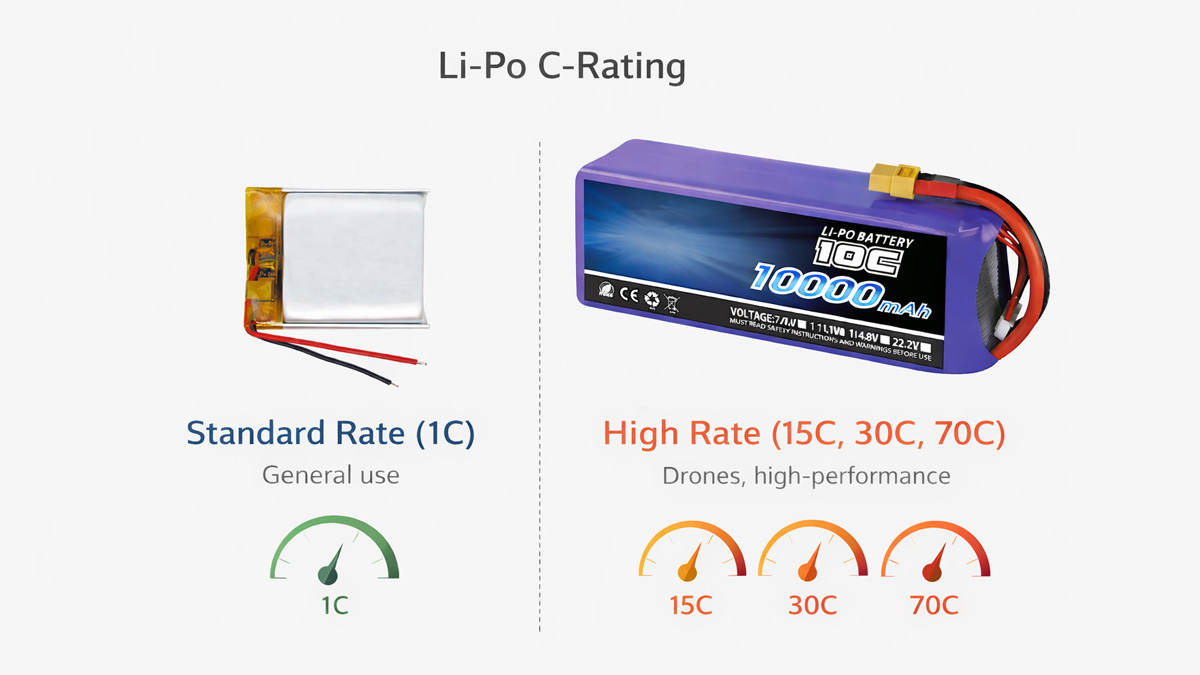
C rating describes how much current a LiPo battery can safely deliver relative to its capacity, which directly affects performance in high-load applications. In setups that demand rapid power output, such as RC cars and drones,
high-discharge LiPo battery options are commonly used to handle large current draw without excessive voltage drop.
• C Rating Calculator: Current (A) = Capacity (Ah) × Charge C rating
• Charge C Rating
Formula: Charge current (A) = Capacity (Ah) × Charge C rating
Example: 2000 mAh (2 Ah) at 1C → 2 A
Most LiPo batteries are charged at 0.5C–1C, unless stated otherwise.
• Discharge C Rating
Formula: Discharge current (A) = Capacity (Ah) × Discharge C rating
Example: 2000 mAh (2 Ah) at 20C → 40 A
High-discharge LiPo batteries for RC and drones are commonly 20C, 30C, 40C, or higher.
• Maximum Limits
Do not exceed the maximum charge or discharge C rating specified by the manufacturer. Going beyond these limits can cause overheating, swelling, or permanent damage.
Types
LiPo batteries come in different designs to suit various devices and space requirements. They can be grouped by shape, discharge performance, and application needs. For an overview of available options and form factors, you can explore our
range of LiPo battery solutions.
By Battery Chemistry
• Most LiPo batteries on the market use ternary lithium chemistry (NCM / NCA) with a nominal voltage of 3.7 V per cell. This type offers a good balance of energy density, discharge performance, and size, which is why it dominates consumer electronics, RC, and drone applications.
• LiFePO₄ (lithium iron phosphate) polymer cells, with a nominal voltage of 3.2 V per cell, do exist, but they are rare in pouch-type LiPo form. In practice, the vast majority of LiPo batteries are ternary lithium-based rather than LiFePO₄.
By Nominal Voltage
• 3.7 V – standard LiPo voltage, most common
• 3.8 V – higher-voltage LiPo, optimized for increased energy density
• 3.85 V – high-voltage LiPo (HV LiPo), requires compatible chargers and devices
• LiPo battery packs are commonly classified by series count (S), with a nominal voltage of 3.7 V per cell: 1S (3.7 V), 2S (7.4 V), 3S (11.1 V / 12 V), 4S (14.8 V), 5S (18.5 V), 6S (22.2 V), 7S (25.9 V / 24 V), 8S (29.6 V).
By Discharge Rate (C-Rate)
• High-discharge LiPo batteries (20C, 30C, 40C and above), Designed for RC cars, drones, and other applications that require high current output and fast response.
• Low-discharge LiPo batteries (around 1C), Used in most consumer electronics such as Bluetooth earphones, power banks, and portable devices, where stable output and longer runtime are more important than high peak current.
By Shape
• Standard LiPo batteries: regular rectangular pouch cells used in most applications
•
Irregular-shaped LiPo batteries: designed to fit special spaces, including curved, round, and super-thin LiPo batteries
LiPo Pack Configuration
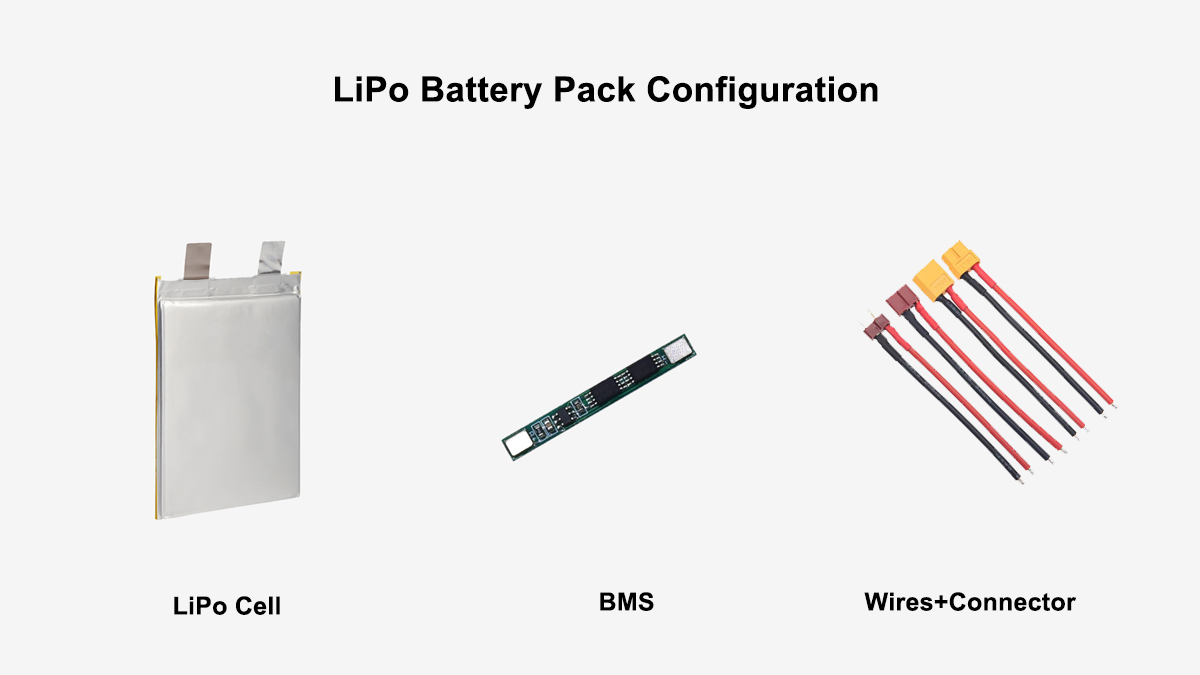
A LiPo battery pack is made up of Cells+BMS+Wires+Connector. In most consumer and industrial battery packs, a protection board is built into the pack to manage charging and discharging safely.
For RC cars and drones, LiPo packs usually do not include a protection board. Instead, protection and voltage control are handled by the RC system, ESC, or flight controller.
Each LiPo cell has a nominal voltage of 3.7V.
| Configuration |
Nominal Voltage |
| 1S |
3.7V |
| 2S |
7.4V |
| 3S |
11.1V (12V) |
| 4S |
14.8V |
| 6S |
22.2V |
| 7S |
25.9V (24V) |
| 8S |
29.6V |
Series (S)
• Increases voltage
• Capacity remains the same
Pack Voltage = 3.7V × ?S
Example:
3S Battery: 3 × 3.7 V = 11.1 V, capacity unchanged.Parallel (P)
• Increases capacity
• Voltage remains the same
Pack Capacity = Cell Capacity × ?P
Example:
Cell Capacity = 2000mAh 3P Battery: 3 × 2000mAh = 6000mAh, Voltage unchanged.
 Lifespan
LiPo battery life describes how long a battery can deliver reliable capacity and performance before aging makes it unsuitable for regular use. Unlike some other battery types, LiPo batteries age from the moment they are manufactured, meaning their lifespan is affected by both usage cycles and time, even if the battery is rarely used.
• Typical cycle life: 300–500 charge cycles
• Typical service life: 2–5 years under normal conditions
• Calendar aging: capacity decreases every year, even if the battery is not used
Factors that determine LiPo battery life:
• Charge voltage: frequent charging to 4.2 V per cell shortens lifespan
• Charge rate: charging above 1C accelerates aging
• Discharge rate: high continuous discharge (high C rating load) reduces cycle life
• Depth of discharge: repeated discharge below 3.2 V per cell shortens lifespan
• Operating temperature: temperatures above 40 °C significantly speed up degradation
• Storage voltage: long-term storage outside 3.7–3.85 V per cell increases aging
• Storage temperature: best kept at 15–25 °C, heat shortens life even when unused
End-of-life indicators:
• Capacity drops below 70–80% of original
• Noticeable voltage sag under normal load
• Increased internal resistance or cell imbalance
Common Problems And Fixing
If you're experiencing issues like charging failure, fast voltage drop, swelling, or imbalance, it's important to first understand the root cause before attempting any fix. LiPo batteries are sensitive systems where small faults—such as a weak cell, improper charging settings, or poor storage conditions—can quickly lead to bigger problems. For a complete breakdown of all common failure types, causes, and solutions, check out
common lipo battery problems, where we cover everything from diagnosis to safe fixing and maintenance best practices.
Checking & Measuring• Visual Inspection
Start by checking the battery’s appearance. Look for swelling, deformation, damage to the pouch, loose wires, or damaged connectors. Any visible swelling or physical damage is a sign the battery should not be used.
• Voltage Check
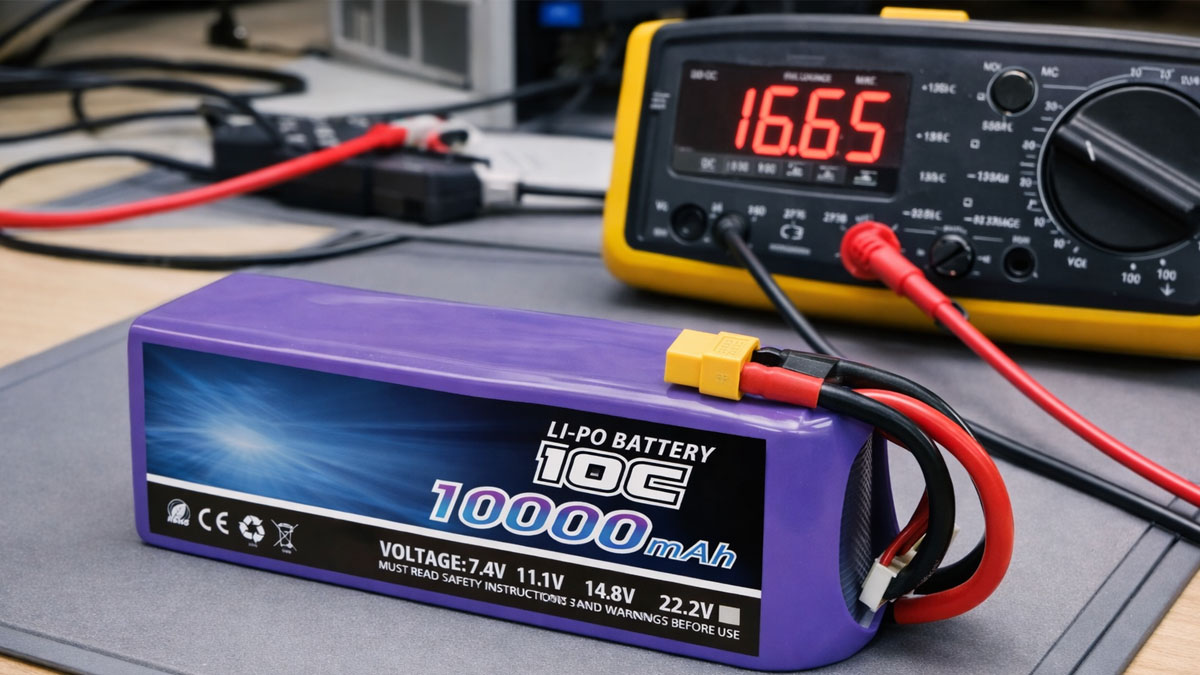
Measure the total pack voltage and the voltage of each cell (each series). Cell voltages should be closely matched. In normal condition, the voltage difference between cells is typically within 10 mV (0.01 V). Larger differences usually indicate imbalance or aging.
• Internal Resistance Check
Measure the internal resistance of each cell. The resistance values should be consistent across all cells. A difference of within 5 mΩ between cells is generally acceptable. Higher or uneven internal resistance indicates cell degradation.
• Capacity Test
Battery capacity cannot be accurately judged by voltage alone. To measure actual capacity, a capacity tester or battery analyzer is required. The battery is discharged under controlled conditions to determine how much capacity it can deliver.
• Flexible shape and size design
LiPo batteries use pouch cells instead of rigid metal casings, allowing manufacturers to customize battery size and shape based on internal product dimensions. This flexibility enables LiPo batteries to serve a wide range of small and medium-sized electronic devices, covering a significant portion of today’s consumer electronics market.
• Different discharge rates for different applications
LiPo batteries are available in multiple discharge rates to match specific power requirements:High C-rate LiPo batteries for drones, RC vehicles, and other high-current applications, Low C-rate LiPo batteries for Bluetooth earphones, power banks, and portable electronics
• No memory effect
Unlike Ni-Cd and Ni-MH batteries, LiPo batteries have no memory effect. Users can recharge at any time without reducing usable capacity, which is a key reason LiPo technology has largely replaced older nickel-based batteries.
Disadvantages• Easily Damaged by Puncture or Impact
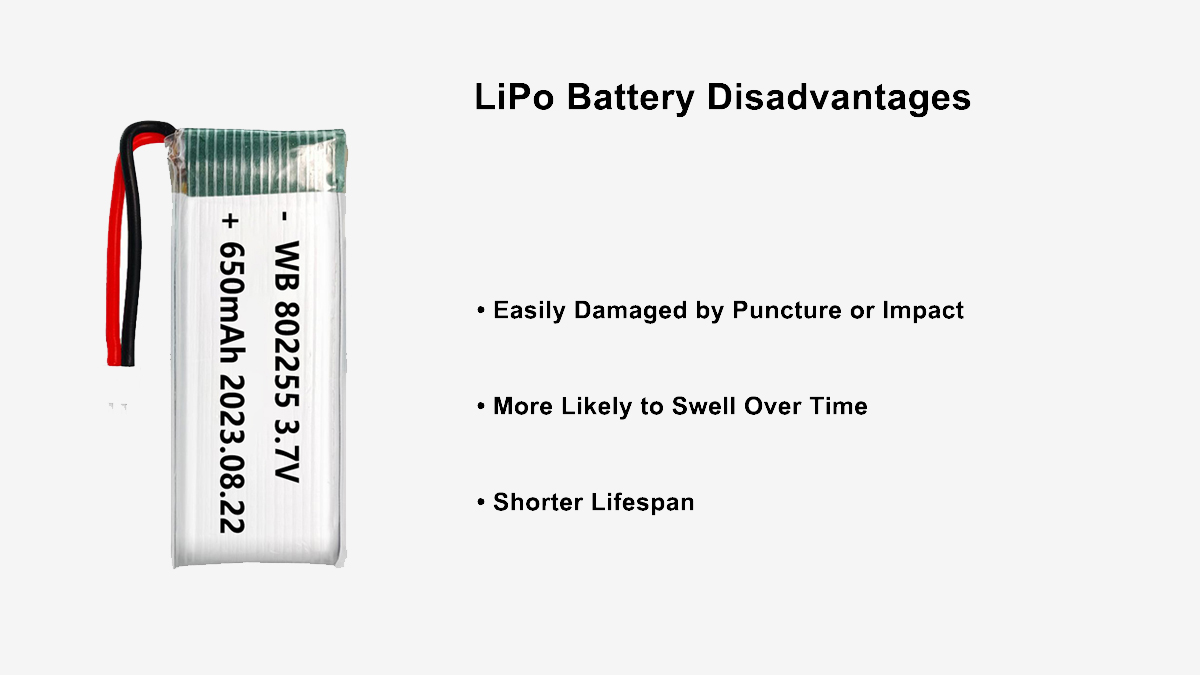
LiPo batteries use a soft aluminum-plastic pouch instead of a hard metal case. Because of this, they can be damaged more easily by sharp objects, squeezing, or strong impact. If the pouch is punctured or crushed, the internal layers may short-circuit, which can damage the battery and, in extreme cases, cause a fire.
• More Likely to Swell Over Time
Unlike metal-cased batteries, LiPo batteries do not have a rigid shell to hold the internal structure tightly in place. During long-term use, small amounts of gas can form inside the battery due to normal aging and chemical reactions. ince the pouch cannot resist internal pressure very well, this gas buildup often causes the battery to swell.
• Shorter Lifespan
The soft pouch design also affects battery lifespan. As a LiPo battery charges and discharges, its internal materials slightly expand and contract. Without a strong outer shell to limit this movement, the internal structure wears out faster over time.
 Maintenance And Care Tips
• Use a charger designed specifically for LiPo batteries. (Charge voltage: max 4.20 V per cell)
• Set the correct cell count and charging voltage. (Cell mismatch or over 4.20 V per cell can cause damage)
• Avoid charging at excessively high current. (Recommended charge rate: 0.5C–1C)
• Do not fully discharge the battery during use. (Stop use at 2.75V per cell; absolute minimum 3.0 V)
• Avoid extreme heat and cold conditions. (Operating range: −20–60 °C / −4–140 °F)
• Allow the battery to cool before recharging. (Charge only when battery temperature is below 45 °C / 113 °F)
• Store at a moderate charge level for long periods. (Storage voltage: 3.7–3.85 V per cell)
• Do not store fully charged or fully discharged. (Avoid long-term storage at 4.2 V or below 3.5 V per cell)
• Inspect regularly for swelling or physical damage. (Any visible puffing = remove from service)
• Stop using the battery if it becomes swollen, damaged, or overheats. (Surface temperature above 60 °C / 140 °F is unsafe)
StorageProper LiPo battery storage plays an important role in reducing aging and safety risks. For detailed guidelines on storage voltage, temperature, and long-term handling, see the dedicated
LiPo battery storage guide.
• Store LiPo batteries at a storage voltage of 3.7–3.85 V per cell
• Do not store batteries fully charged (4.2 V) or fully discharged
• Recommended storage temperature: 15–25 °C (59–77 °F)
• Avoid high heat, freezing conditions, and direct sunlight
• Store in a dry, fire-resistant location
• Keep batteries away from sharp objects and physical pressure
• Check stored batteries periodically for voltage drop or swelling
Operating Temperature Limits
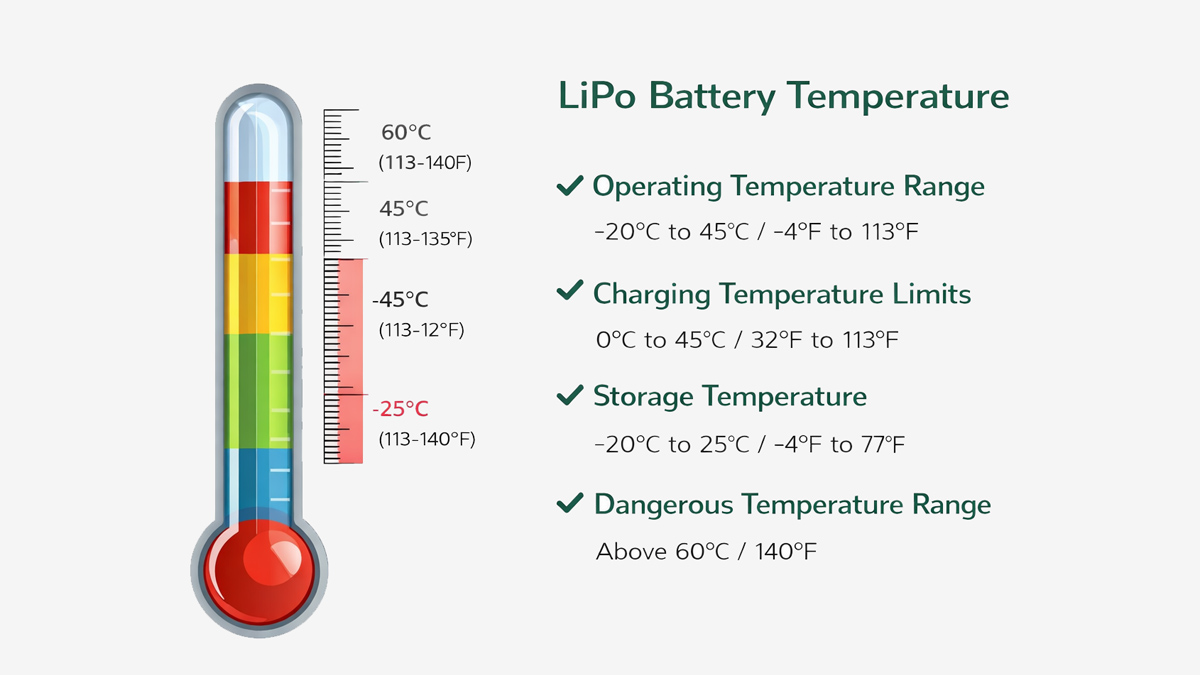
Temperature has a direct impact on LiPo battery safety, performance, and lifespan. Operating or storing a LiPo battery outside the recommended temperature range can increase the risk of fire, swelling (expansion), leakage, and permanent damage.
Operating Temperature Range
• Recommended operating temperature: −20 to 60 °C (−4 to 140 °F)
• Best performance range: 20–40 °C (68–104 °F)
Using LiPo batteries at high temperatures accelerates chemical aging and may lead to overheating. Extremely low temperatures reduce output power and can cause voltage drop under load.
Charging Temperature Limits
• Minimum charging temperature: 10 °C (50 °F)
• Maximum charging temperature: 45 °C (113 °F)
Charging a LiPo battery below the minimum temperature or above the maximum limit can damage the internal structure and increase safety risks. Always allow the battery to return to a safe temperature before charging.
Storage Temperature
• Best storage temperature for LiPo batteries: 15–25 °C (59–77 °F)
• Avoid storing batteries in hot environments, freezing conditions, or direct sunlight.
Improper storage temperature over long periods can lead to capacity loss, swelling, or electrolyte leakage, even if the battery is not in use.
Dangerous Temperature Range
• High-temperature danger zone: above 60 °C (140 °F), May lead to overheating, swelling, electrolyte leakage, or fire.
• Low-temperature danger zone: below −20 °C (−4 °F), Can cause internal damage, unstable performance, and permanent capacity loss.
 Safety: Fire, Explosion & Burning
LiPo batteries can pose safety risks if they are damaged, improperly charged, or used outside recommended conditions. In most cases, safety incidents involve battery fire or burning caused by thermal runaway, while true explosions are rare and usually occur as a result of uncontrolled internal pressure.
Understanding the difference between fire, burning, and explosion is important for proper risk awareness and prevention. For a detailed explanation of causes, warning signs, and safe handling practices, see the full guide on LiPo battery fire and explosion safety.
Disposal & RecyclingLiPo batteries that are damaged, swollen (puffed), leaking, or physically deformed should be handled with extra care and should never be thrown away with regular household waste.
• How to Dispose of LiPo Batteries
Before disposal, fully discharge the battery and cover the terminals to prevent short circuits. Old or damaged LiPo batteries should be taken to a proper battery recycling or hazardous waste facility where they can be handled safely.
• Where to Dispose or Recycle LiPo Batteries
LiPo batteries can be dropped off at authorized battery recycling centers, electronics stores, hobby shops, or local hazardous waste programs. These locations are equipped to safely recycle lithium batteries and prevent fire risks.
FAQWhat is a LiPo battery?A LiPo battery (Lithium Polymer battery) is a rechargeable lithium battery that uses a polymer-based electrolyte and a flexible pouch design. It is lightweight, compact, and widely used in consumer electronics, RC models, and drones.
How to dispose of a LiPo battery?LiPo batteries should not be thrown into household trash. Old or damaged LiPo batteries should be taken to an approved battery recycling or hazardous waste facility for safe disposal.
What is the C rating on a LiPo battery?The C rating indicates how much current a LiPo battery can safely deliver relative to its capacity. A higher C rating allows higher discharge current for power-demanding applications.
How long do LiPo batteries last?Most LiPo batteries last about 300–500 charge cycles or 2–5 years, depending on usage, temperature, and charging habits. Battery aging continues even when the battery is not in use.
Where to Dispose of LiPo Batteries?LiPo batteries should be taken to battery recycling centers or hazardous waste facilities. Some electronics stores and local recycling programs also accept LiPo batteries.