✅ Minimum Voltage✅ Maximum Voltage✅ Voltage Range✅ Storage Voltage✅ Voltage to Percentage
✅ Conclusion
✅ FAQ
What is the minimum voltage of a LiPo battery? What is the maximum voltage of a LiPo battery? What is the normal voltage range of a LiPo battery? What is the recommended storage voltage for a LiPo battery? How does LiPo battery voltage relate to percentage? What is the low voltage for a LiPo battery? What is LiPo battery overvoltage?
LiPo battery ( Lithium Polymer Battery ) voltage is a critical factor that determines performance, safety, and overall battery health. As explained in the LiPo battery overview, voltage reflects the electrical potential of each cell and the combined output when multiple cells are connected in series. Each LiPo cell operates within a specific voltage window, and staying within this range is essential to prevent damage, capacity loss, or safety risks.
Understanding voltage involves more than just the nominal value. It includes the minimum safe voltage, maximum charging voltage, recommended storage voltage, and how voltage corresponds to remaining charge percentage. These voltage limits define how LiPo batteries should be charged, used, and stored to ensure reliable operation and long service life.
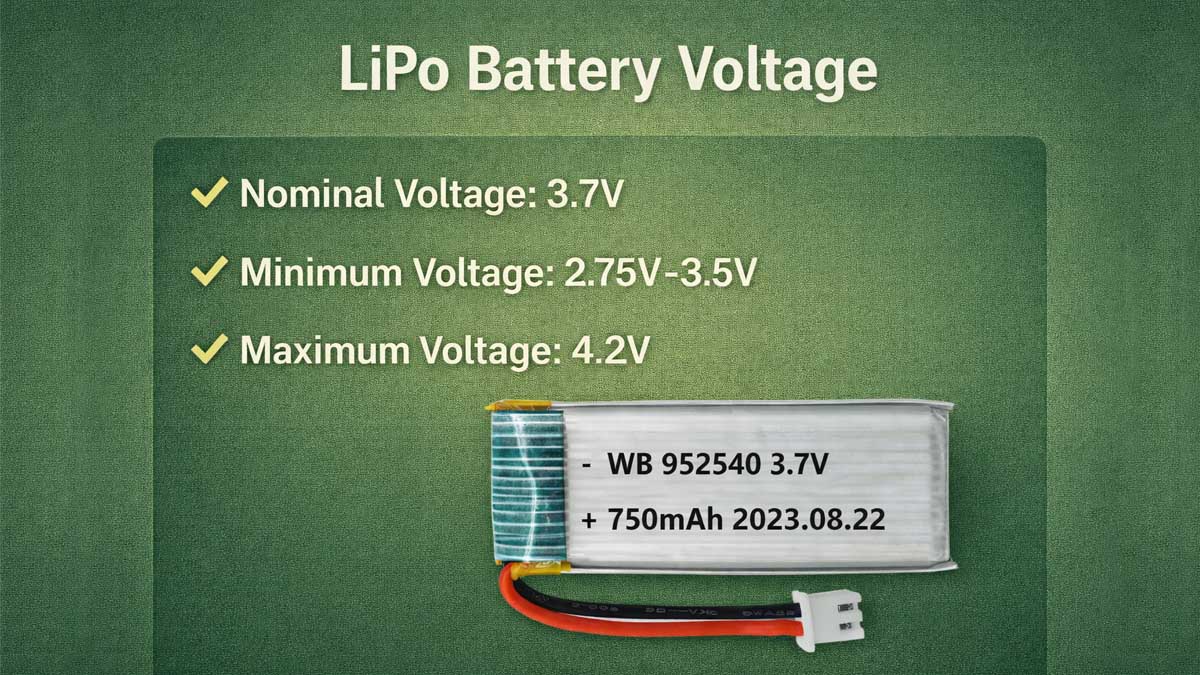
Minimum VoltageThe minimum discharge voltage of a LiPo battery is generally 2.75 V per cell. However, in real-world applications, LiPo batteries are rarely allowed to discharge exactly to this absolute lowest.
In most cases, the battery’s built-in protection board (BMS) or the device’s control circuit will cut off the discharge at around 2.75 V to 3.0 V per cell. This means the cutoff voltage is not a fixed number—it’s a floating range designed to protect the battery from over-discharge.
Because of this, if you notice that the voltage reading is slightly higher or slightly lower than 2.75 V, there’s usually no need to worry. This does not indicate a problem with your battery. Small voltage variations can be caused by load, temperature, measurement accuracy, or the protection circuit’s design.
It’s important to note that 2.75 V refers to the voltage of a single LiPo cell. In multi-cell battery packs (such as 2S, 3S, or higher), the total minimum voltage increases proportionally. The table below lists the minimum safe voltage ranges for 1S to 8S LiPo batteries.
| LiPo Battery Rated Voltage |
LiPo Battery Series |
Minimum Voltage |
| 3.7V |
1S |
2.75V |
| 7.4V |
2S |
5.5V |
| 11.1V ( 12V ) |
3S |
8.25V |
| 14.8V |
4S |
11V |
| 18.5V |
5S |
13.75V |
| 22.2V |
6S |
16.5V |
| 25.9V ( 24V ) |
7S |
19.25V |
| 29.6V |
8S |
22V |
The maximum voltage of a LiPo battery is 4.2 V per cell, which is also the standard charging cutoff voltage. This value is widely used across the lithium battery industry and is built into most battery protection boards (BMS), device control circuits, and dedicated LiPo chargers.
Although 4.2 V is the industry standard, it is not an absolute physical limit. In theory, a LiPo cell’s voltage can fluctuate slightly above this level—typically by 0.05–0.1 V, and the cell’s internal voltage tolerance may reach as high as 4.5 V. However, for safety, longevity, and reliability, manufacturers do not operate batteries near these extreme limits. That’s why 4.2 V per cell is universally adopted as the safe maximum charging voltage.
It’s also worth noting that for single-cell (1S) LiPo batteries, many consumer products use 5 V chargers. This is perfectly safe as long as the battery includes a protection circuit. When the LiPo battery reaches 4.2 V, the protection board automatically stops the charging process, preventing overcharge.
The voltage values discussed above apply to a single LiPo cell. For multi-cell battery packs connected in series (such as 2S, 3S, or higher), the maximum voltage increases proportionally. The table below shows the fully charging voltage for 1S to 8S LiPo batteries.
| LiPo Battery Rated Voltage |
LiPo Battery Series |
Maximum Voltage |
| 3.7V |
1S |
4.2V |
| 7.4V |
2S |
8.4V |
| 11.1V ( 12V ) |
3S |
12.6V |
| 14.8V |
4S |
16.8V |
| 18.5V |
5S |
21V |
| 22.2V |
6S |
25.2V |
| 25.9V ( 24V ) |
7S |
29.4V |
| 29.6V |
8S |
33.6V |
The voltage range of a LiPo (Lithium Polymer) battery typically falls between 2.75 V and 4.2 V per cell. This range represents the battery’s safe operating window, from the maximum charging voltage down to the minimum discharge voltage. Different voltage ranges are suitable for different devices and power needs. If you are choosing a battery based on voltage requirements, you can check available
liPo battery pack options to see common options.
During discharge, a LiPo battery’s voltage gradually drops from the fully charged level (around 4.2 V per cell) down to the cutoff voltage (usually 2.75–3.0 V per cell).
During charging, the process works in the opposite direction—the voltage rises from the lower limit back up to the maximum charging voltage.
It’s important to understand that the 2.75 V–4.2 V range applies to a single LiPo cell. When multiple cells are connected in series (such as 2S, 3S, or higher), the total voltage range increases proportionally. The table below shows the voltage range for multi-cell LiPo battery packs from 1S to 8S.
| LiPo Battery Rated Voltage |
LiPo Battery Series |
Voltage Range |
| 3.7V |
1S |
2.75V - 4.2V |
| 7.4V |
2S |
5.5V - 8.4V |
| 11.1V ( 12V ) |
3S |
8.25V - 12.6V |
| 14.8V |
4S |
11V - 16.8V |
| 18.5V |
5S |
13.75V - 21V |
| 22.2V |
6S |
16.5V - 25.2V |
| 25.9V ( 24V ) |
7S |
19.25V - 29.4V |
| 29.6V |
8S |
22V - 33.6V |
The recommended storage voltage for a LiPo battery is around 3.8 V per cell. This value is not a strict requirement, but rather a balanced and widely accepted guideline that takes safety, battery aging, and quality differences between manufacturers into account.
In practice, storing a LiPo battery at 3.5 V or up to 4.1 V per cell is generally acceptable. However, due to variations in cell quality, internal resistance, and self-discharge rates among different brands and production batches, 3.8 V per cell is considered the most reasonable and safest long-term storage voltage.
If a LiPo battery’s voltage drops slightly during long-term storage, it can usually be recovered by recharging before use. That said, very low storage voltages are not recommended. Batteries with higher self-discharge may slowly fall below 2.75 V per cell, which can lead to permanent damage or failure.
Likewise, storing a LiPo battery at full charge is not recommended. The higher the voltage, the higher the stored energy—and higher energy levels increase chemical stress and potential safety risks during long-term storage. For this reason, storage voltage focuses primarily on safety and battery longevity, rather than maximum capacity.
LiPo Battery Recommended Storage Voltage Table (1S–8S)
| LiPo Battery Rated Voltage |
LiPo Battery Series |
Storage Range |
| 3.7V |
1S |
3.8V |
| 7.4V |
2S |
7.6V |
| 11.1V ( 12V ) |
3S |
11.4V |
| 14.8V |
4S |
15.2V |
| 18.5V |
5S |
19V |
| 22.2V |
6S |
22.8V |
| 25.9V ( 24V ) |
7S |
26.6V |
| 29.6V |
8S |
30.4V |
LiPo battery voltage can be used to estimate the remaining battery percentage. The table below shows the approximate relationship between voltage and battery level for a single 3.7V LiPo cell measured at rest (no load). These values are for reference only, as actual battery percentage may vary depending on load, temperature, and battery condition.
| Voltage |
Battery Level (%) |
| 4.20V |
100% |
| 4.15V |
95% |
| 4.10V |
90% |
| 4.05V |
85% |
| 4.00V |
80% |
| 3.95V |
75% |
| 3.90V |
70% |
| 3.85V |
60% |
| 3.80V |
50% |
| 3.75V |
40% |
| 3.70V |
30% |
| 3.65V |
20% |
| 3.60V |
15% |
| 3.50V |
10% |
| 3.40V |
5% |
| ≤3.30V |
0-2% |
LiPo battery voltage tells you how the battery is actually being used. From charging to discharging and storage, every voltage range matters. In simple terms, 4.2 V per cell is the charging limit, 2.75–3.0 V per cell is the discharge cutoff, and around 3.8 V per cell is best for storage. Staying within these ranges helps avoid battery damage, shortens safety risks, and keeps performance stable over time. Voltage can also be used to estimate battery percentage. While it’s not perfectly accurate, it’s still a practical and reliable way to understand remaining capacity in daily use. If you respect these basic voltage rules, your LiPo batteries will last longer, perform better, and stay much safer.
FAQWhat is the minimum voltage of a LiPo battery?The minimum discharge voltage is usually 2.75–3.0 V per cell. Most devices stop discharging around 3.0 V to protect the battery.
What is the maximum voltage of a LiPo battery?The maximum charging voltage is 4.2 V per cell, which is the standard limit used by LiPo chargers and protection circuits.
What is the normal voltage range of a LiPo battery?A LiPo battery normally operates between 2.75 V and 4.2 V per cell, from full charge to safe discharge cutoff.
What is the recommended storage voltage for a LiPo battery?The recommended storage voltage is around 3.8 V per cell, which helps reduce aging and improve storage safety.
How does LiPo battery voltage relate to percentage?Voltage can be used to estimate battery percentage, but it is not linear and is affected by load, temperature, and battery condition.
What is the low voltage for a LiPo battery?The low voltage for a LiPo battery is
2.75 V per cell. It’s best not to discharge below this level to avoid battery damage.
What is LiPo battery overvoltage?LiPo battery overvoltage occurs when the voltage exceeds 4.25V per cell, which can cause swelling, overheating, or permanent damage.


