

Storage Percentage
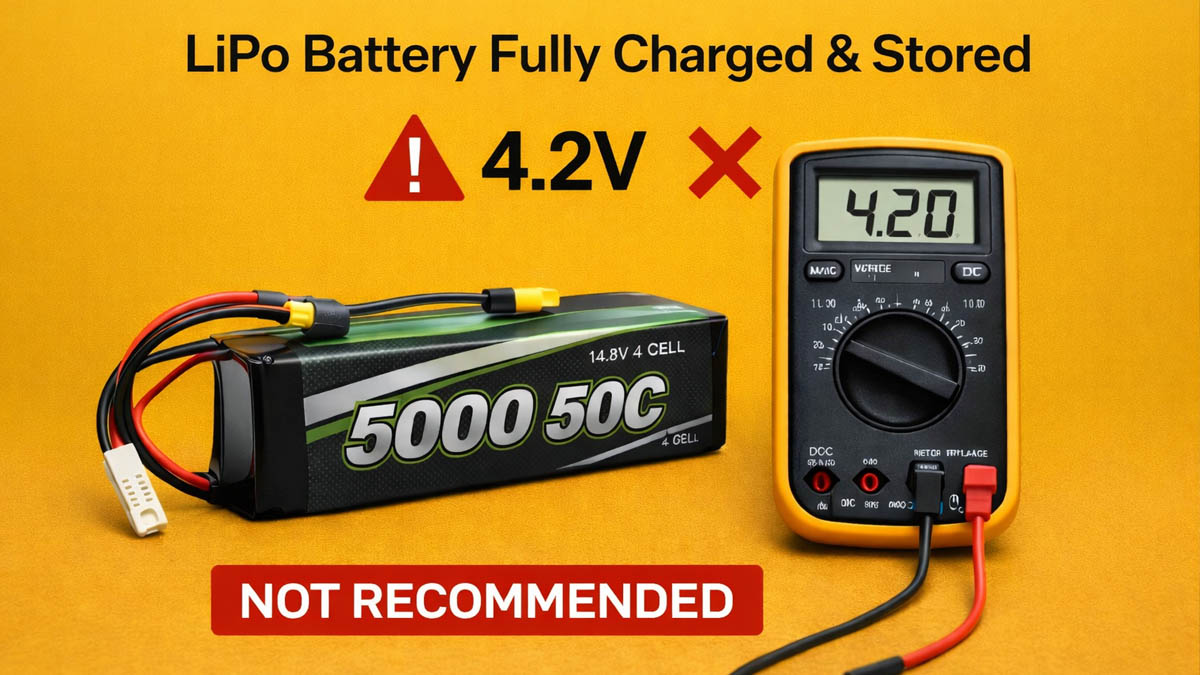
For most LiPo batteries, a storage charge of around 40%–60% is generally recommended. This range keeps the battery at a moderate state of charge, which helps reduce long-term degradation while avoiding the risks associated with storing the battery either fully charged or deeply discharged.
If the battery does not provide a clear charge percentage or state-of-charge display, the storage level can be checked by measuring the cell voltage directly. Using a multimeter, a reading of around 3.8 V per cell typically indicates that the battery is within the recommended storage range.
For long-term storage, it is recommended to keep the battery at a slightly higher state of charge, typically around 3.8V–4.0V per cell.
The main purpose of maintaining this voltage range is to compensate for self-discharge of the battery itself as well as standby power consumption from the device when it is not in active use.
By reserving additional energy before storage, the battery is less likely to become over-discharged over time, which helps prevent capacity loss, performance degradation, or permanent damage caused by deep discharge.
Storage Temperature
LiPo batteries should be stored at a temperature of around 20–25 °C, which helps maintain stable performance and slow internal aging during storage.
They should not be stored in extremely cold or high-temperature environments. Prolonged storage at freezing temperatures (0 °C down to −20 °C) can negatively affect internal materials and reduce recoverable performance once the battery is reused.
Likewise, storage at elevated temperatures such as 30–40 °C significantly accelerates degradation. Even higher temperatures can cause irreversible damage, increase swelling risk, or in severe cases lead to fire or safety incidents. For this reason, LiPo batteries should always be kept in a cool, dry, and temperature-controlled location.
Storage Location
LiPo batteries should be stored in a cool, dry, and well-ventilated indoor environment, away from direct sunlight. Storage areas should be kept clear of heat sources and flammable materials, as elevated temperatures or nearby combustible items can increase safety risks. For improved safety, it is recommended to store LiPo batteries in a fire-resistant metal cabinet or dedicated fireproof container. Using appropriate storage enclosures helps reduce potential damage and limits the impact in the event of overheating or failure during storage.
LiPo batteries can typically remain in storage for 2–4 years or longer, depending on manufacturer quality, cell design, and storage conditions. Variations in materials, production processes, and quality control result in noticeable differences between brands.
However, even when a battery is stored and not actively used for an extended period, its runtime and overall performance will still decline over time. This degradation is primarily caused by inherent material aging mechanisms inside LiPo cells, which continue to progress regardless of usage.
Conclusion
The storage recommendations discussed above are general guidelines rather than strict requirements, and users do not need to be overly concerned if storage conditions are not always ideal. In most cases, storing a LiPo battery at a relatively high or low state of charge for a period of time is unlikely to cause immediate damage or create safety issues.
However, if a LiPo battery is left completely unused for an extended period—such as one year or longer—noticeable declines in runtime and overall performance will still occur, even if the battery itself is not permanently damaged. This degradation is primarily caused by natural material aging inside LiPo cells, which continues over time regardless of use.
For long-term ownership, the most effective way to preserve LiPo battery performance is periodic use or maintenance charging, rather than leaving the battery idle for prolonged periods.
FAQ
How to store lipo batteries?
LiPo batteries should be stored at around 40–60% charge (about 3.6–3.8 V per cell) in a cool, dry place, ideally at 20–25 °C. Avoid long-term storage at full charge or very low voltage.
What Is storage charging or discharging for LiPo batteries?
Storage charging or discharging means adjusting the battery’s charge level so it stays within a safe range for storage, typically around 3.6–3.8 V per cell.
What charge percentage is best for LiPo battery storage?
A storage level of about 40–60% is generally recommended. This range balances safety, aging, and protection against self-discharge.
How long can a LiPo battery last in storage?
Under proper conditions, a LiPo battery can remain usable for 2–4 years or longer, but performance will still decline over time, and quality varies by manufacturer.
How do you put a LiPo battery into storage mode?
Adjust the battery charge to around 40–60% (about 3.8V per cell) using a charger with a storage function, then store it in a cool, dry place.
Can you store lipo batteries fully charged?
Short-term fully charged storage is usually safe, but long-term storage at full charge speeds up aging and is not recommended.
Can you store LiPo batteries below storage voltage?
Short-term storage below storage voltage is usually fine, but long-term low-voltage storage increases the risk of over-discharge and permanent damage.


