✅
EV Batteries Require Proper Disposal • Problems of Improper EV Battery Disposal • Benefits of Recycling EV Batteries✅
The Importance of EV Battery Recycling✅
How to Recycle an EV Battery✅
EV Batteries Enter Reuse or Material Recovery • Second-Life Use Extends the Value of Used EV Batteries • EV Batteries Can Be Processed to Recover Valuable Raw Materials✅
EV Battery Recycling in China✅
EV Battery Recycling Rates by Region✅
Cost of Recycling EV Batteries✅
Conclusion✅
FAQ Are EV Batteries Recyclable? Are EV Batteries Bad for the Environment? How to Recycle an EV Battery? What Percent of EV Batteries Are Recycled? Where Do Old EV Batteries Go?
As electric vehicles become more common, managing batteries at the end of their service life is becoming increasingly important. Old EV batteries still contain valuable materials and stored energy, which means improper handling can create environmental and safety concerns. Understanding key battery safety considerations for EVs is therefore important during disposal, transportation, reuse, and recycling. When handled correctly, retired batteries can be repurposed for second-life applications or processed to recover lithium, nickel, cobalt, copper, and other valuable materials.
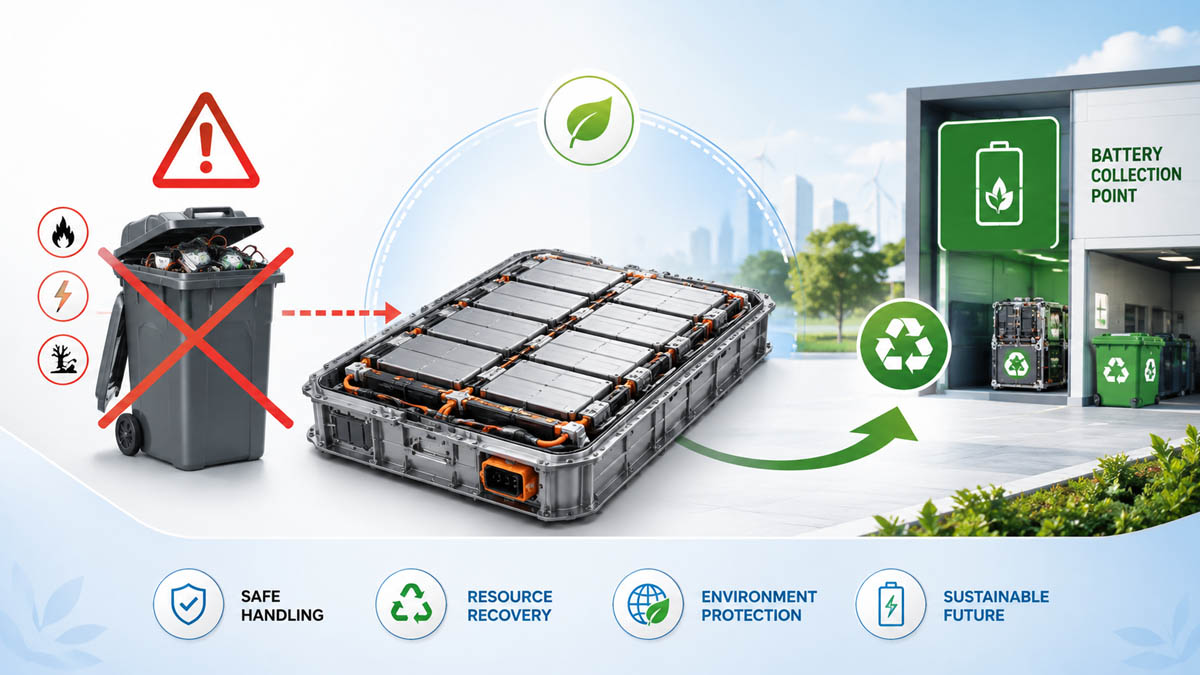 EV Batteries Require Proper Disposal
EV batteries should not be thrown away with household waste or sent directly to ordinary landfills. Even after they are no longer suitable for vehicle use, they may still contain stored energy, chemical materials, and valuable metals. Old EV batteries should instead be sent to authorized collection points, EV service centers, manufacturers, dealers, or licensed recycling facilities.
• Problems of Improper EV Battery Disposal
Improper disposal of EV batteries can create several problems:
- Fire risk: Damaged or crushed batteries may short-circuit, overheat, or enter thermal runaway.
- Environmental contamination: Electrolytes and other battery materials may contaminate soil or water if the battery is damaged or improperly handled.
- Hazardous gas release: Battery fires or severe damage can release harmful gases and fumes.
- Waste of valuable materials: Lithium, nickel, cobalt, copper, aluminum, and other materials may be lost instead of recovered.
- Transportation and handling hazards: Large EV battery packs can remain electrically active and require specialized handling.
- Landfill waste: Discarding batteries increases waste and prevents useful materials from returning to the battery supply chain.
• Benefits of Recycling EV Batteries
Sending old EV batteries to proper recycling facilities provides several benefits:
- Recover valuable materials: Recycling can recover lithium, nickel, cobalt, copper, aluminum, and other useful materials.
- Reduce raw material demand: Recovered materials can reduce dependence on newly mined resources.
- Reduce environmental impact: Proper recycling helps prevent batteries and their components from entering landfills.
- Improve battery safety: Professional recycling facilities are equipped to handle, discharge, dismantle, and process batteries more safely.
- Support a circular battery supply chain: Recovered materials can be used again in batteries or other industrial applications.
- Create value from old batteries: Batteries that are no longer suitable for vehicles may still have value through reuse, remanufacturing, second-life applications, or material recovery.
Proper EV battery disposal therefore means sending old batteries into an authorized collection and recycling system rather than simply throwing them away.
The Importance of EV Battery RecyclingEV battery recycling is essential because old electric vehicle batteries still contain valuable materials and can create environmental and safety risks if they are improperly discarded. Recycling helps recover useful resources, reduce waste, and lower the demand for newly mined battery materials.
- Recover valuable materials: Lithium, nickel, cobalt, copper, and aluminum can be recovered and reused.
- Reduce environmental impact: Recycling helps keep battery materials out of landfills and reduces the risk of soil and water contamination.
- Lower demand for mining: Reusing recovered materials can reduce dependence on newly extracted raw materials.
- Improve resource efficiency: Valuable battery materials can return to the manufacturing supply chain instead of being wasted.
- Support a circular economy: Recycling allows materials from old EV batteries to be used in new batteries or other products.
- Improve end-of-life safety: Professional recycling facilities can handle damaged or depleted batteries more safely than ordinary waste systems.
As the number of electric vehicles continues to grow, recycling will play an increasingly important role in managing used EV batteries. Proper recycling not only reduces waste and environmental risks but also helps recover valuable materials for future battery production, making the EV battery supply chain more sustainable and efficient.
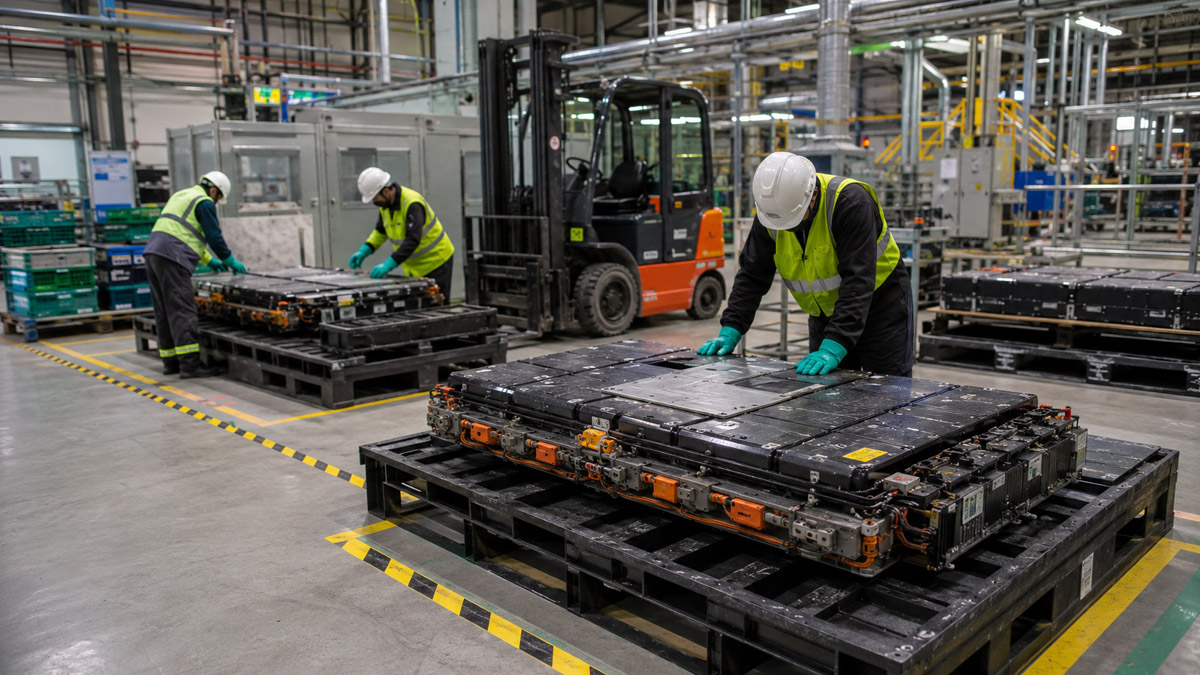 How to Recycle an EV Battery
EV batteries should be recycled through authorized collection centers, vehicle manufacturers, dealerships, service centers, or licensed battery recycling companies. Because high-voltage battery packs can remain electrically active even when they are no longer usable in a vehicle, they should not be dismantled or transported without proper equipment and training.
A typical recycling route includes:
- Battery collection: The used EV battery is collected from a vehicle owner, dealer, repair center, or manufacturer.
- Inspection and evaluation: The battery is checked to determine whether it can be reused, repaired, remanufactured, or must be recycled.
- Safe discharge: Remaining electrical energy is removed or controlled before further processing.
- Battery dismantling: The pack is separated into modules, cells, wiring, casing, and other components.
- Material recovery: Recycling facilities process the battery to recover materials such as lithium, nickel, cobalt, copper, and aluminum.
- Reuse of recovered materials: Recovered metals and materials can be returned to battery manufacturing or used in other industrial applications.
For individual EV owners, the safest option is usually to contact the vehicle manufacturer, dealership, or an approved battery recycling facility rather than attempting to recycle the battery independently.
EV Batteries Enter Reuse or Material RecoveryAfter an EV battery is removed from a vehicle, it does not always go directly into a recycling plant. Depending on its remaining capacity, condition, safety, and economic value, the battery may first be reused in another application or sent directly for processing to recover valuable raw materials.
• Second-Life Use Extends the Value of Used EV Batteries
An EV battery may no longer provide the driving range or power required by a vehicle, but it can still retain useful capacity. Batteries that remain in good condition can be tested, repaired, reorganized, or remanufactured for second-life applications.
Common second-life uses include:
Stationary energy storage: Used EV batteries can store electricity from the grid, solar panels, or wind power systems.
Commercial and industrial storage: Battery packs may be used for peak shaving, backup power, and energy management.
Residential energy storage: Suitable battery modules can be repurposed for home energy storage systems.
Charging infrastructure: Second-life batteries can support EV charging stations by storing electricity and reducing peak power demand.
Low-demand applications: Batteries that no longer meet automotive performance requirements may still be suitable for applications with lower power and energy demands.
Second-life use can extend the useful life of an EV battery before final recycling. However, batteries must first be evaluated for capacity, internal resistance, physical damage, thermal performance, and overall safety. Batteries that are too degraded or damaged are generally not suitable for reuse and are instead sent for material recovery.
• EV Batteries Can Be Processed to Recover Valuable Raw Materials
Batteries that cannot be reused may be dismantled and processed directly for material recovery. After safe discharge and removal of reusable components, battery modules and cells can be mechanically shredded or crushed so that different materials can be separated and further refined.
EV lithium-ion batteries contain valuable materials, which is one of the main reasons recycling is economically and strategically important. Depending on the battery chemistry, recoverable materials may include:
Lithium
Nickel
Cobalt
Manganese
Copper
Aluminum
Graphite
Mechanical processing can separate materials such as steel, aluminum, copper, plastics, and a fine battery material commonly referred to as black mass. This black mass contains valuable active materials from the battery electrodes and can undergo further hydrometallurgical or pyrometallurgical processing to recover metals for reuse.
These recovered materials can return to battery manufacturing or other industrial supply chains. Because materials such as lithium, nickel, cobalt, and copper have significant economic value and require substantial resources to mine and refine, recovering them from old EV batteries can reduce waste, preserve valuable resources, and decrease dependence on newly extracted raw materials.
Ultimately, an old EV battery may follow a second-life route first and be recycled later, while batteries that are damaged, heavily degraded, or unsuitable for reuse can move directly into material recovery.
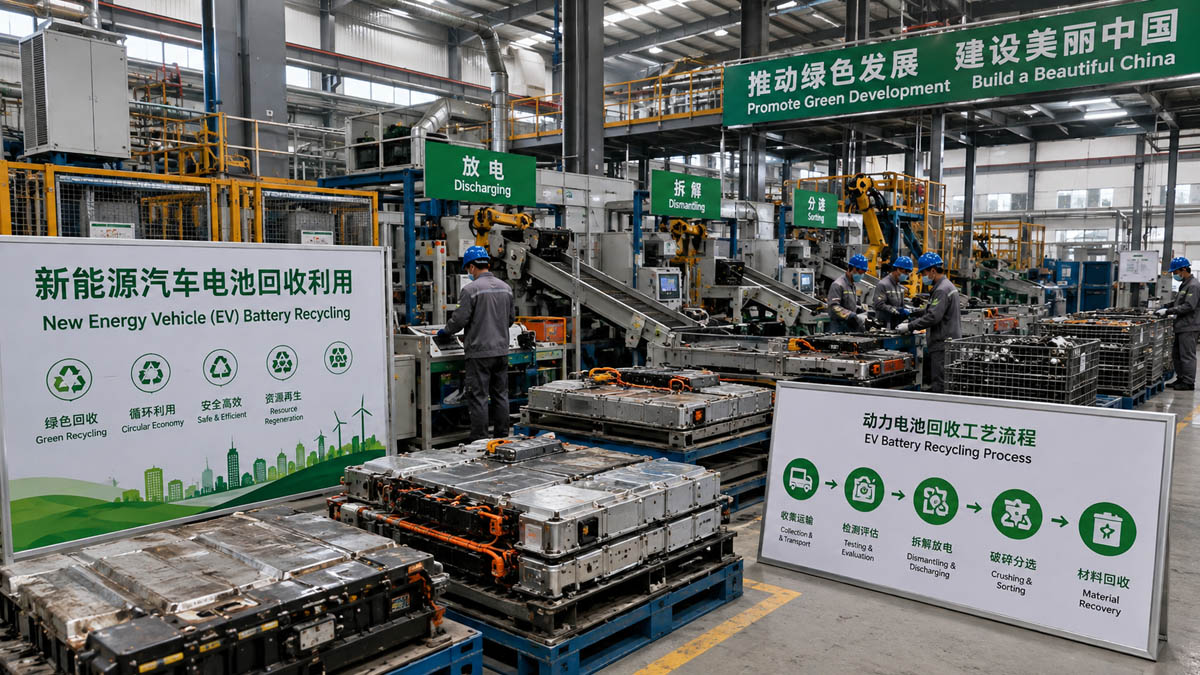 EV Battery Recycling in China
China has built a much larger EV battery recycling industry than Europe or the United States. Its advantage comes from its huge domestic EV market, battery manufacturing supply chain, extensive collection network, and strong demand for valuable materials recovered from used batteries.
| Comparison |
China |
Europe |
United States |
| Share of global battery recycling capacity (2023) |
Over 80% |
Less than 2% |
Less than 2% |
| Latest position |
Over 85% of global recycling capacity according to the IEA in 2026 |
Capacity is expanding |
Capacity is expanding |
| Projected share of global capacity in 2030* |
Around 70% |
Around 10% |
Around 10% |
| Recycling system |
Nationwide producer-led collection and traceability system |
Producer responsibility and mandatory EU recycling requirements |
More decentralized collection through manufacturers, dealers, dismantlers and recyclers |
| Market for used EV batteries |
Large commercial market; retired batteries and battery materials can have significant resale value |
Growing recycling and raw-material recovery market |
Growing recycling and domestic critical-material recovery market |
| Main advantage |
Scale, battery manufacturing integration and access to recycling feedstock |
Strong regulatory recycling and material-recovery targets |
Growing investment and recycling capacity |
The 2030 figures are based on announced projects being completed as planned.
IEA data show how significant the difference is. In 2023, China already accounted for more than 80% of global battery recycling capacity, while Europe and the United States each represented less than 2%. Based on projects announced at that time, Europe and the United States could each reach roughly 10% by 2030, but China would still account for about 70%. The IEA's 2026 update indicates that China's position has become even stronger, with the country now hosting more than 85% of global battery recycling capacity.
China also has substantial actual recycling activity. In 2025, more than 400,000 tonnes of retired EV batteries entered comprehensive utilization in China, an increase of 32.9% from the previous year. The country had also developed 148 major qualified recycling and utilization companies and established recycling networks across all 31 provincial-level regions.
By comparison, the U.S. Department of Energy reported that the United States had domestic facilities capable of reclaiming approximately 35,500 tons of battery materials in 2023, with additional capacity under development. This figure is not directly comparable with China's 400,000-tonne processing volume because the two statistics measure different stages of the recycling industry, but it illustrates the different scale and maturity of the two markets.
Europe's strength lies particularly in regulation. The EU Batteries Regulation requires lithium-based batteries to achieve at least 65% recycling efficiency by the end of 2025, increasing to 70% by 2030. It also establishes material recovery targets, including 50% for lithium and 90% for cobalt, copper and nickel by the end of 2027.
China also differs in the commercial value attached to retired batteries. Used EV batteries are not necessarily treated simply as waste; their lithium, nickel, cobalt and other materials can give them substantial resale value. Chinese government research has noted that rising lithium prices previously pushed up purchase prices for retired batteries, illustrating how strongly battery recycling can be influenced by raw-material values.
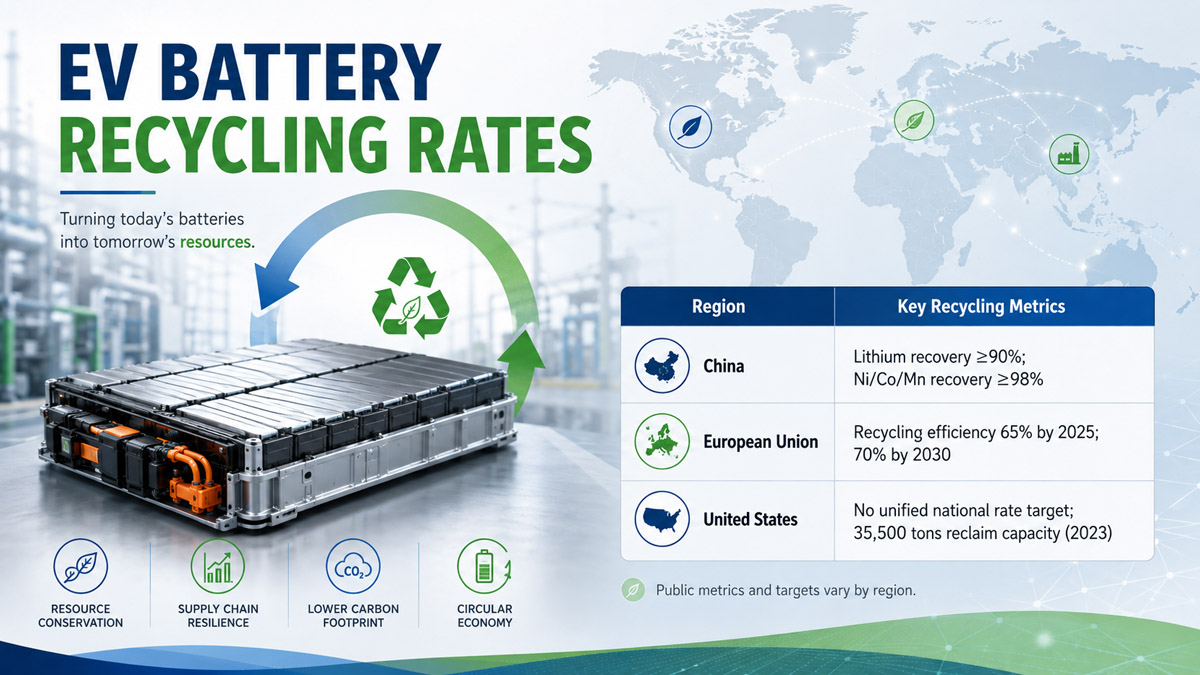 EV Battery Recycling Rates by Region
EV battery recycling rates vary by region and by the way recycling is measured. China currently reports some of the highest material recovery efficiencies, while Europe has established mandatory recycling and material recovery targets. The United States is expanding recycling capacity but does not currently have a single nationwide EV battery recycling-efficiency target comparable with the EU.
| Region |
Recycling / Recovery Rate |
Details |
| China |
≥98% for nickel, cobalt and manganese; ≥90% for lithium |
China’s 2024 industry guidelines set these recovery requirements for qualified recycling companies. Some leading companies have achieved about 99.6% recovery for nickel, cobalt and manganese and 96.5% for lithium. |
| European Union |
≥65% by battery weight |
EU rules require lithium-based battery recycling to achieve at least 65% recycling efficiency by the end of 2025, increasing to 70% by 2030. |
| EU – Key Metals |
90% cobalt, nickel and copper; 50% lithium |
These minimum material recovery targets apply by the end of 2027. By the end of 2031, the targets increase to 95% for cobalt, nickel and copper and 80% for lithium. |
| United States |
No single national percentage target |
The U.S. does not currently publish a directly comparable nationwide EV battery recycling-efficiency requirement. Recycling capacity is expanding rapidly; DOE reported capacity to reclaim about 35,500 tons of battery materials in 2023, with additional facilities planned. |
China’s figures demonstrate the high material recovery efficiency achievable in its established recycling industry. However, these percentages describe how much material can be recovered from batteries that enter the recycling process, not the percentage of all retired EV batteries in the country that are actually collected and recycled. The same distinction applies when comparing recycling statistics between countries.
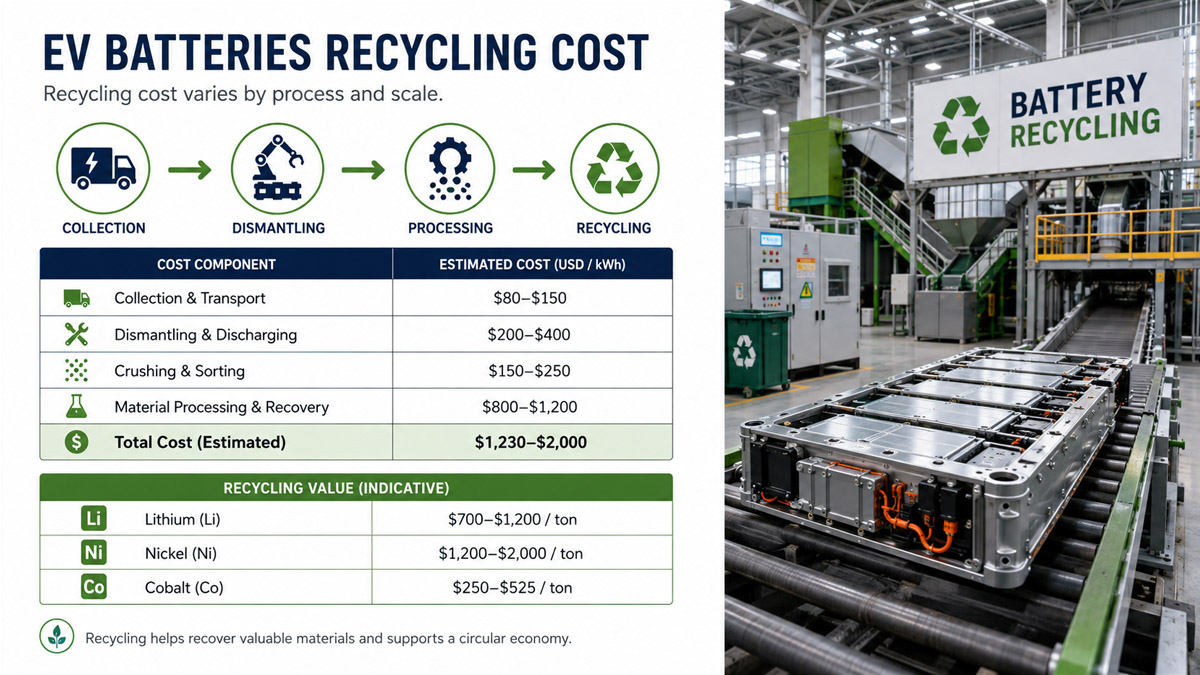 Cost of Recycling EV Batteries
The cost of recycling EV batteries varies widely because there is no single standard battery design or recycling process. Total recycling cost depends on battery chemistry, pack size, condition, transportation distance, labor, dismantling requirements, recycling technology, and the market value of recovered materials.
The main costs usually include:
- Collection and transportation:** EV batteries are heavy, high-voltage products and may require specialized packaging and hazardous-material transportation.
- Discharging and dismantling:** Battery packs must be safely discharged and separated into modules, cells, casings, wiring, and other components.
- Mechanical processing:** Shredding, crushing, sorting, and separation require specialized equipment and energy.
- Chemical processing:** Hydrometallurgical recycling requires chemicals, water treatment, filtration, and purification.
- High-temperature processing:** Pyrometallurgical recycling can require significant energy because batteries are processed at very high temperatures.
- Labor and safety management:** Skilled workers, fire protection, monitoring systems, and environmental controls add to operating costs.
Battery chemistry also has a major influence on recycling economics. Batteries containing higher-value metals such as nickel and cobalt may generate more revenue from recovered materials, while LFP batteries contain less expensive cathode materials and may therefore provide lower material value.
For this reason, the **cost of recycling an EV battery should not be viewed separately from its recovered material value**. Lithium, nickel, cobalt, copper, aluminum, graphite, and other materials can be sold or reused, helping offset part of the recycling cost. As recycling technology improves and processing volumes increase, the economics of EV battery recycling are expected to become more efficient.
Conclusion
EV battery recycling is an essential part of managing electric vehicles at the end of their battery life. Instead of being discarded, used batteries can often be reused in second-life applications or recycled to recover valuable materials such as lithium, nickel, cobalt, copper, and aluminum. Proper collection and recycling help reduce environmental risks, conserve resources, and support a more circular battery supply chain. As EV adoption continues to grow, efficient recycling systems will become increasingly important for both the battery industry and the wider transition to electric transportation.
FAQ
Are EV Batteries Recyclable?
Yes. EV batteries are recyclable and contain valuable materials such as lithium, nickel, cobalt, copper, aluminum, and graphite. Depending on their condition, batteries may first be reused or remanufactured before eventually being processed for material recovery.
Are EV Batteries Bad for the Environment?
EV batteries can have environmental impacts from raw material extraction, manufacturing, and improper disposal. However, proper recycling reduces landfill waste, recovers valuable materials, and lowers the need for newly mined resources, helping reduce their overall environmental impact.
How to Recycle an EV Battery?
EV batteries should be taken to authorized collection centers, vehicle manufacturers, dealerships, service centers, or licensed battery recycling companies. They are typically inspected, safely discharged, dismantled, mechanically processed, and then treated to recover valuable battery materials.
What Percent of EV Batteries Are Recycled?
There is no single global percentage showing how many retired EV batteries are actually collected and recycled. Recycling statistics often refer instead to material recovery efficiency. For example, China requires qualified recyclers to recover at least 90% of lithium and 98% of nickel, cobalt, and manganese, while the EU requires lithium-based batteries to achieve at least 65% recycling efficiency by weight by the end of 2025.
Where Do Old EV Batteries Go?
Old EV batteries generally follow one of two paths. Batteries with sufficient remaining capacity may be reused, remanufactured, or used in second-life energy storage applications. Batteries that are damaged or no longer suitable for reuse are sent to recycling facilities, where they are dismantled and processed to recover valuable raw materials.


