✅
EV Battery Fires Are a Real Safety Concern✅
EV Battery Fires Are Relatively Rare • The Available Data Shows a Low Fire Frequency • Not Every Electric Car Fire Starts in the Battery • A Rare Battery Fire Can Still Become a Serious Incident • The Statistics Are Reassuring but Do Not Eliminate the Risk✅
EV Battery Fire Suppression Requires Cooling and Monitoring • Drivers Should Evacuate Immediately • Firefighters Use Large Amounts of Water • The Battery Must Be Monitored for Reignition✅
EV Batteries Use Multiple Safety Layers • Internal Battery Protection Works at Several Levels • Tesla Controls Battery Temperature and High Voltage • BYD Uses LFP Chemistry and the Blade Battery Structure • CATL Separates Cells with Cooling and Thermal Protection • Mercedes-Benz Uses Structural and Automatic Crash Protection✅
EV Battery Disposal and Recycling✅
Conclusion✅
FAQ Are EV Batteries Safe? Can EV Batteries Explode? Do EV Batteries Catch Fire? How Common Are EV Battery Fires? What Causes EV Batteries to Catch Fire? How To Put Out an EV Battery Fire?
EV battery safety is one of the most important concerns surrounding electric vehicles. A modern EV battery stores a large amount of energy in thousands of lithium-ion cells, so keeping that energy stable during driving, charging and accidents is critical to vehicle safety.
Modern battery packs use multiple layers of protection, including battery management systems, thermal control, electrical isolation and reinforced enclosures. Even with these safeguards, however, overheating, internal short circuits, severe collision damage and thermal runaway can still create a risk of fire.
Understanding EV battery safety therefore means looking beyond whether electric cars are simply “safe” or “unsafe.” This article examines how EV battery fires occur, how common they are, what causes them, how manufacturers reduce the risk, and how battery fires should be handled when they happen.
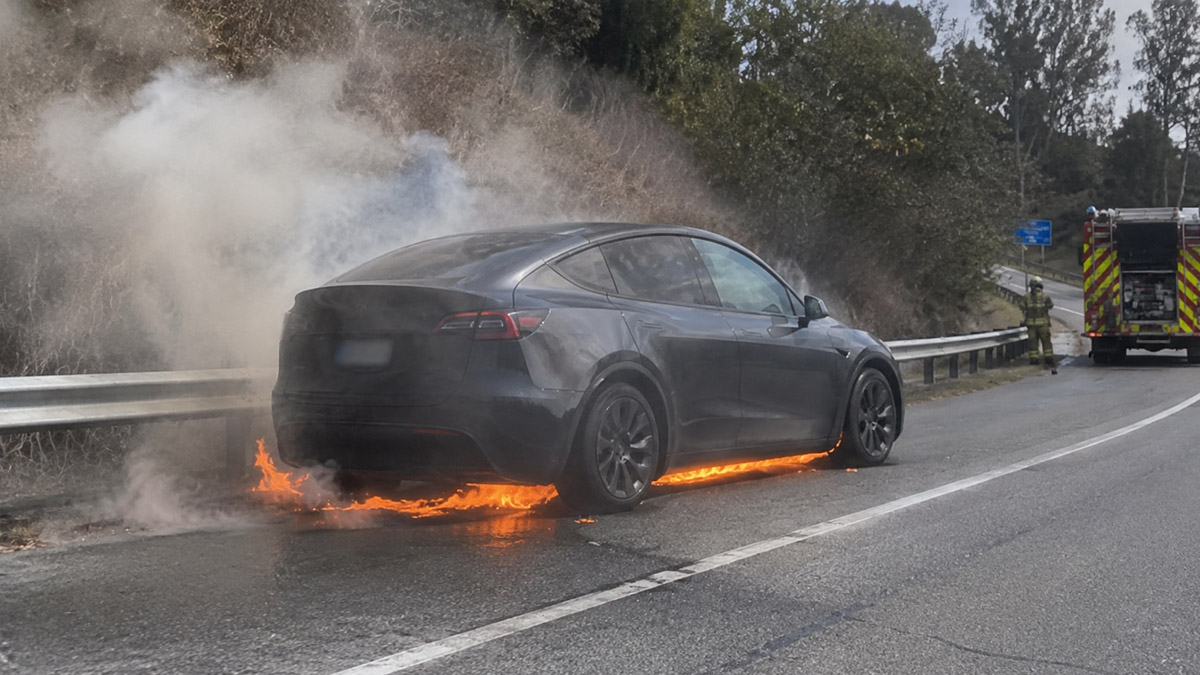
EV Battery Fires Are a Real Safety ConcernEV battery safety is one of the most important considerations in the development and use of electric vehicles. Although modern electric cars are equipped with battery management systems, cooling systems and structural protection, battery fires remain a real safety concern that should be acknowledged rather than overlooked.
EV battery fires can occur during a severe collision, while a vehicle is charging, after the battery pack has been damaged or, in rare cases, while the vehicle is parked. An incident may begin with unusual heat, smoke or gas release before developing into visible flames. In some cases, the fire can spread within the battery pack, continue for an extended period or reignite after the initial flames have been brought under control.
These fire characteristics are closely connected to the large amount of energy stored inside an EV battery and the chemical properties of lithium-ion cells. When a battery remains intact and operates within its designed limits, this energy is safely controlled. However, abnormal conditions can disturb that stability and create a potential fire hazard.
Recognizing this hazard does not mean that every electric vehicle is unsafe or likely to catch fire. Modern battery packs contain multiple layers of protection intended to prevent failures and limit their consequences. Nevertheless, no battery system can eliminate every possible accident, defect or extreme operating condition.
EV battery fires should therefore be treated as a genuine part of electric vehicle safety. The more important question is not whether the risk exists, but how significant the risk is, under what conditions it increases and how effectively it can be controlled.
 EV Battery Fires Are Relatively Rare
For most drivers, the concern is straightforward: Can an electric car catch fire while driving, charging or sitting in a garage? The honest answer is yes. EV battery fires do occur, but the available data indicates that they are uncommon compared with the number of electric vehicles on the road.
• The Available Data Shows a Low Fire Frequency
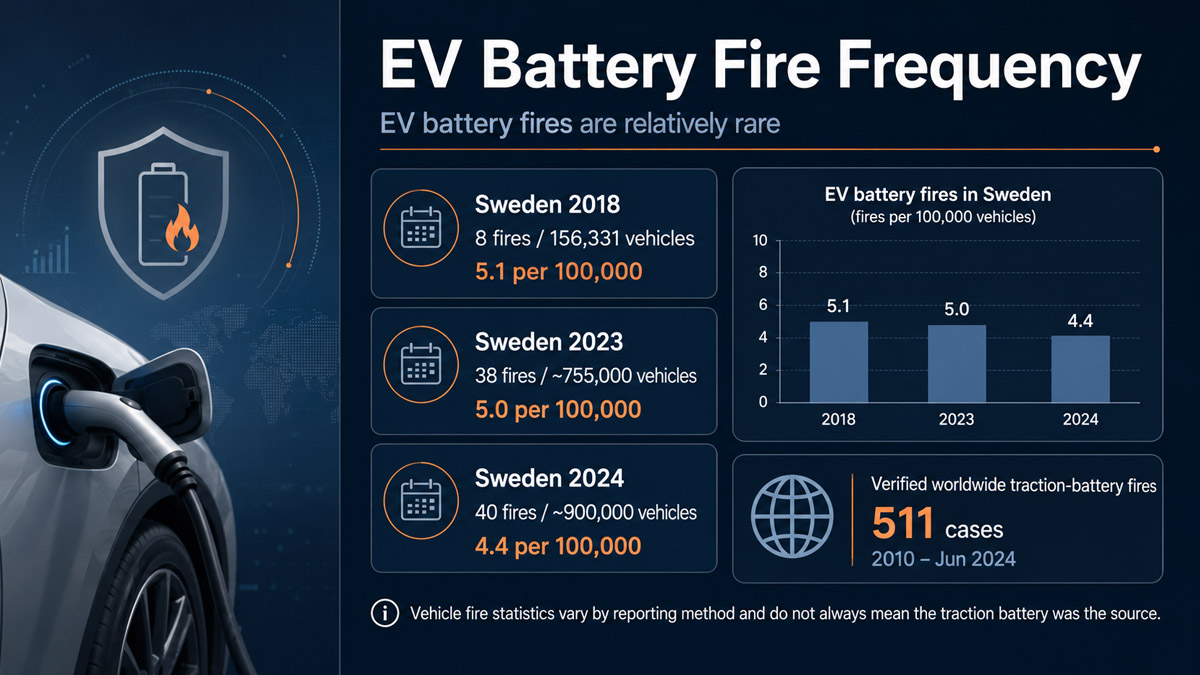
National data from Sweden provides a useful indication of how often fires involve electric and hybrid passenger cars. Although the number of registered vehicles increased rapidly, the annual number of reported fires remained relatively low.
| Year |
Reported Fires |
Electric and Hybrid Cars in Use |
Approximate Fire Rate |
| 2018 |
8 |
156,331 |
5.1 per 100,000 vehicles |
| 2023 |
38 |
Approximately 755,000 |
5.0 per 100,000 vehicles |
| 2024 |
40 |
Nearly 900,000 |
4.4 per 100,000 vehicles |
The figures show that electric and hybrid vehicle ownership increased substantially between 2018 and 2024, while the reported fire rate remained at approximately four to five incidents per 100,000 vehicles. This suggests that fires involving these vehicles were uncommon relative to the size of the fleet.
Global records show a similar pattern. EV FireSafe verified 511 passenger EV traction-battery fires worldwide between 2010 and June 2024. However, its database is not exhaustive, so the figure should be treated as a collection of verified incidents rather than a complete global total. Even with this limitation, the available evidence does not suggest that EV battery fires are frequent events.
• Not Every Electric Car Fire Starts in the Battery
A report of an “EV fire” does not automatically mean that the high-voltage battery caused it. A fire involving an electric car may begin in:
- The passenger compartment
- The low-voltage electrical system
- Charging equipment or building wiring
- Materials damaged during a collision
- A nearby vehicle or building
- An intentionally started fire
- The high-voltage traction battery
This distinction matters because general vehicle-fire statistics are often presented as EV battery fire statistics. The Swedish figures count fires involving electric and hybrid cars, whereas EV FireSafe records incidents in which the traction battery entered thermal runaway, ignited or experienced a related pressure event.
• A Rare Battery Fire Can Still Become a Serious Incident
The low frequency of EV battery fires does not make the hazard unimportant. When a high-voltage lithium-ion battery enters thermal runaway, the incident can involve:
- Rapidly increasing heat and pressure
- Flammable gas and heavy smoke
- Fire spreading between neighboring cells
- Delayed ignition after a collision
- Reignition after visible flames have been extinguished
- Extended cooling and temperature monitoring
The U.S. National Transportation Safety Board investigated three severe crashes involving damaged EV batteries. In all three cases, the batteries reignited after firefighters had initially extinguished the vehicle fires. The NTSB linked this risk to damaged cells and the energy that remained trapped inside the batteries.
• The Statistics Are Reassuring but Do Not Eliminate the Risk
The available evidence does not support the idea that electric cars frequently burst into flames during normal use. For the average driver, an EV battery fire remains an unlikely event.
However, unlikely does not mean impossible. The concern surrounding EV battery fires comes less from how often they occur and more from how they can behave once they begin. Thermal runaway, internal fire spread, hazardous gases and reignition make these incidents more complex than their relatively low frequency might suggest.
EV battery fire risk should therefore be understood through two separate questions:
- How likely is a battery fire to occur? The available data suggests the likelihood is low.
- How serious can the event become? A battery fire can be difficult to control and requires specialized emergency procedures.
The balanced conclusion is that EV battery fires are uncommon, but their distinctive hazards make them an important part of electric vehicle safety.
 EV Battery Fire Suppression Requires Cooling and Monitoring
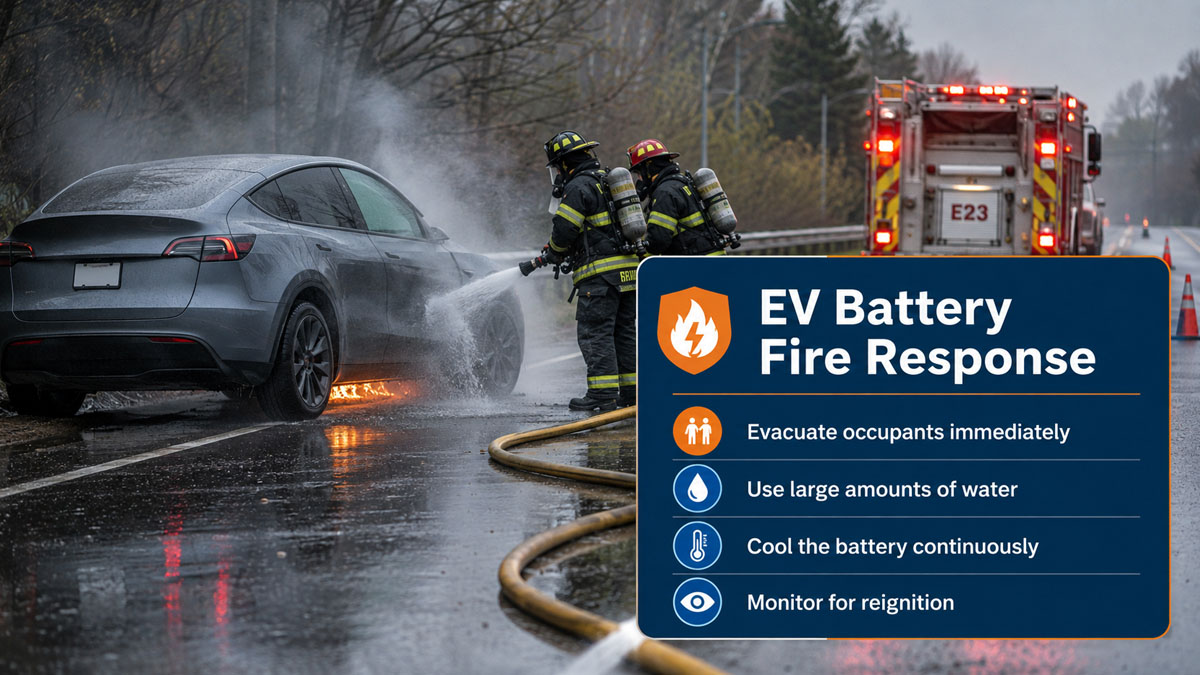
EV battery fires are difficult to extinguish because damaged cells can continue generating heat even after visible flames disappear. The main goal is to cool the battery, prevent the fire from spreading and watch for reignition.
• Drivers Should Evacuate Immediately
Drivers and bystanders should not try to extinguish a high-voltage battery fire themselves. They should:
- Leave the vehicle immediately.
- Move away from smoke and flames.
- Call emergency services.
- Tell responders that an electric vehicle is involved.
- Avoid touching exposed cables or damaged battery parts.
• Firefighters Use Large Amounts of Water
Water is commonly used to cool the battery pack and slow thermal runaway. Firefighters may:
- Apply water continuously to the battery area.
- Protect nearby vehicles and buildings.
- Follow the manufacturer’s emergency response guide.
- Avoid cutting or puncturing the battery pack.
• The Battery Must Be Monitored for Reignition
An EV battery can reignite because heat may remain inside damaged cells. After the fire is controlled, the vehicle should be isolated and monitored for rising temperature, smoke or gas release. Putting out an EV battery fire therefore requires evacuation, sustained cooling and continued monitoring rather than simply extinguishing the visible flames.
EV Batteries Use Multiple Safety LayersEV manufacturers cannot completely eliminate the possibility of battery fire, but they can reduce it through cell chemistry, temperature control, electrical protection and a strong battery-pack structure. These systems are designed to prevent a single abnormal cell from developing into thermal runaway or spreading heat to the entire battery pack.
• Internal Battery Protection Works at Several Levels
A modern EV battery system commonly includes:
- Battery management system: Monitors cell voltage, current, temperature and state of charge.
- Thermal management system: Uses liquid cooling or other methods to keep cells within a safe temperature range.
- High-voltage contactors and fuses: Disconnect the battery when a serious electrical fault or collision is detected.
- Strong battery enclosure: Protects cells from crushing, puncture, water and road impacts.
- Cell and module separation: Slows heat transfer from a failed cell to neighboring cells.
- Gas vents and thermal barriers: Direct hot gases away from other cells and reduce thermal runaway propagation.
• Tesla Controls Battery Temperature and High Voltage
Tesla battery systems use temperature sensors and liquid cooling to prevent cells from becoming excessively hot during driving and charging. Published Tesla service information also describes high-voltage contactors that disconnect the battery from the rest of the vehicle when unsafe conditions are detected.
Tesla’s main fire-prevention measures include:
- Continuous battery temperature monitoring
- Active liquid cooling
- Automatic charging and power limitations
- High-voltage contactors that default to an open position during certain failures
- A sealed battery enclosure beneath the vehicle
- Emergency systems for disconnecting the high-voltage circuit
These protections are intended to detect abnormal conditions before excessive heat develops and to isolate the battery during an accident or electrical failure.
• BYD Uses LFP Chemistry and the Blade Battery Structure
BYD’s Blade Battery uses lithium iron phosphate, or LFP, cells, which generally have greater thermal stability than many nickel-based lithium-ion chemistries. Its long, thin cells are installed directly in an array, creating a strong pack structure while reducing the number of conventional modules.
BYD reports that its Blade Battery:
- Did not produce smoke or fire during its nail-penetration test
- Maintained a surface temperature of approximately 30–60°C during the test
- Uses a strong cell array to improve structural protection
- Includes battery thermal management to control operating temperature
- Has passed crushing and heavy-vehicle rollover tests
The design aims to reduce the likelihood that an internal short circuit will develop into combustion or spread through the battery pack.
• CATL Separates Cells with Cooling and Thermal Protection
CATL’s Qilin battery integrates a liquid-cooling plate, thermal pad and structural support into multifunctional layers between cells. These layers improve cooling while creating additional separation between neighboring cells.
Its safety-focused structure includes:
- A larger heat-transfer area
- Shorter cooling paths
- Thermal insulation between cells
- Structural protection against vibration and impact
- Dedicated vents for gases released during thermal runaway
This arrangement is designed to remove heat more quickly and reduce the possibility of one failing cell heating nearby cells.
• Mercedes-Benz Uses Structural and Automatic Crash Protection
Mercedes-Benz uses a multi-stage high-voltage safety system. Its electric vehicles place the battery inside a strong protective housing, while the high-voltage system can switch off automatically after a serious collision.
The protection strategy includes:
- A reinforced battery enclosure
- Protected installation within the vehicle floor
- Automatic high-voltage shutdown
- Crash monitoring and electrical isolation
- Battery management software testing
- Mechanical crash and impact testing
In Mercedes-Benz crash demonstrations, the high-voltage batteries remained intact and the electrical systems shut down automatically as designed.
No single component can prevent every EV battery fire. Effective protection depends on several layers working together: stable cell chemistry, accurate monitoring, active cooling, rapid electrical disconnection, structural protection and control of heat propagation.
EV Battery Disposal and RecyclingWhen an EV battery reaches the end of its useful life, it should be handled through a controlled collection and recycling process rather than disposed of as ordinary waste. Depending on its condition, the battery may first be evaluated for reuse or second-life applications before it is sent for material recovery.
Understanding how used EV batteries are handled is important because even an old battery can still contain stored energy and valuable materials such as lithium, nickel, cobalt, copper and aluminum.Specialized facilities can dismantle battery packs, separate reusable components and recover materials for future battery production. Proper disposal and recycling can also reduce environmental impact while lowering demand for newly mined raw materials.
Conclusion
EV battery safety depends on understanding both the strengths and the limitations of lithium-ion technology. Battery fires are possible, especially after severe damage, internal failure or thermal runaway, but available data shows that they are relatively uncommon compared with the number of EVs in use.
Modern electric vehicles reduce these risks through battery management systems, active cooling, structural protection, electrical isolation and increasingly stable battery chemistries. Manufacturers such as Tesla, BYD and CATL continue to improve battery design to limit overheating and prevent a single-cell failure from spreading through the pack.
When a battery fire does occur, evacuation, sustained cooling and continued monitoring are critical because damaged cells can retain heat and reignite. At the end of the battery’s life, proper recycling and disposal are also essential for both safety and material recovery.
EV batteries are not risk-free, but effective design, testing, maintenance and emergency response can significantly reduce those risks and make electric vehicles safer throughout the battery life cycle.
FAQ
Are EV Batteries Safe?
Yes. Modern EV batteries are generally safe under normal driving and charging conditions. Battery management systems, thermal management, high-voltage protection and reinforced battery enclosures are used to prevent overheating and electrical failures. However, lithium-ion batteries still carry a potential fire risk if they are severely damaged, defective or exposed to abnormal conditions.
Can EV Batteries Explode?
EV batteries can experience pressure release or localized explosions during severe thermal runaway, but they do not normally explode like conventional explosives. Overheated lithium-ion cells can release flammable gases, and these gases may ignite or build pressure inside the battery pack.
Do EV Batteries Catch Fire?
Yes, EV batteries can catch fire, although such incidents are relatively uncommon. Battery fires may occur after severe collisions, internal short circuits, manufacturing defects, overheating, flooding or other conditions that cause lithium-ion cells to enter thermal runaway.
How Common Are EV Battery Fires?
Available data indicates that EV battery fires are relatively uncommon compared with the number of electric vehicles in use. However, statistics vary between countries because some datasets include all fires involving EVs, while others count only fires confirmed to originate in the high-voltage battery.
What Causes EV Batteries to Catch Fire?
The main causes of EV battery fires include internal short circuits, severe collision damage, manufacturing defects, overheating, electrical faults, water intrusion and external fires. These conditions can trigger thermal runaway, causing a battery cell to rapidly generate heat and potentially spread the failure to neighboring cells.
How To Put Out an EV Battery Fire?
A suspected EV battery fire should be handled by trained emergency responders. Firefighters commonly use large amounts of water to cool the battery pack, limit thermal runaway and prevent the fire from spreading. Because damaged cells can retain heat and reignite, the battery may also require continued temperature monitoring after the visible fire has been extinguished.


