✅
EV Battery Charging Technology✅
BYD Fast Charging and Energy Storage • Blade Battery and Charging Safety • Fast Charging System Integration • Energy Storage System Applications✅
CATL Fast Charging • High-Energy-Density Battery Systems • Ultra-Fast Charging and Thermal Management • Energy Storage and Grid Support✅
EV Charging Time✅
EV Charging Cost vs Gasoline✅
Common EV Charging Methods✅
EV Charging Efficiency✅
Charge Loss in EVs • Charge loss over time • Charge loss when not in use • Charge loss when parked • Cold weather impact✅
Charging Habits and EV Battery Health • Fast charging can increase battery stress • Slow charging is better for daily battery care • Low-temperature charging needs extra care • DC charging is faster while AC charging is gentler •
Frequent charging is usually not a problem •
Charging to 100% adds more battery stress✅
Best Way to Charge an EV for Battery Life✅
How EVs Charge the 12V Battery • Why EVs Still Need a 12V Battery • The Way EVs Charge the 12V Battery✅
Conclusion✅
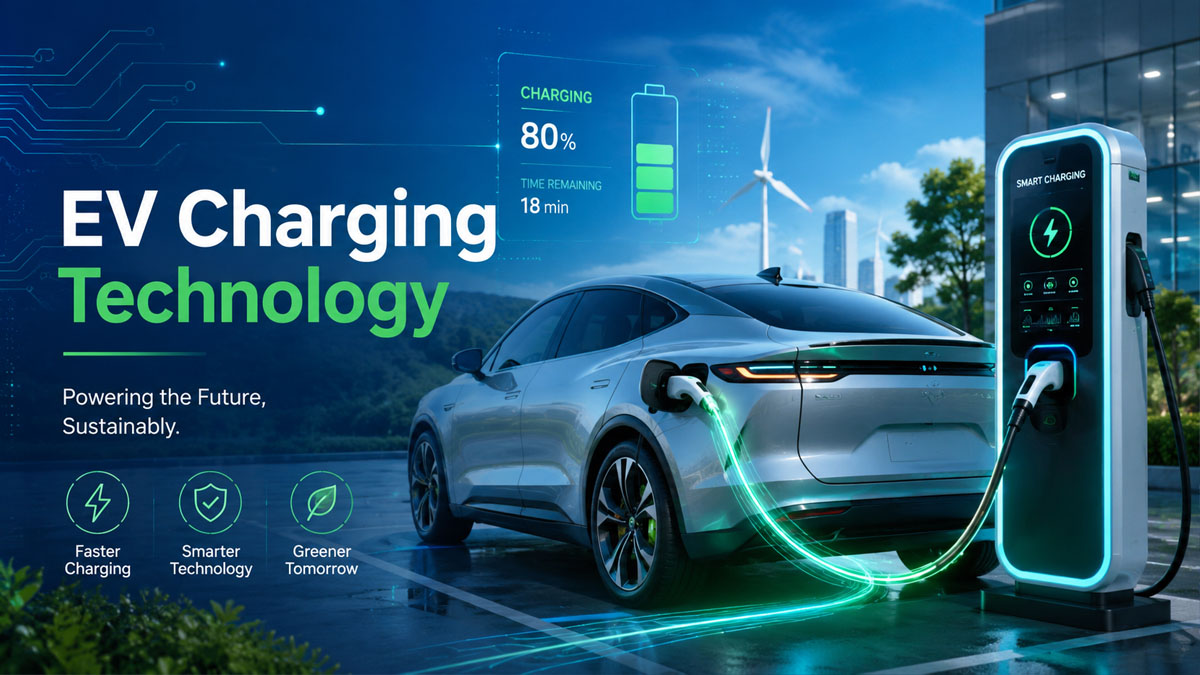
FAQ How Long Does It Take to Charge an EV Battery? Is Fast Charging Bad for EV Battery? Can You Charge an EV From a Battery? Do EV Batteries Lose Charge in Cold Weather? Does Charging an EV to 100% Damage the Battery?Electric vehicle (EV) battery charging technology plays a critical role in determining the performance, efficiency, and usability of modern electric vehicles. As EV adoption continues to grow, charging systems have evolved from simple low-power AC charging to advanced high-voltage fast charging solutions supported by intelligent battery management systems.
Understanding how EV batteries are charged is essential for evaluating charging speed, battery lifespan, and overall vehicle performance. For a deeper understanding of how EV batteries work as a system, you can also refer to our detailed guide on
electric vehicle battery fundamentals, which explains battery structure, chemistry, and core operating principles.
Today’s EV charging technology integrates multiple advanced systems, including DC fast charging, thermal management, and smart BMS controls, enabling faster and safer energy transfer while reducing long-term battery degradation.
EV Battery Charging TechnologyEV battery charging technology has evolved through several key stages, improving in speed, efficiency, and system intelligence over time.
- Early Slow Charging Stage
Early EVs mainly used low-power AC charging with basic onboard chargers. Charging was slow, often taking 8–12 hours, and battery management systems were still very limited.
- DC Fast Charging Introduction Stage
With the introduction of DC fast charging, electricity began flowing directly into the battery, significantly reducing charging time and improving overall usability.
- Smart Charging and High-Voltage Stage
Modern EVs now use high-voltage architectures (400V–800V), advanced BMS systems, and liquid cooling technologies, enabling much faster and safer charging.
- Emerging Next-Generation Stage
New technologies such as ultra-fast charging (350kW+), solid-state batteries, and battery swapping are shaping the future of EV charging systems.
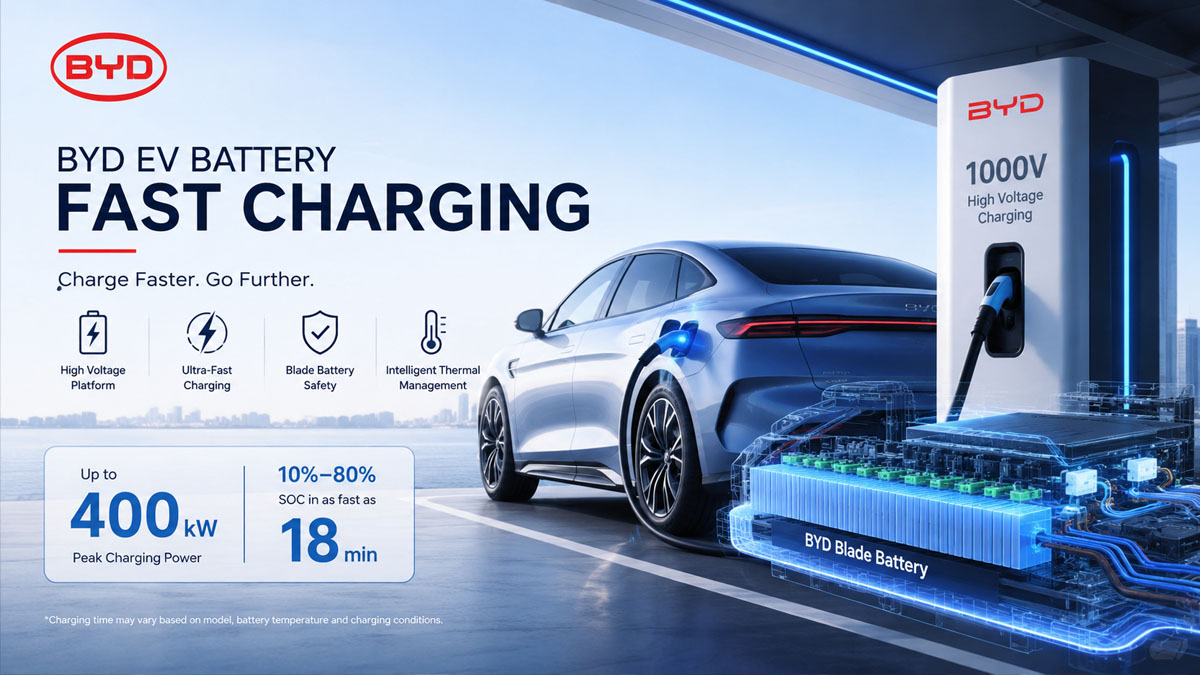
BYD Fast Charging and Energy StorageBYD has developed a vertically integrated EV battery system that combines fast charging capability with large-scale energy storage applications. Its strategy focuses on safety, thermal stability, and system-level efficiency rather than purely maximum charging speed.
• Blade Battery Architecture and Charging Safety
The Blade Battery is designed with a long-cell LFP structure that improves thermal stability and significantly reduces the risk of thermal runaway during fast charging.
Unlike traditional battery designs, this architecture allows:
- Better heat dissipation during high current input
- More stable voltage behavior under fast charging conditions
- Improved safety under repeated charging cycles
This makes BYD systems particularly suitable for sustained fast charging in mass-market EV applications.
• Fast Charging System Integration
BYD’s fast charging performance is not only dependent on battery chemistry but also on full system integration, including BMS and vehicle-level energy management.
Key characteristics include:
- Controlled charging curves to reduce battery stress
- Adaptive thermal management during high-power charging
- Optimization between charging speed and battery lifespan
This approach prioritizes long-term durability over peak charging speed, making BYD systems more stable in real-world usage.
• Energy Storage System Applications
Beyond EVs, BYD also applies its battery technology in grid-scale energy storage systems.
These systems support:
- Renewable energy stabilization (solar and wind integration)
- Peak load balancing for power grids
- Large-scale fast charging infrastructure support
This dual application strengthens BYD’s position in both mobility and energy sectors.
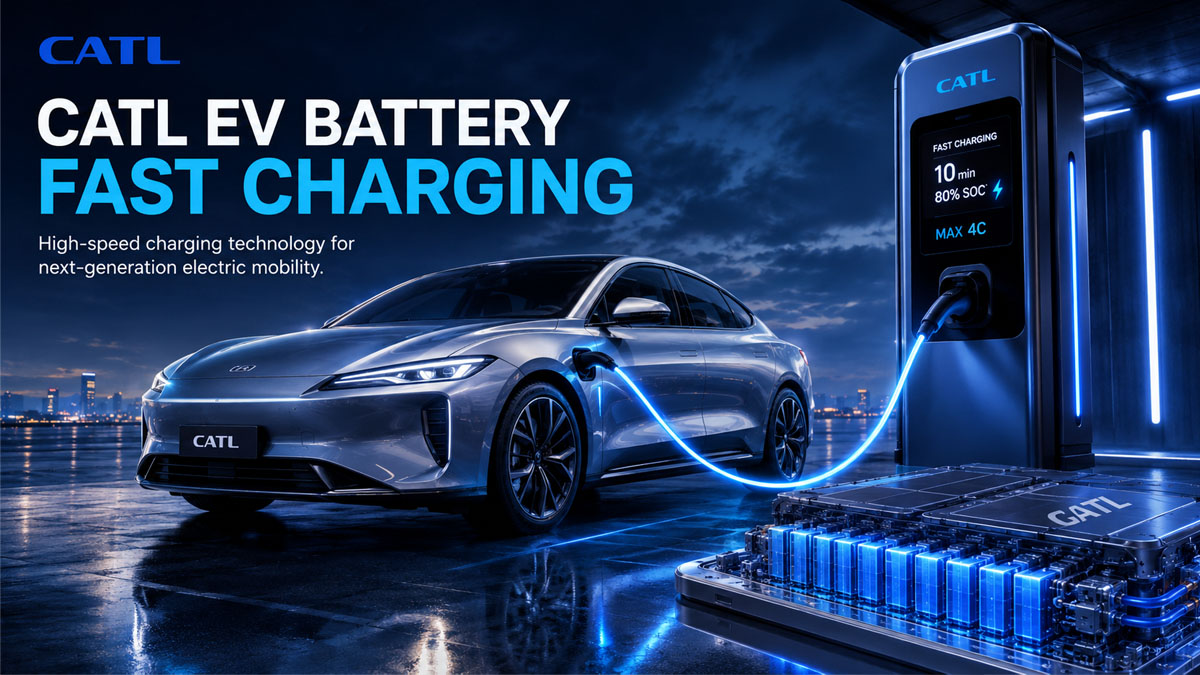
CATL Fast ChargingCATL is the world’s largest EV battery supplier, focusing on high-energy-density lithium-ion systems and advanced fast charging capabilities. Its innovations are widely used across global EV manufacturers.
• High-Energy-Density Battery Systems
CATL focuses on improving energy density while maintaining fast charging capability. This is achieved through:
- Advanced lithium-ion chemistry optimization
- Silicon-enhanced anode materials (in some platforms)
- Improved ionic conductivity for faster charge acceptance
These improvements allow EVs to charge faster without significantly increasing thermal stress.
• Ultra-Fast Charging and Thermal Management
CATL’s fast charging systems are designed to support high-power charging scenarios (including 250kW–350kW+ levels in compatible platforms).
Key technologies include:
- Multi-layer thermal management systems
- Electrolyte formulations optimized for high current input
- Structural battery design improvements to reduce internal resistance
This enables faster charging while maintaining cycle stability and safety.
• Energy Storage and Grid Support
CATL is also a dominant player in energy storage systems, which directly support EV charging infrastructure.
Applications include:
- Grid-scale battery storage for peak shaving
- Buffer systems for fast-charging stations
- Renewable energy storage integration
This helps stabilize energy supply during high-demand fast charging periods, especially in urban charging networks.
 EV Charging Time
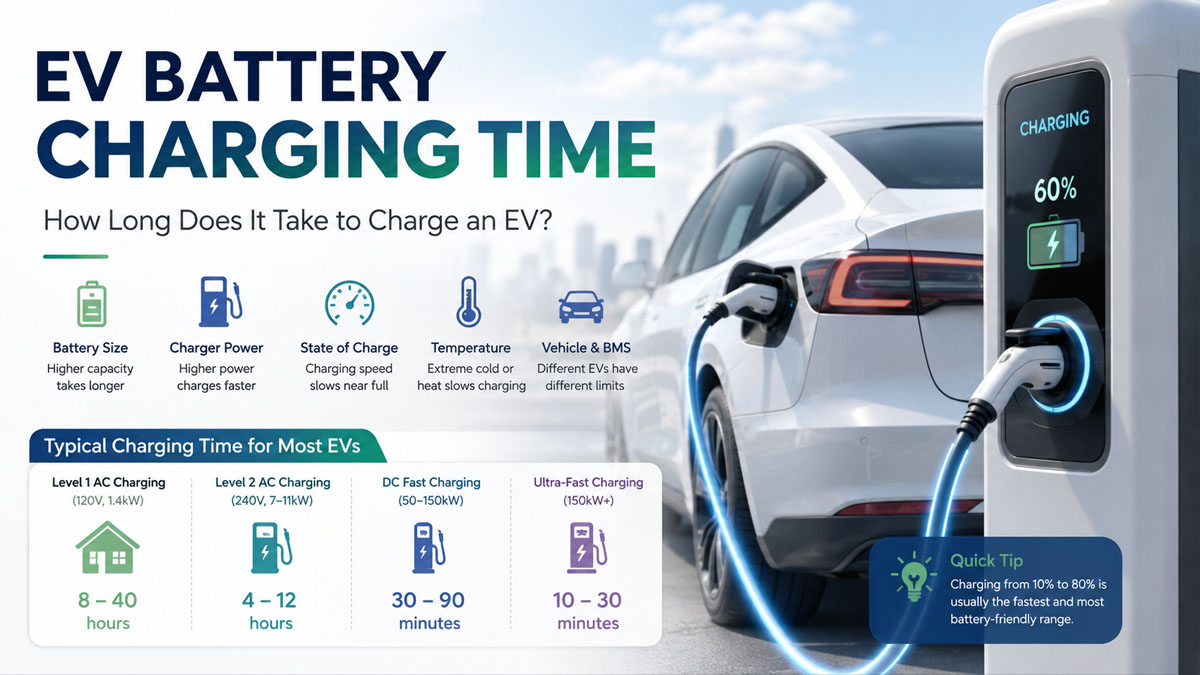
EV charging time varies significantly depending on the charging method, vehicle architecture, and battery conditions. In real-world usage, most modern electric vehicles take anywhere from around 20 minutes to more than 10 hours to reach a full charge.
For DC fast charging, many current EVs can charge from 10% to 80% in approximately 20–40 minutes under optimal conditions. This is typically used on highways or during long-distance travel, where speed is prioritized over long-term battery optimization.
For home charging using Level 2 AC systems, which is the most common daily charging method, a full charge usually takes around 4–8 hours, depending on battery size and onboard charger capability. In contrast, standard household outlets (Level 1 charging) can require 8–20+ hours, making them suitable mainly for overnight or low-mileage use.
However, these figures are only reference ranges. Actual charging time is influenced by several key factors:
Battery state of charge (SOC): Charging slows significantly after around 70–80% to protect battery health
Thermal conditions: Cold or hot temperatures reduce charging speed due to battery protection systems
Charging curve behavior: EV batteries do not charge linearly; speed gradually decreases as the battery fills
Vehicle architecture: Newer 800V platforms can accept much higher charging power than older 400V systems
Charger output limits: Real-world infrastructure often operates below peak advertised charging speeds
In recent years, charging technology has advanced rapidly beyond conventional fast charging standards. For example, BYD has introduced its new Flash Charging system, which enables compatible vehicles to gain roughly 400 km of range in about 5 minutes under ideal conditions, with full charging achievable in under 10 minutes in optimized scenarios. This is achieved through megawatt-level charging power combined with next-generation Blade Battery architecture and advanced thermal control systems.
These developments show that EV charging is no longer defined by a single fixed duration, but by a dynamic balance between speed, battery protection, and system design.
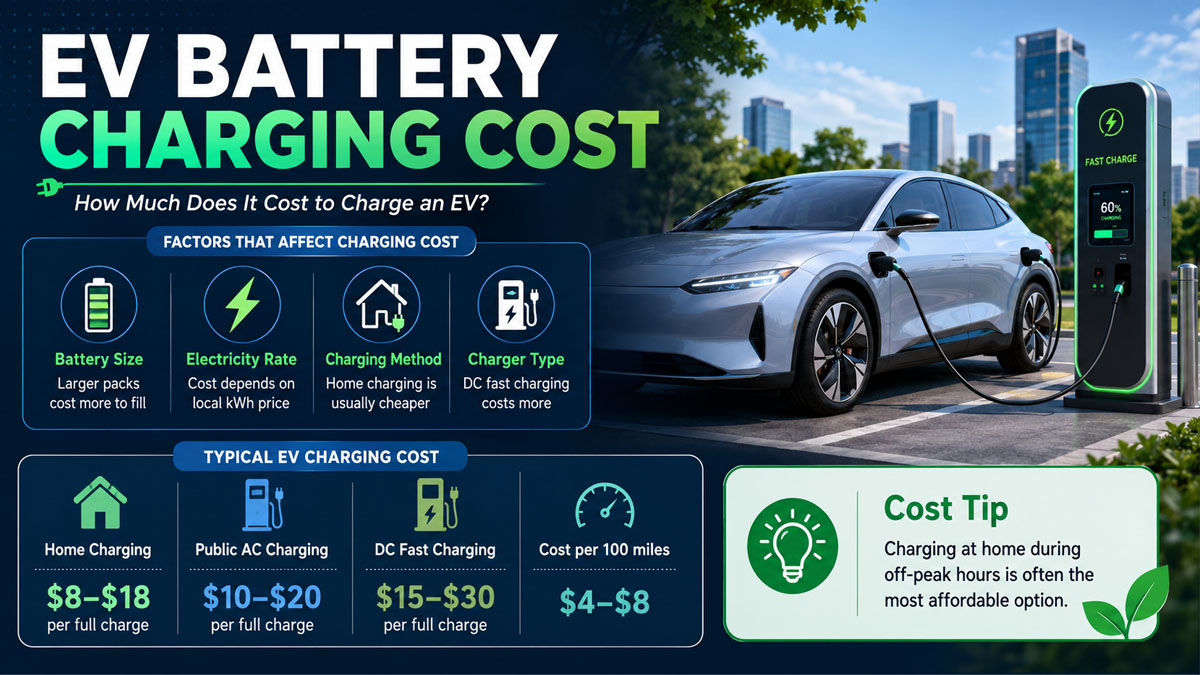
EV Charging Cost – Electricity vs Gasoline ComparisonEV charging cost varies significantly across regions, mainly due to differences in electricity prices, gasoline taxes, and energy infrastructure. However, in most real-world scenarios, charging an electric vehicle is still cheaper per mile than refueling a gasoline car, especially when charging at home.
In the United States, residential electricity typically ranges around $0.15–$0.25 per kWh, depending on the state. Based on an average EV efficiency of about 3–4 miles per kWh, the cost works out to roughly $0.04–$0.08 per mile. In comparison, gasoline vehicles often cost around $0.12–$0.18 per mile depending on fuel prices and MPG. This means EVs are generally 30%–70% cheaper to run, although fast public charging can narrow the gap due to higher per-kWh pricing .
In China, electricity prices are typically lower, especially for residential charging, often around ¥0.5–¥0.8 per kWh. Combined with highly efficient EV platforms, the cost per kilometer can be extremely low—sometimes around one-third or less of gasoline vehicle operating cost. Gasoline prices remain relatively high compared to electricity, which makes EVs particularly cost-effective for daily commuting in urban areas.
In Europe, electricity prices vary widely by country, often ranging from €0.25–€0.45 per kWh for home charging and even higher for public fast charging. Gasoline prices are also among the highest globally due to taxes. Even so, EVs still typically offer 20%–60% lower running costs per mile, especially for drivers who can charge at home rather than relying on public fast charging networks.
| Region |
Electricity Price (per kWh) |
Gasoline Price (per liter/gallon equivalent) |
EV Operating Cost (per mile/km) |
Gasoline Vehicle Cost (per mile/km) |
| United States |
$0.15 – $0.25 / kWh |
~$0.90 – $1.20 / liter ($3.5–$4.5/gal) |
$0.04 – $0.08 / mile |
$0.12 – $0.18 / mile |
| China |
¥0.5 – ¥0.8 / kWh |
~¥7 – ¥9 / liter |
Very low (~30% of ICE cost) |
Higher due to fuel price |
| Europe |
€0.25 – €0.45 / kWh |
€1.6 – €2.2 / liter |
€0.05 – €0.12 / mile |
€0.10 – €0.20 / mile |
Overall, the cost advantage of EVs depends heavily on charging behavior. Home charging remains the most economical option across all regions, while frequent use of DC fast charging can significantly reduce savings. Despite regional differences, EVs generally maintain a clear long-term cost advantage over gasoline vehicles due to higher energy efficiency and lower per-mile energy consumption.
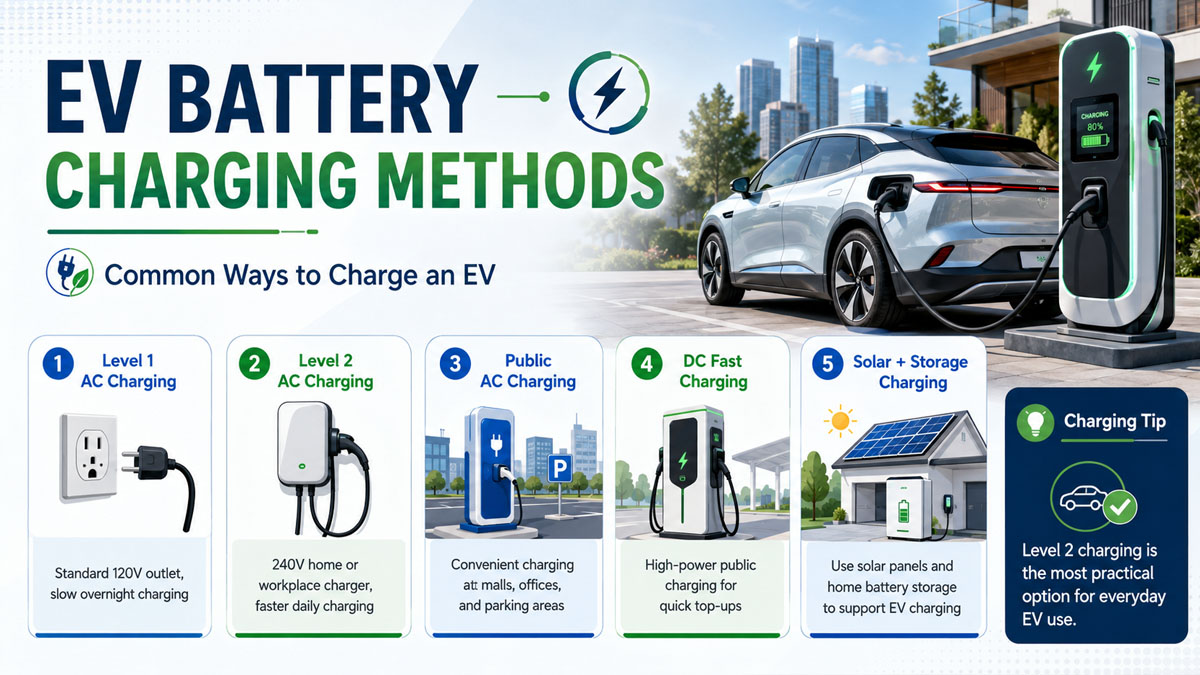
Common EV Charging MethodsEVs can be charged in several ways, depending on where the vehicle is used, how fast charging is needed, and what energy source is available. Traditional grid charging is still the most common method, but solar storage, battery storage systems, and mobile charging solutions are becoming more important as EV infrastructure continues to grow.
| Charging Method |
How It Works |
Advantages |
Disadvantages |
| Home AC Charging |
Uses a household outlet or wall-mounted home charger to charge the EV, usually overnight. |
Convenient for daily use, lower charging cost, gentle on the battery. |
Charging speed is slower, and a dedicated home charger may require installation. |
| Public AC Charging |
Uses Level 2 chargers in parking lots, workplaces, shopping centers, hotels, or public areas. |
Suitable for long parking periods, widely available in many cities, battery-friendly. |
Slower than DC fast charging and not ideal when quick charging is needed. |
| DC Fast Charging |
Delivers high-power direct current directly to the EV battery through fast charging stations. |
Very fast charging speed, useful for long-distance travel and quick range recovery. |
Higher cost, more heat generation, and frequent use may increase battery stress over time. |
| Solar Charging with Energy Storage |
Solar panels generate electricity, which is stored in a battery system and later used to charge the EV. |
Uses cleaner energy, reduces grid dependence, lowers long-term charging costs. |
Higher upfront cost and charging capacity depends on sunlight and storage size. |
| Battery Storage Charging |
A stationary battery system stores power from the grid or renewable sources and supplies energy to EV chargers when needed. |
Helps reduce grid pressure, supports fast charging stations, useful during peak demand. |
Requires storage equipment, space, and smart energy management. |
| Mobile Battery Charging |
A portable or vehicle-mounted battery system provides temporary charging for EVs. |
Useful for emergency charging, roadside service, fleets, or locations without fixed chargers. |
Limited capacity and usually not suitable for regular full charging. |
| Workplace Charging |
EVs are charged at company parking lots during working hours. |
Convenient for employees, extends daily range, supports business sustainability goals. |
Depends on workplace infrastructure and charger availability. |
| Battery Swapping |
The depleted EV battery is replaced with a fully charged battery at a swapping station. |
Very fast energy replenishment and reduces waiting time. |
Requires dedicated swapping stations and standardized battery designs, so availability is limited. |
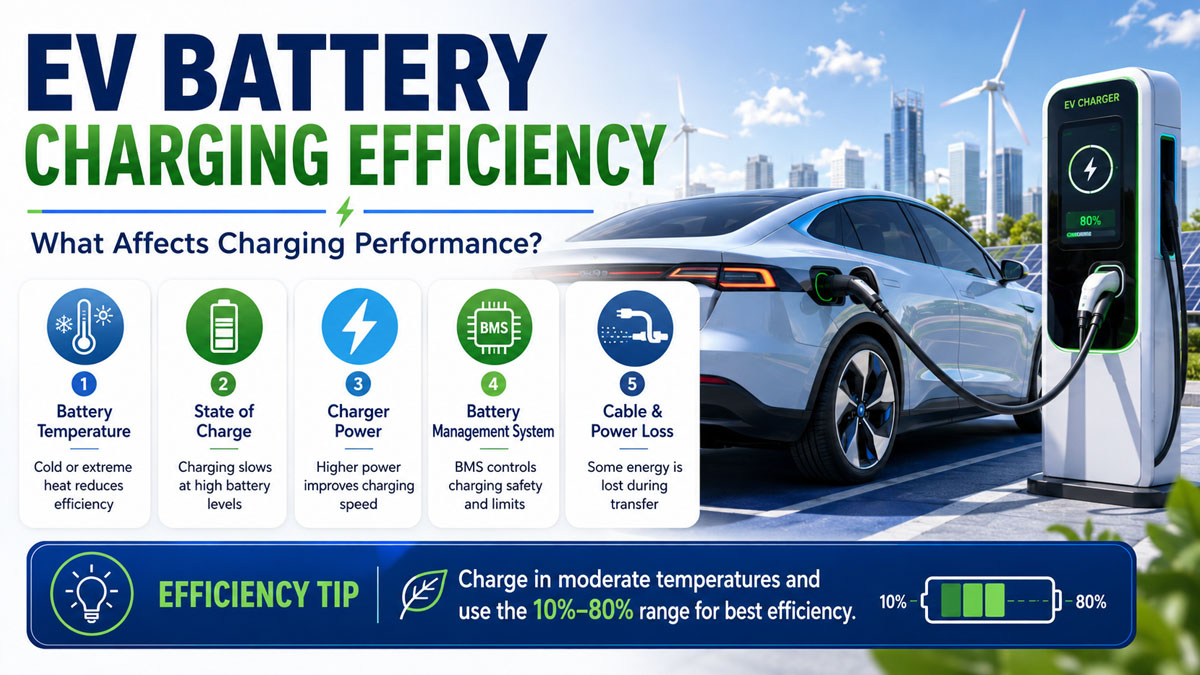
EV charging efficiency is not just about how fast a battery charges, but how much of the electricity from the grid is actually stored and used in the battery. In real-world conditions, energy loss always occurs through heat, voltage conversion, and battery management system (BMS) regulation, which means charging efficiency varies depending on method and conditions.
One key difference is between AC charging (Level 1 and Level 2) and DC fast charging. AC charging is generally more stable and efficient because the conversion process is slower and produces less heat. DC fast charging delivers energy directly to the battery at high power, which reduces charging time but can increase thermal load and slightly reduce efficiency, especially during repeated fast-charging sessions or in extreme temperatures.
Efficiency is also strongly influenced by battery state of charge (SoC). EV batteries charge fastest and most efficiently in the mid-range (roughly 20%–80%), while the last 20% requires slower balancing to protect battery health, which lowers efficiency and increases charging time per percentage gained.
In addition, temperature management and battery chemistry play a major role. Lithium-ion systems perform best within an optimal temperature range, and both overheating and cold conditions can reduce charging efficiency. Modern EVs actively manage this through thermal systems and smart charging algorithms, but real-world efficiency still varies depending on driving patterns, weather, and charging habits.
Charge Loss in EVsEV batteries can lose a small amount of charge over time, but in most modern electric vehicles the loss is minimal and usually not noticeable in daily use. This is mainly due to natural self-discharge, standby power use, and environmental factors such as temperature.
• Charge loss over time
EV batteries naturally lose a small amount of charge over time even when not in use. This is caused by internal chemical activity and low-level power draw from systems like the BMS and onboard electronics.
• Charge loss when not in use
When an EV is not being driven, it still powers background systems such as security monitoring and connectivity features. This leads to a slow but continuous energy drain.
• Charge loss when parked
EVs parked for long periods may show gradual battery reduction. The amount depends on software activity, battery condition, and how the vehicle manages standby functions.
• Cold weather impact
Cold temperatures can make EV batteries appear to lose charge faster. This happens because low temperatures reduce efficiency and increase energy use for thermal management systems.
Charging Habits and EV Battery Health
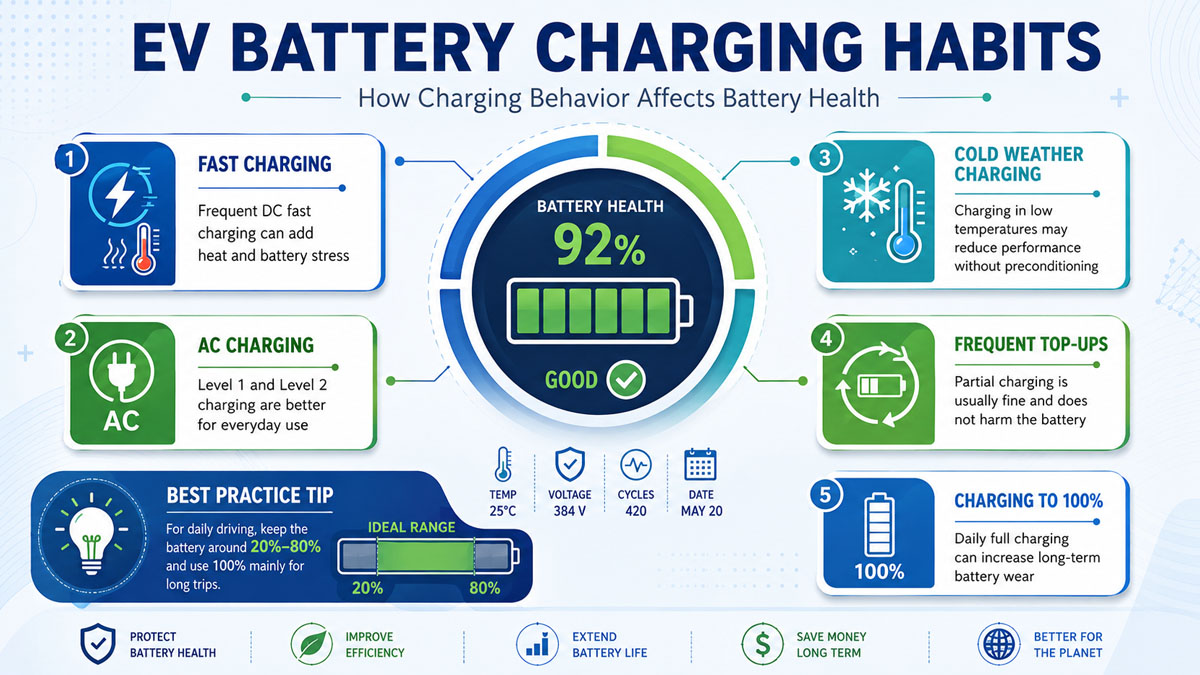
Overall, EV charging habits do not immediately damage the battery, but they can affect long-term battery health depending on frequency, temperature conditions, and charging behavior. Modern battery management systems (BMS) are designed to minimize damage and optimize charging safety under most conditions.
• Fast charging can increase battery stress
Fast charging is not directly harmful when used occasionally. However, frequent fast charging can generate more heat and create extra chemical stress inside the battery, which may speed up battery degradation over time. Most modern EVs are designed to manage fast charging safely within controlled temperature limits.
• Slow charging is better for daily battery care
Slow charging is usually better for long-term battery health because it produces less heat and allows energy to enter the battery more steadily. For daily use, AC charging is often the preferred option because it helps reduce unnecessary battery wear.
• Low-temperature charging needs extra care
Charging in cold weather does not immediately damage the battery, but low temperatures can reduce charging efficiency and increase internal resistance. If fast charging is used in cold conditions without proper battery heating or thermal management, it may increase the risk of lithium plating and affect long-term performance.
• DC charging is faster while AC charging is gentler
DC fast charging is useful for long trips because it can quickly add range in a short time. AC charging is slower but gentler on the battery, making it more suitable for regular home or workplace charging. Both methods are safe when properly managed by the vehicle’s battery management system.
• Frequent charging is usually not a problem
Frequent charging is not harmful if the battery stays within a healthy charging range. Modern EVs use intelligent battery management systems to control charging behavior and prevent over-stress. However, repeated deep charging or frequent high-power charging may still contribute to gradual battery aging.
• Charging to 100% adds more battery stress
Charging to 100% is safe when needed, especially before a long trip. However, keeping the battery fully charged every day can increase stress on lithium-ion cells. For better long-term battery health, many EV owners keep the daily charge level between 20% and 80%.
Different charging habits affect EV batteries in different ways, but most modern EVs are well protected by advanced battery management systems. Occasional fast charging, full charging, or cold-weather charging is usually safe, but for daily use, slower AC charging and moderate charge levels are better for extending battery life.
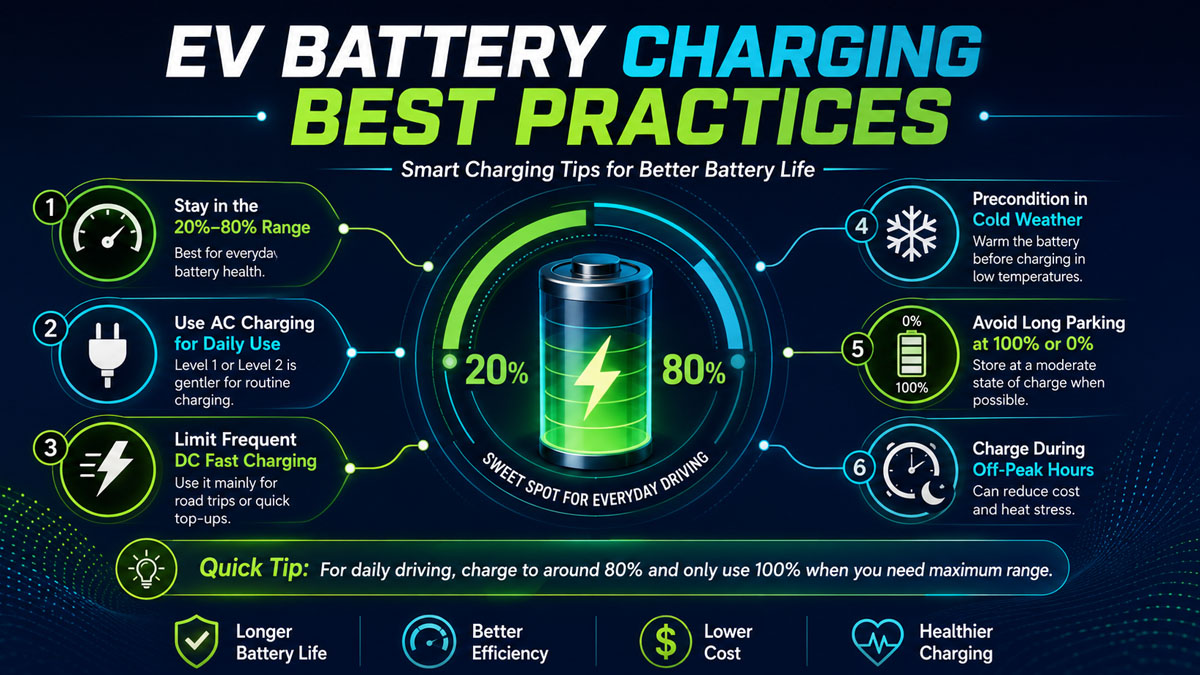
Best Way to Charge an EV for Battery LifeTo maximize EV battery lifespan, the charging method and habits are more important than charging speed alone. The following are the most effective practices for maintaining long-term battery health:
- Keep the battery between 20% and 80%
Avoid frequently charging to 100% or letting the battery drop to very low levels. Staying in the mid-range helps reduce stress on lithium-ion cells and slows long-term degradation.
- Use Level 2 charging for daily use
Level 2 AC charging is generally the most battery-friendly option for regular charging. It generates less heat compared to fast charging and provides a stable charging rate, which is better for long-term battery health.
- Limit frequent DC fast charging
DC fast charging is useful for long trips, but repeated use can increase heat and accelerate battery wear over time. It is best used occasionally rather than as a daily charging method.
- Avoid extreme temperatures during charging
Charging in very hot or very cold conditions can affect battery chemistry and efficiency. If possible, charge in moderate temperatures or use vehicles with thermal management systems.
- Use smart or scheduled charging features
Many EVs allow users to schedule charging during off-peak hours or optimize charging speed automatically. This helps reduce unnecessary stress on the battery and improves overall efficiency.
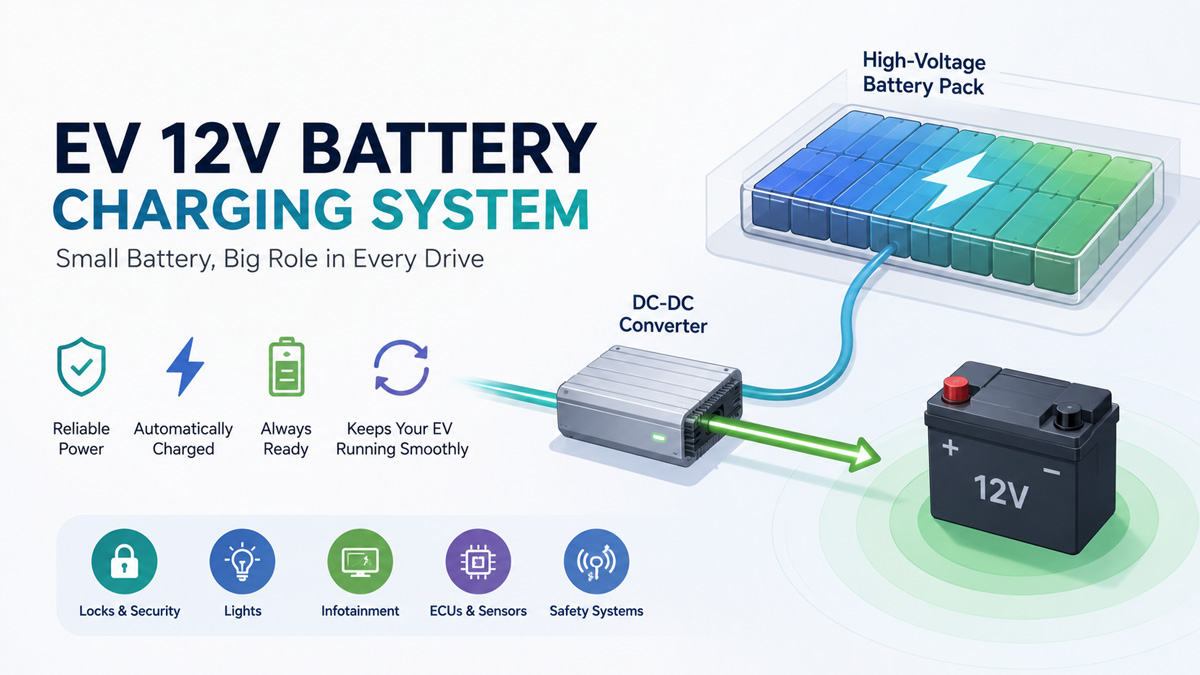
How EVs Charge the 12V BatteryIn an electric vehicle, the 12V starter battery is not charged by an alternator. Instead, it is kept alive by the main high-voltage EV battery through a DC-DC converter. This converter quietly steps high-voltage power down to 12V, allowing the vehicle’s low-voltage systems to work smoothly in the background.
• Why EVs Still Need a 12V Battery
Although an EV has a large traction battery for driving, the vehicle still needs a separate 12V battery to power many essential electronic systems. Door locks, lights, sensors, control modules, safety circuits, and communication systems all depend on low-voltage power.
More importantly, the 12V battery helps wake up the vehicle before the high-voltage system becomes active. In this sense, it works like a small but critical gateway. Even when the main EV battery has plenty of energy, the car may still fail to start or respond properly if the 12V battery is weak or dead.
• The Way EVs Charge the 12V Battery
The 12V battery is charged by the DC-DC converter, which transfers energy from the main traction battery and converts it into stable 12V power. When the EV is running, this system supplies electricity to low-voltage components while also maintaining the 12V battery.
The charging process can also happen when the vehicle is parked. If the battery management system detects that the 12V battery level is dropping, the DC-DC converter may activate briefly to top it up. This is especially important for standby functions such as security monitoring, remote access, software checks, and connectivity features.
In simple terms, the 12V battery does not work alone. It is continuously supported by the larger EV battery, while the DC-DC converter acts as the bridge between the high-voltage driving system and the low-voltage electronic system.
ConclusionEV battery charging technology has progressed from basic low-power AC charging to highly sophisticated, software-driven systems supported by fast-charging infrastructure and advanced battery design. Today’s innovations, including high-voltage platforms, smart BMS, and liquid cooling systems, have significantly improved charging efficiency and user experience.
Leading companies such as Tesla, BYD, and CATL continue to drive this evolution, while emerging technologies like ultra-fast charging, solid-state batteries, and wireless charging are shaping the future of electric mobility.
As EV adoption continues to accelerate globally, charging technology will remain a key factor in determining performance, convenience, and long-term sustainability.
FAQHow Long Does It Take to Charge an EV Battery?EV battery charging time depends on the charging method, battery size, vehicle architecture, and battery state of charge. With DC fast charging, many EVs can charge from 10% to 80% in about 20–40 minutes under ideal conditions. Level 2 home charging usually takes around 4–8 hours, while a standard household outlet may take 8–20 hours or longer.
Is Fast Charging Bad for EV Battery?Fast charging is not bad for an EV battery when used occasionally. Modern EVs use battery management systems and thermal control to manage charging safely. However, frequent fast charging can generate more heat and battery stress over time, so AC charging is usually better for daily use, while DC fast charging is best for long trips or quick charging needs.
Can You Charge an EV From a Battery?Yes, an EV can be charged from a battery system, but it usually requires a proper power conversion and charging setup. Battery storage systems can store electricity from the grid or renewable sources such as solar panels, then supply power to EV chargers when needed. This method is useful for homes, businesses, fast-charging stations, and areas where grid power is limited or unstable.
Do EV Batteries Lose Charge in Cold Weather?Yes, EV batteries can lose charge more noticeably in cold weather. Low temperatures reduce battery efficiency and may cause the vehicle to use extra energy for battery heating. Even when not in use, an EV battery can slowly lose charge over time because of natural self-discharge and standby systems. This small loss may also happen when the EV is parked for a long period, especially in cold conditions.
Does Charging an EV to 100% Damage the Battery?Charging an EV to 100% occasionally does not directly damage the battery, especially before long trips. However, keeping the battery at full charge every day can increase stress on lithium-ion cells and may reduce battery life over time. For daily use, many EV owners keep the charge level between 20% and 80% to support better long-term battery health.