✅ Phone Battery Types
• Material Improvements • Limited Breakthroughs In New Phone Battery Types✅ Phone Battery Inside Parts And Materials✅ Capacity, Runtime, And Lifespan✅ Phone Battery Voltage✅ Phone Battery Charging
✅ Phone Batteries by Major Smartphone Brands✅ Problems And Repair✅ Phone Battery Use And Safety Risks✅ Battery Saving Habits For Longer Phone Use✅ New Phone Battery Technology✅ Phone Battery Price And Buying Options✅ Replacement And Change✅ Conclusion✅ FAQ Does Cell Phones Have Lithium Batteries? What Are Cell Phone Batteries Made Of? What Type Of Battery Is In A Mobile Phone? What Is The Voltage Of A Phone Battery?Modern phones rely on compact lithium-based batteries to power everything from the screen and processor to cameras, apps, wireless connections, and background services. These batteries are lightweight, rechargeable, and energy-dense, but they do not stay new forever. Over time, charging cycles, heat, heavy use, and natural chemical aging can reduce capacity, shorten daily runtime, and make problems like fast battery drain, slow charging, sudden shutdowns, or swelling more likely.
To understand phone battery life, health, replacement, and safety, it helps to first understand the broader
lithium battery technology behind rechargeable devices. This guide explains how phone batteries work, how long they usually last, how to check battery health, when replacement makes sense, and what to do when a battery becomes damaged, swollen, overheating, or no longer holding a charge.
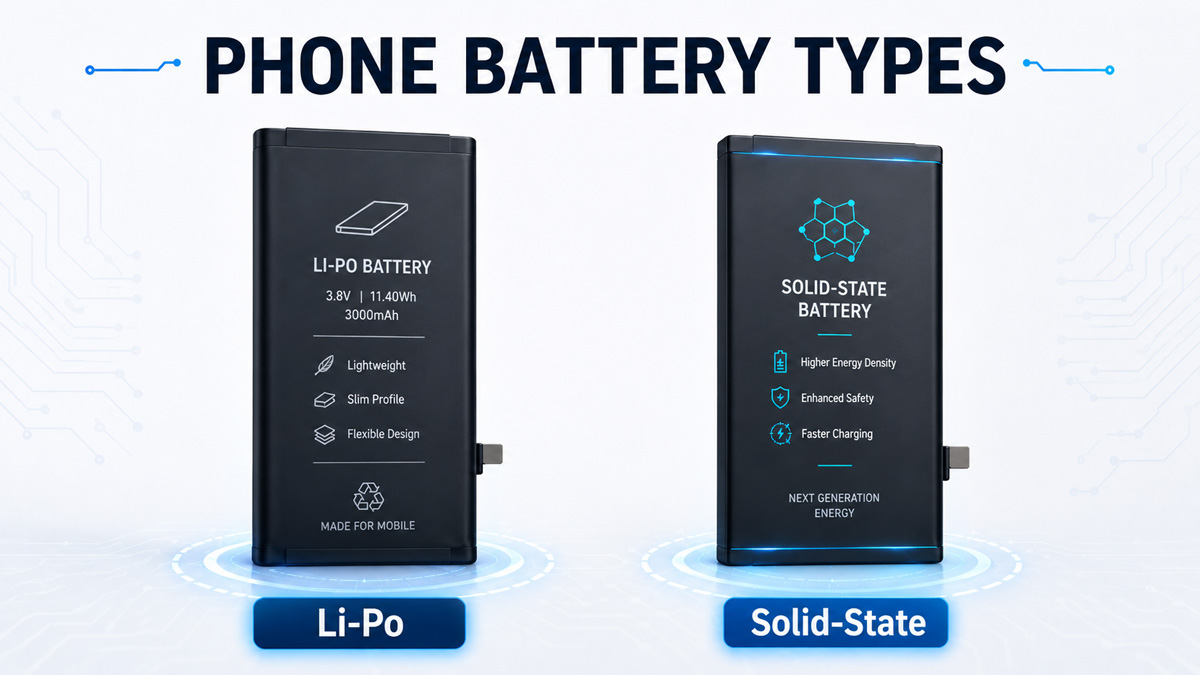
Phone Battery TypesModern phone batteries are almost all rechargeable lithium batteries. More specifically, most smartphones use lithium polymer batteries, which belong to the broader lithium-ion battery family. Lithium-ion describes the battery chemistry, while lithium polymer usually refers to the thin pouch-style structure that fits well inside slim phone bodies.
Older nickel-based batteries are no longer common in smartphones. New names such as silicon-carbon, graphene, or solid-state do not usually mean phones have moved away from lithium batteries. In most cases, they are material upgrades or future directions within the lithium battery system.
• Material Improvements
Although modern phone batteries are still mainly lithium polymer batteries, their materials are not standing still. Most improvements happen inside the lithium battery system, especially in the anode, electrolyte, separator, pouch structure, and battery management design. These upgrades are meant to increase capacity, reduce heat, support faster charging, and slow long-term battery aging without changing the phone battery into a completely different battery type.
| Material Or Technology |
Main Advantage |
| Graphite Anode |
Mature, stable, and widely used in lithium phone batteries |
| Silicon-Carbon Anode |
Helps increase capacity in the same battery size |
| Improved Electrolyte |
Supports safer charging and better cycle life |
| Thinner Separator |
Saves internal space while reducing short-circuit risk |
| High-Density Pouch Design |
Fits more active material into a slim phone body |
| Graphene-Enhanced Materials |
May improve conductivity and heat control |
| Battery Management System |
Controls voltage, current, temperature, and charging behavior |
The most practical improvement today is silicon-carbon material. It can help phone batteries hold more energy without making the phone much thicker, but it is still an upgrade inside the lithium battery system, not a completely new battery type.
• Limited Breakthroughs In New Phone Battery Types
Many “new battery” terms sound revolutionary, but most have not yet replaced lithium polymer batteries in mainstream smartphones.
- Solid-state batteries: Promising for safety and energy density, but still limited by cost, mass production, charging performance, and thin phone design.
- Graphene batteries: Often more of a supporting material or marketing term. Graphene may help conductivity or heat control, but it is not the mainstream phone battery type.
- Silicon-carbon batteries: The most realistic near-term improvement, but still a lithium battery with upgraded anode material.
- Semi-solid batteries: May improve safety and energy density, but they are not yet common in ordinary smartphones.
- Dual-cell fast charging: Helps charging speed and heat control, but it is a structure and charging-control improvement, not a new chemistry.
Overall, phone batteries have not moved far away from lithium battery technology. Most smartphones still use lithium polymer batteries, while newer improvements mainly come from silicon-carbon anodes, better electrolytes, high-density pouch design, smarter battery management, and improved heat control. Solid-state and graphene batteries are worth watching, but they are not yet mainstream breakthroughs for phone batteries.
Phone Battery Inside Parts And MaterialsA phone battery is a compact lithium-based battery pack, not just a single loose cell. In most modern smartphones, the battery is actually a type of lithium polymer battery, which belongs to the broader lithium battery family. Its structure includes the electrochemical cell, flexible pouch packaging, connection tabs, sensors, and control components that help the phone charge, discharge, and monitor battery status safely.
- The main parts usually include:
- Positive electrode:
The positive electrode, also called the cathode, is usually made from lithium-based metal oxide materials. It plays a major role in battery capacity, energy density, voltage, and long-term performance.
- Negative electrode:
The negative electrode, also called the anode, is commonly made from graphite. During charging and discharging, lithium ions move in and out of this layer.
- Electrolyte:
The electrolyte allows lithium ions to move between the positive and negative electrodes. It is essential for charging and discharging, but it also needs stable protection because damaged batteries can become unsafe.
- Separator:
The separator sits between the positive and negative electrodes. Its job is to let ions pass through while preventing the two electrodes from touching directly, which helps reduce the risk of internal short circuits.
- Pouch or outer casing:
Most phone batteries use a thin pouch-style package, which is one reason they are commonly described as lithium polymer batteries. This flexible packaging helps the battery fit inside slim smartphones and gives manufacturers more freedom in battery shape and size.
- Protection circuit and sensors:
A phone battery may include a protection circuit, temperature sensor, connector, insulation film, and adhesive layers. These parts help the phone detect overheating, control charging behavior, estimate battery percentage, and reduce safety risks during normal use.
This structure is why phone battery performance depends on more than just mAh. Capacity, voltage, material quality, protection design, heat control, and physical compatibility all matter. When replacing a phone battery, the new battery should match the original model, connector, voltage range, size, and safety design instead of being chosen only by a larger capacity number.
Capacity, Runtime, And LifespanPhone battery capacity is usually measured in mAh, but mAh alone does not decide
how long a phone lasts on one charge. To understand how phone battery life changes over time, you also need to look at screen size, refresh rate, processor efficiency, signal strength, background apps, temperature, and battery age. As the battery goes through more charge cycles, its usable capacity gradually drops, so the same phone may last all day when new but drain much faster after one or two years of use.
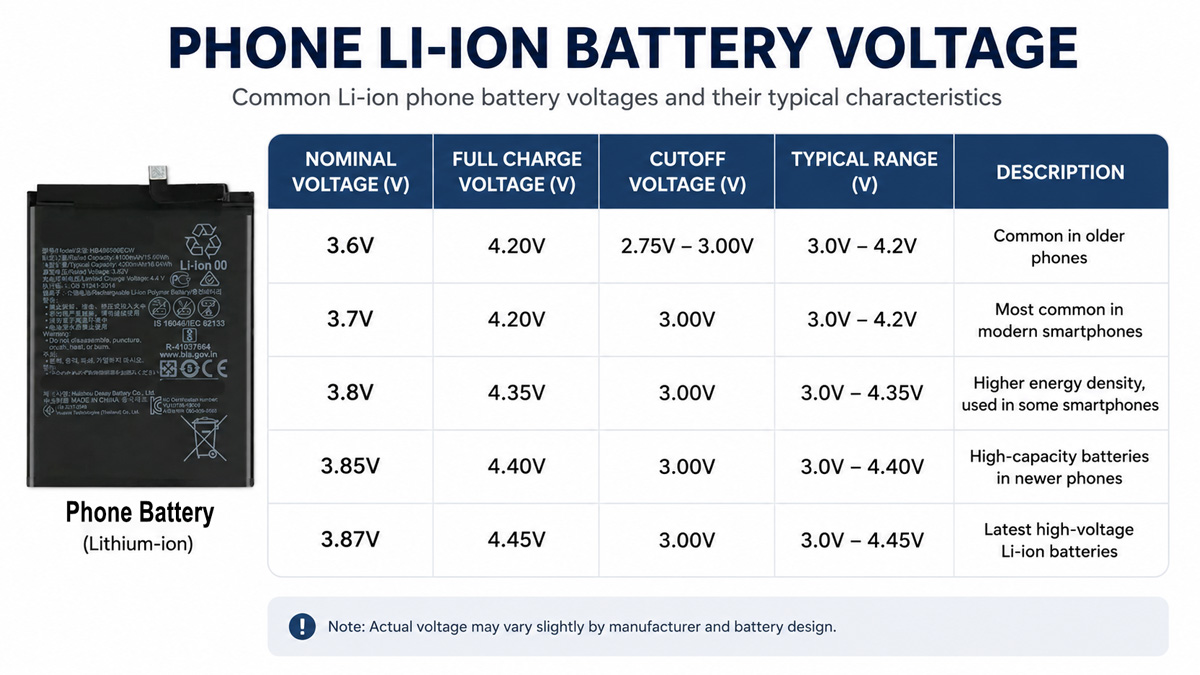
Phone Battery VoltageMost modern phone batteries use a single lithium polymer cell, so their voltage is usually close to other single-cell lithium batteries. The typical nominal voltage is 3.7V or 3.85V, while the full-charge voltage is usually around 4.2V or 4.35V, depending on the battery design. The voltage does not stay fixed during use. It rises during charging and drops during discharging, while the phone’s power management system keeps the battery within a safe working range.
| Voltage Type |
Typical Range |
Meaning |
| Nominal Voltage |
3.7V–3.85V |
The typical rated voltage used to describe the phone battery |
| Full Charge Voltage |
4.2V–4.35V |
The upper voltage when the battery is fully charged |
| Normal Working Voltage |
About 3.5V–4.35V |
The common voltage range during daily charging and discharging |
| Low Battery Voltage |
About 3.0V–3.4V |
The battery is close to empty, and the phone may limit performance or shut down soon |
| Cut-Off Voltage |
Around 3.0V or slightly lower |
The lower protection limit where the phone stops using the battery to prevent damage |
| Deep Discharge Voltage |
Below about 2.8V–3.0V |
An unsafe or abnormal state that may damage the battery and make charging difficult |
Phone battery voltage is not a fixed number. Most modern phone batteries have a nominal voltage of about 3.7V or 3.85V, and they usually reach about 4.2V or 4.35V when fully charged. As the phone is used, the voltage gradually drops, and when it becomes too low, the phone may shut down or activate battery protection. This is why voltage is important for understanding battery status, charging behavior, and safe replacement.
Phone Battery ChargingPhone battery charging is controlled by the phone, charger, cable, battery management system, and battery temperature together. To understand how phone battery charging works, users need to know that charging is not always the same speed from 0% to 100%. A phone usually charges faster at lower battery levels, then slows down near the top to reduce heat and battery stress. Fast charging can be convenient, but long-term battery health still depends on proper chargers, stable temperature, and avoiding heavy use while charging.
Phone Batteries by Major Smartphone Brands
Although most smartphones use similar lithium-based battery technology, battery design, capacity, charging systems, and battery management can vary across brands and models. The sections below provide more detailed information about batteries used by major smartphone manufacturers.
- Apple iPhone: iPhone batteries are designed around Apple’s hardware and iOS power management system, with capacity, charging support, and battery health features varying across generations. Learn more about battery features and performance across iPhone models.
- Samsung Galaxy: Samsung uses different battery sizes and charging technologies across its Galaxy S, Galaxy Z, Galaxy A, and other smartphone lines. See battery details for Samsung Galaxy phones for information covering different models.
- Google Pixel: Google Pixel phones combine lithium-based batteries with Android power management and adaptive battery features designed to manage everyday energy use.
- Xiaomi: Xiaomi offers a wide range of smartphone batteries, with many models placing particular emphasis on larger capacities and fast-charging technology.
- OnePlus: OnePlus smartphones commonly combine relatively large batteries with high-speed charging systems across many of their recent models.
- Huawei: Huawei uses lithium-based batteries across its smartphone lineup, with battery capacity, charging capability, and power-saving features varying by series and model.
Phone batteries share many of the same basic technologies, but their capacity, charging systems, battery management, and overall design can vary between brands and models. Apple, Samsung, Google, Xiaomi, OnePlus, Huawei, and other manufacturers each take a slightly different approach to balancing battery life, charging speed, and device performance.
Understanding these differences can help users better evaluate battery specifications, recognize normal battery behavior, and make more informed decisions when maintaining or replacing a phone battery.
Problems And RepairPhone battery problems can appear as fast drain, slow charging, sudden shutdowns, overheating, swelling, bad battery health, or a phone that will not turn on at all. Before trying to fix anything, it helps to understand
which phone battery problems can be repaired and which ones usually require battery replacement, charging port service, or professional inspection. Simple issues may come from the charger, cable, dirty port, software bugs, or battery percentage calibration, but a swollen, leaking, physically damaged, or severely overheating battery should not be repaired or reused.
Phone Battery Use And Safety RisksPhone battery safety mainly depends on proper charging, normal temperature control, and careful handling when the battery becomes damaged. To understand
safe phone battery use and disposal, users should know that overheating, swelling, leakage, strange smells, physical damage, or a battery that becomes hot during normal use can be warning signs of a serious problem. A damaged phone battery should not be charged, squeezed, punctured, repaired at home, or thrown into regular trash, because lithium polymer batteries can catch fire or even explode under severe abuse. The safer choice is to stop using the phone, keep it away from heat and flammable materials, and take the battery or device to a professional repair shop or approved battery recycling point.
Battery Saving Habits For Longer Phone UsePhone battery saving is mainly about reducing unnecessary power use while also protecting long-term battery health. To learn
practical ways to make a phone battery last longer, users should look at screen brightness, background app activity, location services, weak signal areas, high-refresh-rate display settings, push notifications, and temperature habits together. Lowering power demand can help the phone last longer on one charge, while avoiding heat, extreme low battery, and constant full charging can help slow long-term battery degradation.
 New Phone Battery Technology
New phone battery technology is mainly improving in five areas: battery materials, cell structure, fast charging, battery management, and long-term safety. Most smartphones still use lithium polymer batteries, but manufacturers are trying to increase energy density, reduce heat, shorten charging time, and slow capacity loss without making the battery thicker or less safe.
- New electrode materials: Phone batteries still rely on lithium-based chemistry, but newer designs may use improved cathode materials, silicon-carbon anodes, or higher-energy-density formulations to store more energy in the same space. Silicon-based anode materials are especially promising because they can hold more lithium than traditional graphite, which may help future phone batteries deliver higher capacity without greatly increasing size.
- Higher-density cell design: Another direction is improving the internal structure of the battery. Better stacking, thinner separators, more efficient current collectors, and optimized pouch packaging can help fit more active material into a limited phone body. This is why some newer phones can offer larger mAh ratings even when the device thickness does not change much.
- Fast charging technology: Fast charging is not only about using a higher-watt charger. It also depends on charge control, battery temperature, voltage management, and cell design. Many phones use staged charging, where the battery charges quickly at lower percentages and slows down near the top to reduce stress. Some systems also split the battery into dual-cell designs, allowing higher charging power while controlling heat more effectively.
- Battery management systems: Modern phones use battery management chips and software algorithms to monitor voltage, current, temperature, charging speed, battery health, and usage patterns. These systems help prevent overcharging, overheating, and unsafe current levels. They also support features like optimized charging, which may delay full charging until closer to the time the user normally unplugs the phone.
- Heat control and safety design: Heat is one of the biggest limits for phone battery performance. Newer phones combine better battery materials with graphite sheets, vapor chambers, thermal gels, and smarter power control to reduce heat during gaming, fast charging, video recording, or 5G use. Better heat management can improve both daily performance and long-term battery lifespan.
- Future battery technologies: Several future technologies are often discussed for phones, including solid-state batteries, lithium-silicon batteries, graphene-enhanced batteries, and new electrolyte systems. Among these, silicon-carbon anodes and better lithium polymer cell designs are the most realistic near-term improvements, because they can build on existing manufacturing methods. Solid-state batteries may offer better safety and energy density in the long term, but they still face challenges in cost, mass production, charging performance, and durability for very thin consumer devices.
The most promising future direction for phone batteries is not one single breakthrough. It is likely to be a combination of higher-density materials, silicon-based anodes, safer electrolytes, smarter charging control, and better thermal management. These improvements may help phones charge faster, last longer on one charge, and lose capacity more slowly over several years of daily use.
Phone Battery Price And Buying OptionsPhone battery price depends on the phone model, battery quality, repair channel, warranty, and whether the replacement is original, branded third-party, or low-cost aftermarket. To understand
what affects phone battery cost, buyers should compare not only the battery part price but also labor cost, compatibility, safety design, and after-sales support. A cheaper battery may look attractive at first, but poor cell quality, wrong voltage, weak protection circuits, or an inaccurate capacity label can lead to short runtime, overheating, swelling, or another replacement soon after purchase.
Replacement And ChangePhone battery replacement becomes necessary when the battery can no longer hold a normal charge, drains too fast, shuts down suddenly, charges abnormally, overheats, or shows visible swelling. Before changing a phone battery, users should check when a phone battery should be replaced, because some problems may come from the charger, cable, charging port, software, or battery calibration rather than the battery itself. A replacement battery should match the original phone model, connector, voltage range, size, and protection design, and swollen or damaged batteries should be changed by a professional instead of being removed or repaired at home.
ConclusionPhone batteries are compact lithium polymer batteries designed to provide high energy density, stable output, and reliable daily use inside slim smartphones. Their performance depends on more than capacity alone. Materials, voltage, charging control, temperature, battery health, usage habits, and safety design all affect how long a phone lasts on one charge and how many years the battery can remain usable.
As a phone battery ages, users may notice shorter runtime, faster drain, slow charging, sudden shutdowns, overheating, or swelling. Some issues can be improved by changing settings, checking battery health, cleaning the charging port, using proper chargers, or reducing heat exposure. However, a damaged, swollen, leaking, or severely degraded battery should not be repaired at home. Safe replacement, careful buying choices, and proper recycling are the better options when the battery is no longer reliable.
FAQ
Does Cell Phones Have Lithium Batteries?Yes, most cell phones have lithium batteries. More specifically, most modern smartphones use lithium polymer batteries, which belong to the broader lithium-ion battery family. They are thin, rechargeable, and suitable for compact phone designs.
What Are Cell Phone Batteries Made Of?Cell phone batteries are usually made of a positive electrode, negative electrode, electrolyte, separator, pouch casing, protection circuit, sensors, and connectors. In most phone batteries, the negative electrode is commonly graphite, while the positive electrode uses lithium-based metal oxide materials.
What Type Of Battery Is In A Mobile Phone?Most mobile phones use lithium polymer batteries. They are still part of the lithium-ion battery family, but their thin pouch-style structure makes them better suited for slim smartphones than older rigid battery formats.
What Is The Voltage Of A Phone Battery?Most phone batteries have a nominal voltage of about 3.7V or 3.85V. When fully charged, the voltage is usually around 4.2V or 4.35V, depending on the battery design. The voltage drops gradually during use and rises again during charging.