✅ Car battery Normal Voltage
• Lead-Acid Car Battery Normal Voltage • LiFePO4 Car Battery Normal Voltage • Low Voltage Means Charging Is Needed • Low Voltage Requires Immediate Inspection
✅ Car Battery Max Voltage
• Why There Is a Maximum Voltage Limit • Risks of Exceeding the Maximum Voltage • Using the Correct Charging Method
✅ Car Battery Resting Voltage
• Why Resting Voltage Is Not Constant • What Affects Resting Voltage • Practical Interpretation
✅ Voltage vs Charge Percentage
• Lead-Acid Battery Voltage vs Percentage • Lithium (LiFePO4) Battery Voltage vs Percentage
✅ Charging Voltage
• Lead-Acid (Including AGM) Charging Voltage by Stage • Lithium (LiFePO4) Charging Voltage by Stage
✅ Car Battery Starting Voltage
• Minimum Voltage to Start a Car Battery
✅ Car Battery Voltage Range
• Why the Voltage Range Appears Wider Than Normal • Lead-Acid Battery Voltage Range • Lithium (LiFePO4) Battery Voltage Range
✅ Conclusion
✅ FAQ What voltage is a car battery? What is a good car battery voltage? What should battery voltage be when car is on? What is a fully charged car battery voltage? What is the maximum voltage of a car battery? What is a good resting car battery voltage?Voltage in modern vehicles follows a clear and consistent electrical structure. In most cases, the batteries used for starting operate within a 12V system, which remains the standard across passenger cars. To place that figure in context, it also helps to understand the
basic role of an automotive battery before comparing voltage, charging behavior, and replacement requirements.
Lead-Acid as the Primary Type (Including AGM)
In practical use, the majority of car batteries are lead-acid types (including AGM), with a nominal voltage of about 12V.
Lithium (LiFePO4) as a Growing Alternative
A smaller but increasing number of vehicles and aftermarket options use lithium batteries—most commonly 12V lithium iron phosphate (LiFePO4), and some
12V LiFePO4 options for starter battery replacement are designed to work within the same standard system.
Despite differences in chemistry, both battery types function within the same typical 12V electrical framework, which is why car batteries are generally referred to as 12V.
Car battery Normal Voltage
For a typical 12V system, the normal car battery voltage spans a relatively wide range depending on whether the battery is resting, charging, or discharging.
• Lead-Acid Car Battery Normal Voltage
Resting (no load): 12.6V–12.8V → this is the most healthy state
Fully charged (surface charge): about 13.0V–13.2V
Charging (engine running): 13.8V–14.8V → considered a proper charging range
Discharge cutoff: should not go below 10.5V–10.8V
As long as the battery operates within these ranges, it can be considered in an ideal working condition for daily use.
• LiFePO4 Car Battery Normal Voltage
Resting (no load): 12.6V–13.5V
Fully charged: briefly around 14.6V
Discharge cutoff: should not go below 10V
Lithium batteries maintain a flatter voltage curve, so their readings may appear more stable compared to lead-acid.
• Low Voltage Means Charging Is Needed
If a lead-acid battery drops below 12.4V (engine off), it is no longer within a normal car battery voltage condition.
Around 12.2V–12.3V: partially discharged
Around 12.0V or lower: significantly undercharged
At this stage, the battery should be charged immediately. Prolonged low voltage can damage the battery and reduce its lifespan.
• Low Voltage Requires Immediate Inspection
If voltage approaches the lower limits:
Lead-acid: near or below 10.5V–10.8V
LiFePO4: near or below 10V
the battery is already in an abnormal state.
If it cannot return to a normal range after charging, this usually indicates deeper issues such as aging, internal failure, or charging system problems. In this case, the battery and vehicle system should be inspected and repaired immediately to avoid sudden breakdown
Car Battery Max VoltageIn a typical 12V automotive system, the maximum battery voltage is generally around 14.4V to 14.8V during charging.
• Why There Is a Maximum Voltage Limit
A battery can only safely accept a certain level of voltage. As it approaches full charge, the charging system limits the voltage within a controlled range to avoid excessive stress. Increasing the voltage beyond this point does not improve charging, but instead puts unnecessary strain on the battery.
• Risks of Exceeding the Maximum Voltage
If the voltage goes above the normal limit, it can lead to overheating, faster wear, and potential damage to both the battery and the vehicle’s electrical system. In many cases, sustained high voltage indicates a problem with the charging system or incorrect charging conditions.
• Using the Correct Charging Method
To prevent these issues, it is important to use a proper charging method and keep the voltage within the recommended range. A controlled charging process ensures stable performance and helps extend battery life.
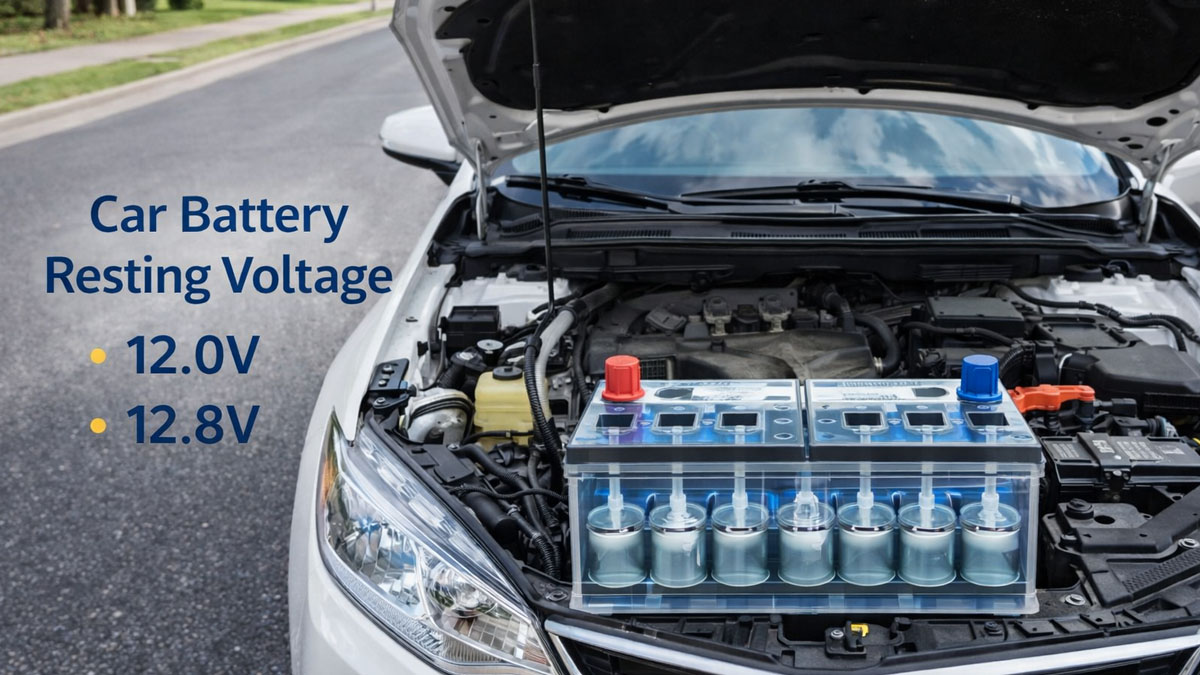 Car Battery Resting Voltage
Car battery resting voltage should be understood as a range rather than a fixed value. In a typical 12V automotive system, it generally falls between about 12.0V and 12.8V under real-world conditions.
• Why Resting Voltage Is Not Constant
The main reason is that battery voltage does not stabilize immediately after the engine is shut off.
When the engine is running, the battery is held at a higher charging voltage
After the engine is shut off, charging stops, but the voltage remains temporarily elevated
As the battery sits, this excess (surface charge) gradually dissipates
Because of this transition, the measured voltage can vary depending on how long the battery has been at rest.
• What Affects Resting Voltage
Even after the battery has stabilized, the voltage is still influenced by several practical factors:
State of charge — higher charge results in higher voltage
Time since last use — recent driving can temporarily raise readings
Small electrical loads — standby systems slowly draw power
Temperature and battery condition — both affect voltage behavior
As a result, two measurements taken at different times may not be identical, even for the same battery.
• Practical Interpretation
For this reason, resting voltage should be treated as a reference range rather than a precise number. In general:
Higher voltage indicates the battery is closer to full charge
Lower voltage suggests partial discharge or reduced condition
Voltage vs Charge PercentageBattery voltage can be used as a general indicator of charge level when the engine is off and the battery is at rest. However, the accuracy of this method depends on the battery type.
• Lead-Acid Battery Voltage vs Percentage
For most vehicles, voltage provides a relatively reliable estimate of state of charge:
| Voltage |
Approx. Charge Level |
| 12.6V – 12.8V |
100% |
| 12.4V |
~75% |
| 12.2V |
~50% |
| 12.0V |
~25% |
| 11.8V |
~10–20% |
| 11.6V or lower |
Near empty / deeply discharged |
In practice, a resting voltage below about 12.4V usually means the battery is no longer fully charged and should be recharged soon.
• Lithium (LiFePO4) Battery Voltage vs Percentage
For 12V LiFePO4 batteries, voltage is a much less reliable indicator of charge level:
| Voltage |
Approx. Charge Level |
| 13.4V – 13.6V |
~100% |
| 13.2V – 13.4V |
~90% |
| 13.0V – 13.2V |
~70–80% |
| 12.8V – 13.0V |
~50–70% |
| 12.6V – 12.8V |
~30–50% |
| 11.0V – 12.6V |
~10–30% |
| 10.0V – 11.0V |
Near empty (rapid drop zone) |
Unlike lead-acid batteries, lithium batteries maintain a relatively flat voltage curve during most of their discharge cycle. This means voltage stays high until the battery is nearly depleted, then drops more quickly.
Voltage can be a useful way to estimate battery charge, especially for lead-acid batteries, where voltage drops steadily as capacity is used. For lithium batteries, however, voltage remains relatively stable over most of the discharge cycle, so percentage estimates based on voltage alone are less precise.
Charging VoltageMost car batteries used for starting are 12V lead-acid types (including AGM), and in normal vehicle operation, the charging voltage typically ranges between about 13.5V and 14.8V, controlled by the vehicle’s charging system. For lithium replacements—most commonly 12V LiFePO4 batteries—the charging voltage is usually slightly more defined, typically reaching up to around 14.6V during the constant voltage stage.
Although their charging characteristics differ, both battery types are designed to operate within the same 12V automotive system, which is why the overall charging voltage range remains broadly similar in real-world use.
| • Lead-Acid (Including AGM) Charging Voltage by Stage |
| Charging Stage |
Voltage Range |
Description |
| Bulk (Constant Current) |
~12.0V → 14.2V–14.8V |
Voltage rises while current remains high. This stage restores most of the battery capacity. |
| Absorption (Constant Voltage) |
~14.2V–14.8V (held) |
Voltage is held steady while current gradually decreases as the battery approaches full charge. |
| Float (Maintenance Stage) |
~13.2V–13.8V |
Voltage is reduced to maintain full charge. Current is minimal, offsetting self-discharge without overcharging. |
| • Lithium (LiFePO4) Charging Voltage by Stage |
| Charging Stage |
Voltage Range |
Description |
| Constant Current (CC) |
~14.2V–14.6V |
Current remains steady while most of the battery capacity is delivered. |
| Constant Voltage (CV) |
~14.2V–14.6V |
Voltage is held constant while current gradually decreases as the battery reaches full charge. |
Summary
In practical use, most 12V lead-acid car batteries charge within a range of 13.5V to 14.8V, while 12V LiFePO4 batteries typically reach a more defined upper limit of around 14.6V. Although the exact charging behavior differs, both are designed to work within the same automotive charging system, resulting in broadly similar voltage levels during operation.
Car Battery Starting VoltageThere is no strict fixed voltage for starting a car. In practice, starting voltage generally falls within the battery’s normal operating range, typically around 12.0V to 12.8V under engine-off conditions.
Even if the resting voltage has dropped below a fully charged level, the battery may still be able to crank the engine. What matters during starting is not the exact voltage itself, but the battery’s ability to deliver sufficient current under load. This is why a battery with relatively low voltage may still start the engine, while a weak battery can fail even if its voltage appears acceptable.
• Minimum Voltage to Start a Car Battery
There is no exact minimum voltage required to start a car. In many cases, a battery around 12.0V or slightly below may still crank the engine, depending on its condition.
As voltage drops further, starting becomes less reliable. For most vehicles, once the battery falls below this level, it may no longer provide enough current to turn the engine consistently, even though some voltage is still present.
When the engine is off, voltage can indicate the general condition of the battery, but it does not guarantee starting performance. Many vehicles also include low voltage protection, which may shut off certain systems or prevent starting if the voltage drops too far.
Car Battery Voltage RangeIn a typical 12V automotive system, car battery voltage should be understood as a range rather than a fixed value. Under normal conditions with the engine off, lead-acid batteries typically operate around 12.0V to 12.8V, while lithium (LiFePO4) batteries usually remain within a slightly higher range of about 12.8V to 13.4V.
Higher voltages, such as 13.5V to 14.8V, occur only during charging when the engine is running and are not part of the battery’s normal operating range.
• Why the Voltage Range Appears Wider Than Normal
At the upper end, voltage can briefly rise after charging, but this higher value is only temporary and will drop quickly once the engine is shut off. At the lower end, the battery may still show a measurable voltage, but in practice it is already close to empty and no longer performing effectively.
For this reason, the most meaningful voltage range is not the full span, but the practical operating range, where the battery is actually functioning under normal conditions.
• Lead-Acid Battery Voltage Range
Overall range: ~11.8V – 14.8V
Practical operating range: ~12V – 13V
Lead-acid battery voltage drops progressively with discharge, making it relatively easy to estimate battery condition based on voltage. However, once voltage falls below about 12.0V, the battery is already significantly discharged, even though it may still register a reading.
• Lithium (LiFePO4) Battery Voltage Range
Overall range: ~10.0V – 14.6V
Practical operating range: ~12V – 13.5V
LiFePO4 batteries can operate down to lower voltages, but most of the usable capacity exists within a narrower, higher voltage band. Voltage may remain relatively stable for much of the discharge cycle, then drop quickly once the battery approaches empty.
Summary
Although the full voltage range of a car battery appears wide, much of that range represents temporary or low-performance conditions. In practice, both lead-acid and LiFePO4 batteries operate within a narrower and more stable voltage band during normal use.
ConclusionCar battery voltage is not a fixed number, but a range that changes depending on operating conditions such as resting, charging, and engine running. In most vehicles, this range typically falls between 12.0V and 14.8V, reflecting how the battery interacts with the vehicle’s electrical system.
While most car batteries are still lead-acid (including AGM), lithium alternatives—primarily 12V LiFePO4—are becoming more common. Although their voltage characteristics differ slightly, both types operate within the same 12V framework.
Understanding these voltage ranges makes it easier to interpret battery condition in real use. A higher or lower reading does not always indicate a problem on its own, but when viewed in context, voltage can be a practical and reliable way to assess battery health and charging performance.
FAQWhat voltage is a car battery?A car battery is typically part of a 12V system, but actual voltage varies. It usually ranges from about 12.0V (low) to 14.8V (charging) depending on conditions.
What is a good car battery voltage?A good car battery voltage is generally around 12.4V to 12.8V when the engine is off, indicating the battery is in a healthy and usable condition.
What should battery voltage be when the car is on?When the engine is running, voltage is typically between 13.5V and 14.8V, as the charging system is actively supplying power.
What is a fully charged car battery voltage?A fully charged battery usually reads about 12.6V to 12.8V at rest after the vehicle has been off for a period of time.
What is the maximum voltage of a car battery?In normal operation, the maximum voltage is typically around 14.4V to 14.8V during charging. Higher readings may indicate overcharging.
What is a good resting car battery voltage?A good resting voltage is generally 12.4V to 12.8V, measured when the engine is off and the battery has had time to stabilize.


